

Tupelo came home on a Saturday in the middle of March 2026, and by Sunday evening I had learned something I did not expect. A dog does not arrive with a place to sleep. My old Lab mix, Duke, died in 2014, and I gave every last thing of his away that same year, so when the rescue called about a young Boykin Spaniel who needed a house, I was starting from nothing. No crate, no bowls, not one bed. The first thing I bought that weekend was a wire crate. The second was the Bedsure orthopedic bed in Medium, and eight months later it is still sitting by my sliding door with a dog asleep on it. The option I nearly bought instead was an elevated cot bed, and I have thought about that choice more than once since.
Here is the short answer before the long one. For a young dog who sleeps indoors in a house like mine, the Bedsure bed did more of the work. It has a foam base and a bolster on all four sides that a dog can push his back against, it sits low on the floor so nothing has to be climbed, and the cover unzips and goes in my machine after a wet morning at the marsh. An elevated cot bed does one thing better and it does it well: air moves underneath, and a dog who runs hot will often choose that over foam. If your dog sleeps on a screened porch, lives in real heat, or destroys fabric, the cot deserves a serious look. In my living room, in the corner where the afternoon sun lands, the bed won.
| Bedsure Orthopedic Bed, Medium | Elevated Cot Bed | |
|---|---|---|
| Cushioning | Foam base with a four sided bolster to lean against | No padding, a taut sling stretched over a frame |
| For a dog that likes to curl | Raised edge on all four sides, 6.5 inches thick | Open on every side, nothing at his back |
| Airflow on a hot day | Foam holds warmth | Air moves under and around the sling |
| Hard on fabric | Cover and foam, Tupelo chewed a bolster corner and it held | Less fabric to grab, a determined chewer does less damage |
| Washing after mud | Cover unzips into the machine, foam core stays out | Rinse with a hose, air dries in an afternoon |
| Warmth on a cold floor | Foam and fabric hold the dog off cold boards | Open and airy, cooler by design |
| Getting on and off | Sits flat on the floor, no step at all | Raised height, a step up for an older or short legged dog |
| Footprint in the room | 28 inches long by 23 wide, flat | Similar floor space, plus clearance around the frame |
| Best for | Indoors, older dogs, dogs that like to be tucked | Porches, hot rooms, kennels, serious chewers |
Where the Bedsure Bed Wins
The bolster is the part I did not expect to matter. The listing calls it a four sided bolster design, which in my living room means Tupelo can curl into the middle and press his back against a raised edge instead of against open air. He is a spaniel. He likes to be tucked in. For the first month he slept in a tight ball in one corner of it. Now he sprawls across the whole thing with his chin on the bolster and one ear flipped inside out, and I have stopped straightening it.
Before I bought it I tried the cheap route first. I folded a blanket from the linen closet into a pad and put it in the corner by the sliding door, the spot where the sun lands about two in the afternoon. He dragged it into the middle of the room twice in one evening and then walked around it. A blanket does not hold a shape and it does not stay where you set it down, which is the whole reason I went looking at actual beds instead of folding something else.
The second advantage is height. The bed is 6.5 inches thick and sits flat on my hardwood, so a dog walks onto it without a step or a hop. The full measurements on the listing are 28 inches long by 23 inches wide. That is right for 32 pounds of spaniel and a little generous when he stretches out. In the mornings he comes off it front paws first and stretches with his back end still resting on the bolster, and on the two days I carried it out to the porch to air, he stood in the empty spot and looked at me. That is not a scientific measure of anything, but it told me more than the product description did.
One honest note on size. The listing gives a maximum weight recommendation of 30 pounds, and Tupelo is a couple of pounds over that. It has held up fine for eight months, but I would not put a heavier dog on this Medium and I would not tell a friend with a 50 pound dog that this is the size to buy.
The third thing is quieter than the other two. It looks like a bed in my living room rather than like a piece of equipment. A cot on a low frame with a sling stretched across it is a sensible thing, but it is unmistakably a piece of dog gear sitting in the middle of a room. At 61 I care about that more than I expected to, and I suspect I am not the only one.
What the Listing Says, and What I Noticed
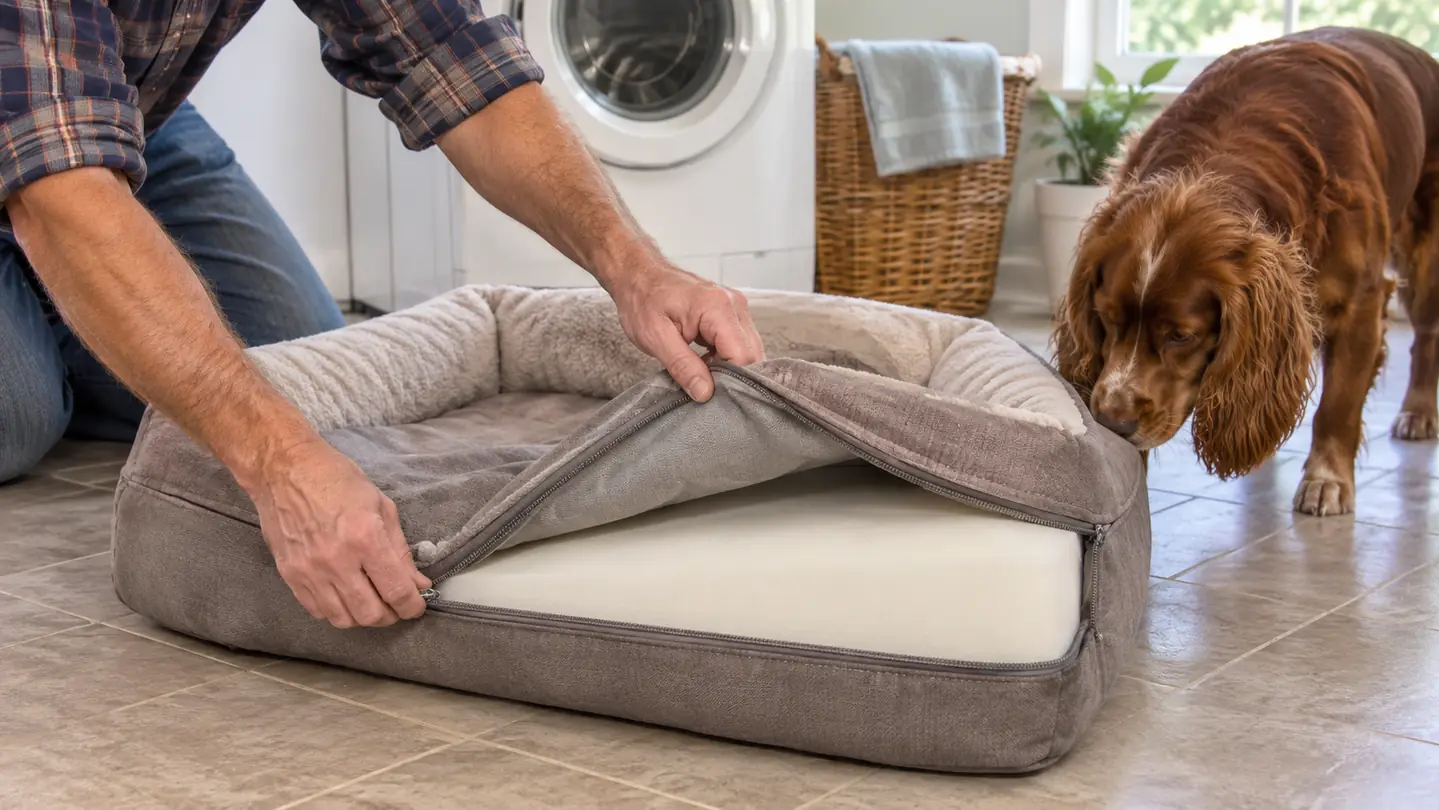
What the listing says, in plain words. The bed is foam filled. The cover is removable, and the listing describes the bed as waterproof, easy to clean and orthopedic. The materials are certified, the foam as CertiPUR-US and the fabric as OEKO-TEX standard 100. I am not a chemist and I am not a vet, so I will not tell you what any of that means for your dog's joints or his health. I will tell you that I read the label before I bought anything for this dog, the way I read every label, and those certifications were one of the reasons I chose this bed over one from a brand I had never heard of.
The cover unzips. I have washed it several times since April, mostly after mornings on the marsh boardwalk when Tupelo comes home smelling like low tide. The cover goes in the machine, the foam core stays out of it, and the two go back together while the cover is still a little damp, which is fine because the cover is the part that touches him. The waterproof side matters more than I expected. He has had two upset stomachs in eight months, and both times I had a cover to deal with instead of a soaked foam base.
He has had two upset stomachs in eight months, and both times I had a cover to deal with instead of a soaked foam base.
One caution from my own house. In his first weeks with the bed, Tupelo chewed the corner of the bolster. He was a youngster then and everything went in his mouth. The corner held. The stitching did not open and the foam did not come out, and he stopped once it was no longer new and he had something better to chew. A dog who is a serious chewer rather than a puppy who samples would worry me with any fabric bed, and I would say that to a friend before I said anything about this particular one.
I want to be careful about one more thing. I am not a trainer and I am not a vet, and nothing on this page is medical advice about hips or joints or anything else. If your dog is stiff getting up or reluctant on the stairs, that is a conversation with your own vet, not a shopping decision. What I can offer is what a retired librarian with a young spaniel noticed in her own living room over eight months, and that is all it is.
Where the Elevated Cot Wins
Now the honest part about the cot. I did not buy one, so what I know comes from the listings I read in March and from putting my hands on three of them in a store aisle here in Brunswick. Take it that way rather than as eight months of living with one. Even in that aisle, one thing was obvious. The difference between a cot that holds a dog up and one that sags is the sling. A loose one gives the moment weight lands on it and the dog is practically on the floor again. A taut one holds firm under a palm. Whatever cot you look at, press the middle of it hard before you carry it to the register, because the frame is the easy part to get right.
Air is the whole point of a cot. The dog lies on a sling stretched over a frame, off the floor, and air moves under him. That is why they turn up on porches, in warm states, and in kennels where things need to dry quickly. A foam bed holds warmth instead. If your dog flops down on the tile in July and ignores the carpet, a cot is the better answer and a foam bed will sit empty in the corner of the room. A sling also gives a heavy chewer less fabric to grab than a bolster does, and after watching what Tupelo did to that corner in his first weeks, I take that seriously.
Washing is the other place the cot wins, and it wins easily. Mud on a sling means a hose and an afternoon of drying on the porch. Mud on my bed means unzipping a cover, starting a wash cycle, and hoping the dog does not decide to nap on the bare foam in the meantime, which he has done twice. Where the cot loses ground in my house is height. It is raised, and a raised edge is one more thing for an older dog or a very small one to think about. Tupelo hops on and off furniture all day so it would not bother him now. It might bother him in eight years, and that is worth thinking about before you buy for a dog you plan to keep for a decade.
The Bed He Walks Onto Without Being Asked
Foam filled, a bolster on all four sides, a cover that unzips and washes, 28 inches long and 6.5 inches thick. It has been by my sliding door since April.
Amazon Check Today's Price on Amazon →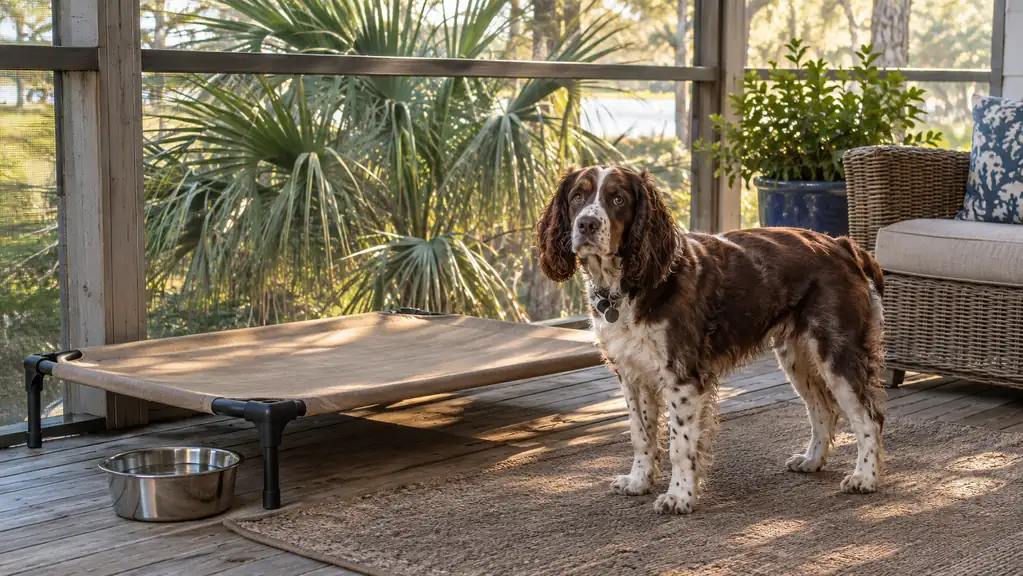
How I Would Decide If I Were Starting Over
If a friend called me tomorrow with a new dog and this question, I would ask three things before I said one word about either option. Where does the dog sleep, indoors or out. Does the dog destroy fabric or just sample it. And how hot does that room get in August. Those three answers settle it more often than any feature list. Coastal Georgia in July is not the same as a living room in November, and the right answer for a porch dog is not the right answer for a spaniel who sleeps three feet from the sofa.
The first week he was here I moved the bed around the living room four times looking for the right corner. I tried the wall by the bookcase, then the space beside the sofa, then the hallway where I could not see him from the kitchen. He settled where the afternoon sun lands and where he can watch the back door at the same time. Light, and a sight line to the door. I would not have guessed either one, and I would tell a friend to expect to move the thing twice before it stays put.
The other thing I would say is that a bed is not the same purchase as a crate or a bowl. A crate is equipment. A bed is the place your dog goes when the house is quiet. Tupelo puts himself on that bed at about nine every night, before I have said anything, and that started somewhere in his third week here. I cannot prove a cot would not have done the same. I can only tell you what I saw in my own house, which is a dog who chose the thing with an edge to lean on.
Who Should Buy Which
Buy the Bedsure bed if your dog sleeps indoors, if he likes to curl and lean, if he is a medium dog near the 30 pound recommendation on the listing, and if you want something you can unzip and wash. Buy it if you have an older dog who should not be climbing, or a dog like mine who wants a raised edge at his back. Skip it if your dog runs hot and always chooses the tile, or if he is a genuine chewer who has opened a cushion before. And be honest about size: 32 pounds on a Medium is already at the top of what I would call a good fit.
Buy an elevated cot instead if the dog sleeps on a porch or in a kennel run, if you live somewhere that stays warm, if cleaning means hosing something down, or if the dog is hard on fabric. Some people keep both, a cot outside and a bed inside, and after this first summer I understand why. My back porch is where a cot would have earned its place, not my living room.
Still the One by the Sliding Door
CertiPUR-US foam, a four sided bolster, a removable cover that washes, 28 by 23 inches. Eight months in, it is still his daytime bed.
Amazon Check Today's Price on Amazon →