
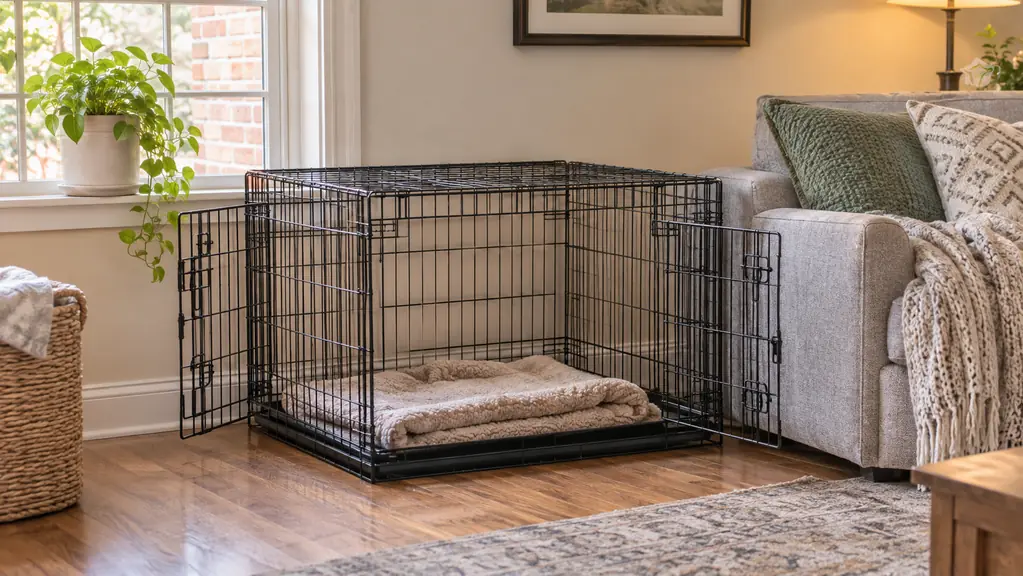
The crate arrived on a Wednesday, three days before the dog did. I had ordered the MidWest Homes for Pets 30 inch double door iCrate the week before, on the advice of the rescue's foster mother, and then I sat in my living room in Brunswick and looked at the box for a good hour before I opened it. I am 61. I retired from running a school library in 2024. I had not had a dog in this house since Duke died in 2014, and when he died I gave away every last thing that had anything to do with a dog. Crate, leash, bowls, the lot. So this box was not replacing anything. It was the first object of its kind in my house in twelve years, and I badly wanted to get it right.
So here is the short answer, because I know why you are reading this. If you are bringing home a medium sized rescue and you want one crate that will hold him, that folds flat when you need the floor back, that opens on two sides, and that arrives with a tray already in the box, this one did the job for us. Tupelo is a Boykin Spaniel, about 32 pounds, and he came home at fourteen months old, already full grown. I never used the divider panel. It is in the hall closet with the ironing board. That is the review in two sentences. Everything after this is what eight months of real use taught me, including the one thing I would do differently if I were setting it up again tomorrow.
The Quick Verdict
A plain, sturdy wire crate that has not bent, jammed or rattled in eight months of nightly use. Buy it for an already grown medium dog, and expect the divider panel to sit in a closet.
Amazon Check Today's Price →The crate that was standing in the corner before he walked through the door
The 30 inch double door iCrate from MidWest Homes for Pets, sized for medium breeds from 21 to 40 pounds. Two doors, a leak proof tray, a carry handle, and it folds flat. This is the one in my living room.
Amazon Check Today's Price on Amazon →How I've Used It
I set the crate up on the Saturday he came home, in the corner of the living room between the sofa and the bookcase, on the side where the afternoon sun does not land. It took me about ten minutes, with no tools at all, because the panels fold out and the whole thing goes together by hand. I laid the leak proof tray in the bottom and put a folded fleece blanket on top of that. Not a bed. A blanket. My thinking was that if he chewed it or soiled it, I could wash it or throw it out without grieving over a purchase. That blanket is still in there.
Where it sits matters more than I expected. The foster mother told me a crate in a back bedroom is a crate the dog learns to dread, because the only time he sees it is when the household goes quiet and he is left alone. So mine went where the household life happens, even though the household life is mostly me and a radio. He could see me on the sofa. He could hear the kitchen. For the first two weeks I sat on the floor next to it in the evenings with a book, doing nothing in particular, so that the crate was simply furniture and not an event.
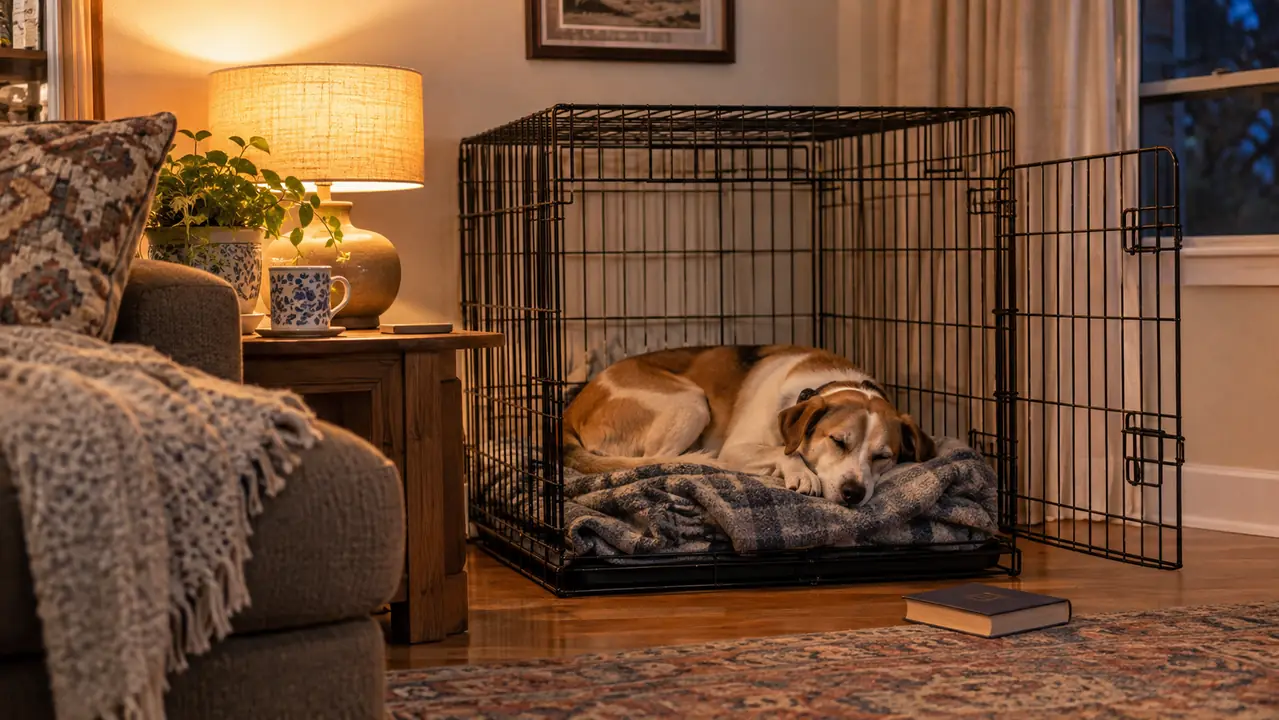
For the first few months he slept in it at night with the door latched, and he napped in it during the day with the door open. Since late summer the night door has stayed open most nights. He still goes in. He picks the crate over the rug and over the bed by the sliding door about half the time, which I did not expect, and which tells you more about the crate than anything I could write. It is still in the same corner. Nothing about that has changed in eight months.
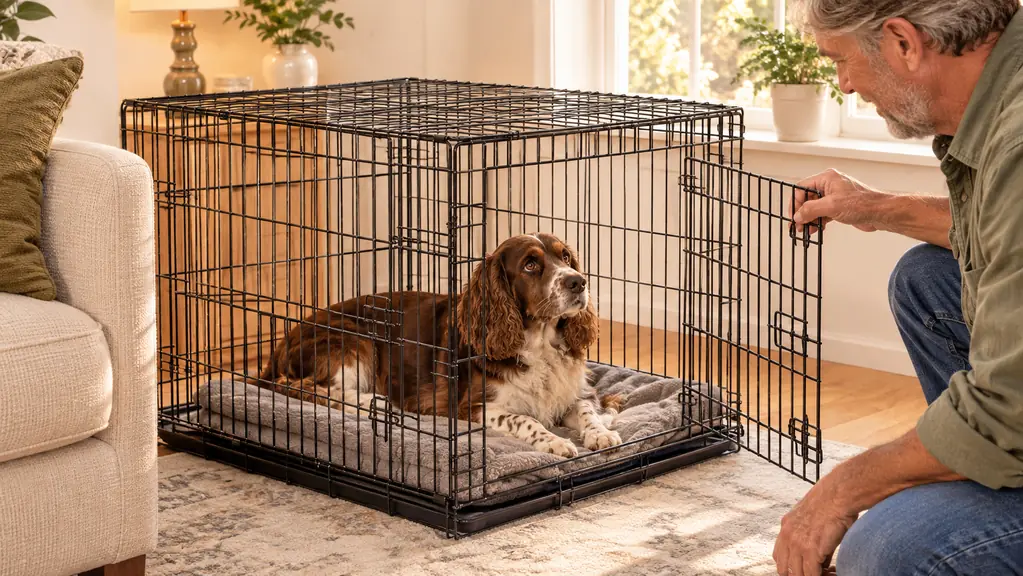
The second door is the part I did not think I needed and now would not do without. The short end faces the room. The long side door opens toward the sofa. When the crate was new and he was nervous, I could sit on the sofa, open the side door, and let him come out to me without him having to back out of a narrow opening. For a dog who is still deciding whether the house is safe, that matters. It is a small thing. It is also the reason I would buy this exact crate again over a single door model.
What the Listing Says, and What That Meant in My Living Room
The listing gives the outside measurement as roughly 30 and a half inches long, 19 and a quarter wide, and 21 and a half tall, and rates it for medium breeds from 21 to 40 pounds. Tupelo at 32 pounds fits with room to turn around and stretch out flat, and he can stand up without his head touching the top. If your dog sits at the very top of that range, or is a heavy boned 40 pounds, I would look at the next size up rather than squeeze him in. A crate a dog cannot stand up in is a crate he will fight.
The listing also says it ships with a divider panel so the crate grows with a puppy. I want to be straight with you about that, since it is one of the main selling points. If you are bringing home a young puppy, the divider is genuinely useful, because it lets you shrink the space so the puppy does not use one end as a bathroom. My dog was fourteen months old and already his full size, so the divider came out of the box, went into the closet, and has not moved since. That is not a fault in the crate. It is a note about which rescue you are bringing home. Know your dog's adult size before you order.
The rest of the list is unglamorous and all of it turned out to be true. The tray is leak proof, which I tested the hard way in week three and can now confirm. There are rubber feet on the bottom, so the crate does not skate across a wood floor when a dog turns around inside it. There is a carry handle, which sounds like a small detail until the night I decided the crate needed to move into my bedroom at eleven o'clock and found I could carry the whole thing, dog and blanket included, by myself. It weighs 17 pounds. It folds flat. It has two doors and both of them latch.
The gap between the bars is listed at 37.5 millimeters. I did not know what that meant until I put a ruler next to it, and then I understood why the foster mother asked what size dog I was getting before she would tell me which crate to buy. A small dog can push a nose or a paw through a gap that size. Tupelo's nose does not fit, and he has never once tried. If you are bringing home something well under 20 pounds, ask someone who knows that dog before you buy this size. This is the MidWest Homes for Pets crate for medium dogs, and the listing says so plainly.
The First Two Weeks
I am not going to tell you the crate solved anything, because it did not. What it did was give him one square of the house that was his and never changed. The first night he cried. Not for long, and I will not pretend it did not bother me, because I sat on the floor with my back against the sofa and my hand through the bars until he lay down. Eleven minutes the first night. About four the second. By the end of that week he was walking in on his own when I said the word.
There were accidents. Two of them, both in the first ten days, both on the blanket, both easy to deal with because the tray underneath caught what the blanket did not. That is the whole reason I would tell anyone to use a tray and a washable blanket rather than a fitted bed in the early weeks. The orthopedic bed I bought him in April has never been inside the crate, not once, and I think that was the right call. Beds go where the sun is. Crates are for sleeping and settling.
The thing I would do differently: I would set the crate up a full week before the dog arrived, not three days. Three days was enough for the assembly. It was not enough for me to stop hovering over it. By the time he came through the door I was still fussing with the blanket and nudging the tray into place, and dogs read that. If I did it again the crate would be assembled, in position, and thoroughly boring before he ever smelled the house.
One plain caution, and then I will get off it. If your dog hurts himself trying to get out, or panics rather than fusses, that is a conversation for your vet or a trainer, not a crate review from a retired librarian. Mine fussed. Fussing I could sit with. Panic is a different animal, and nobody should take my word for what to do about it.
Eight Months In
The crate looks like a crate. The wire has not bent. The latches still catch the way they did in March. The tray slides out and goes back without a fight, which matters more than it sounds like it should, because a tray that jams is a tray you stop cleaning. I wipe it down every couple of weeks and the blanket goes in the wash with my own laundry. The rubber feet are all still there. The one year manufacturer warranty is in a folder in my desk and I have never had to open it.
What I have noticed is how little he uses it in the daytime now. In March he was in and out of it all afternoon. In November he uses it for the night and for the odd hour when the doorbell or the garbage truck has unsettled him, and the rest of the time he is on the rug in the sun. I take that as the point. The crate is not where he lives. It is where he goes.
The alternative I weighed, and why I did not pick it: a soft sided crate. A friend who travels with her dog swears by hers, and if I were folding a crate into a car twice a month I would look hard at one. But a soft sided crate is a fabric box, and I had a young rescue with a chewing habit who had never been crated in his life. The wire crate from MidWest Homes for Pets had nothing soft on it to ruin except the blanket I chose, and the blanket was mine to lose. For a dog who is going to be in the same corner of the same room, the metal one made more sense. If your dog is calm and your life involves hotel rooms, the arithmetic changes and I would not argue with you.
What I Liked
- Goes together by hand in about ten minutes, no tools, and folds flat again
- Two doors, and the side door lets a nervous dog step out toward you instead of backing out of a narrow opening
- Leak proof tray, rubber feet and a carry handle, at 17 pounds it is light enough for one person to move
- Has not bent, jammed or rattled in eight months of nightly use
- Divider panel included, which a puppy owner will actually use
Where It Falls Short
- No pad or bed is included, so the tray alone is a hard floor until you add something
- The 37.5 millimeter bar gap is too wide for a small dog
- 30 inches is snug for a heavy dog at the top of the 21 to 40 pound range
- The divider panel is dead weight if your rescue is already full grown
He cried for eleven minutes the first night and about four the second. By the end of that week he was walking in on his own. That is the whole of what a crate did for us.
Who This Is For
This is for the person bringing home a medium sized rescue in that 21 to 40 pound window, who wants one fixed spot in the house that belongs to the dog and never moves. It suits a one level house with a living room corner going spare, and it suits an owner who wants the crate in the middle of family life rather than shut away in a back room. It also suits someone like me, starting from nothing, who wants the tray, the divider and both doors in the same box on the same day.
It fits a dog who fusses a little at first and settles. Mine took a week. He was already grown, so the size question was easy to answer, and the MidWest Homes for Pets 30 inch crate was the size the foster mother named before she had even seen my house.
Who Should Skip It
Skip it if your dog is under about 20 pounds, because of that bar spacing, or if your dog is a solid 45 pounds and up, because this crate will be tight and you will both be unhappy. Skip it if your dog panics in enclosed spaces rather than fusses, and talk to your vet or a trainer instead of a wire crate listing. And skip it if you already know you will be folding a crate into a car most weekends, because a soft sided one is built for that job and this one is not.
Also skip it if you want the crate to look like furniture. This is a metal wire crate with a tray in the bottom, and it looks like exactly that. I do not mind. My living room is not a magazine. But you should know before it arrives.
If you are setting up the corner this week, order it before the dog gets here
The 30 inch double door iCrate from MidWest Homes for Pets. Medium breeds, 21 to 40 pounds, two doors, tray and divider in the box, and it goes together by hand. Assemble it a week early and let it be boring.
Amazon Check Today's Price on Amazon →