
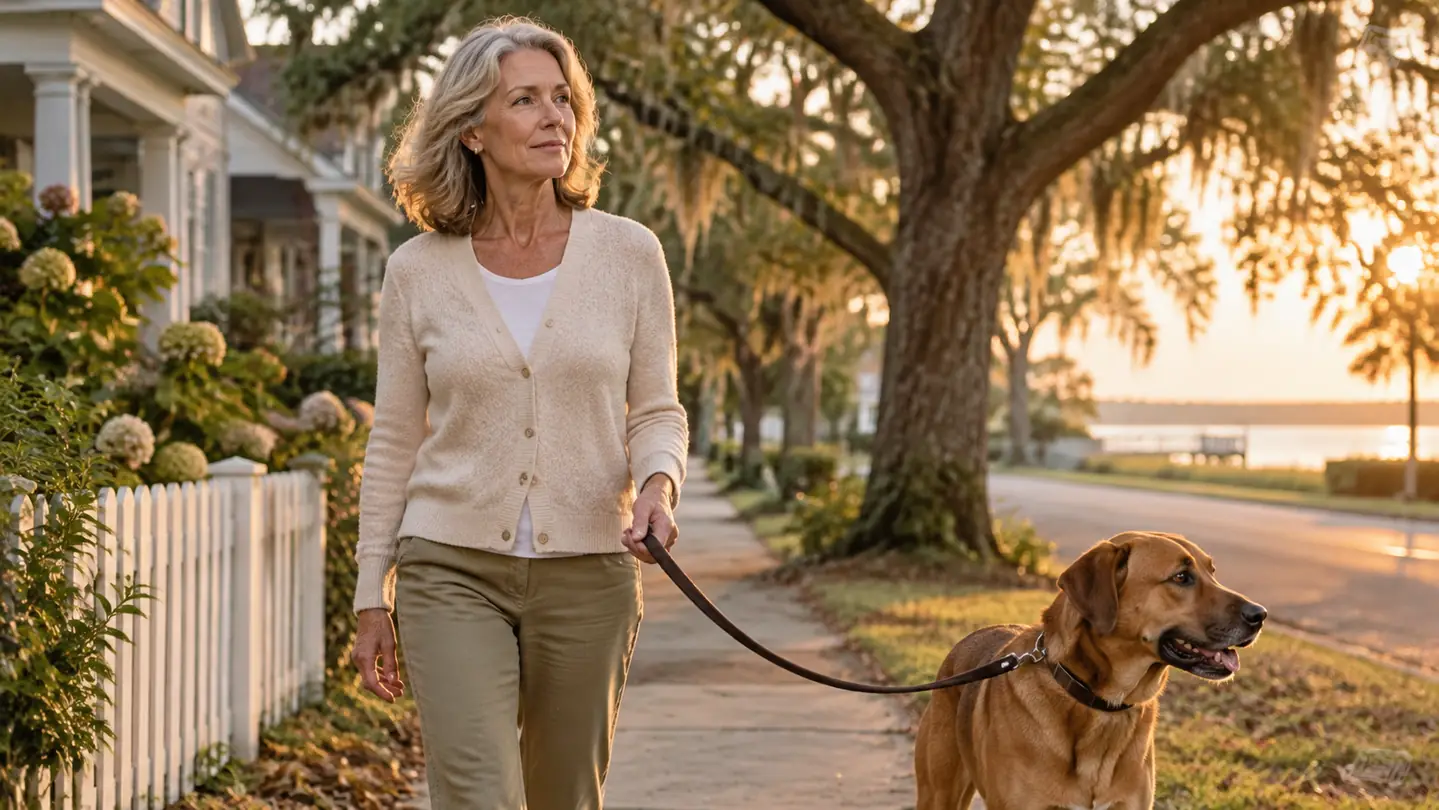
Tupelo came home on a Saturday in the middle of March, and by Tuesday I had learned the thing nobody at the rescue mentioned. A fourteen month old Boykin Spaniel wants to inspect every smell on the street at the same time, and he wants to do it at a trot. Thirty two pounds of forward momentum attached to a nose. Our first two walks happened on a plain collar and a plain six foot leash, and both of them ended with me braced like a sailor in a headwind while a squirrel told us off from a live oak.
I am sixty one, retired after thirty one years as a school librarian here in Brunswick, and I had not had a dog since Duke died in 2014. I gave every one of Duke's things away that year, so when Tupelo arrived there was nothing in the house for him. No leash, no bowl, no crate. By the end of that first week I had ordered a rabbitgoo no pull harness in size Medium, partly because the listing mentioned two leash clips and four adjustable straps, and partly because two women on my street walk their dogs with one. Eight months later it still hangs on the hook by my back door, and it is the first thing I would replace if it ever wore out.
The Quick Verdict
Eight months of twice daily walks and the rabbitgoo harness has stayed put, held its stitching, and made a pulling spaniel easier to hold. It has not made him stop wanting squirrels, and I never expected it to.
Amazon Check Today's Price →The harness that made our morning walk a walk again
Two metal hook loops for the leash, four adjustment points, and reflective strips for dark mornings. Size Medium covers a chest of 15 to 27.8 inches, which is where Tupelo landed at thirty two pounds.
Amazon Check Today's Price on Amazon →How I've Used It
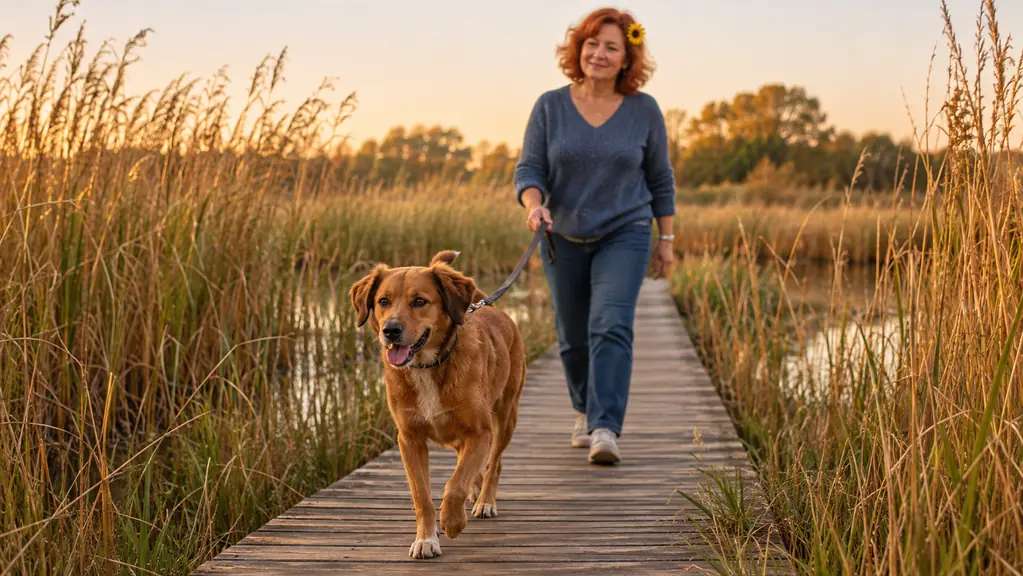
We walk twice a day, morning and evening, around my neighborhood here in Brunswick. Our morning loop is a little under a mile, out to the corner and back past the church, and the evening one is shorter, four blocks, because I am sixty one and my knees have opinions. On weekends we drive out to the marsh boardwalk, where the smells are apparently so interesting that Tupelo forgets I exist. That is eight months of daily use on one harness, and the rabbitgoo vest has been on every one of those walks since the first week of March. I put the leash on the chest loop almost every time. The back loop comes out when we are somewhere open and I am not expecting a squirrel ambush, which is to say rarely.
I am not a trainer and I am not a vet. This is one woman's notes about one harness and one dog. If your dog has a training problem, anxiety, or a health issue, ask your own vet and a qualified trainer, because a harness is a piece of equipment and not a behavior plan. What I can tell you honestly is how it fit, how it held up, and what changed in our house over eight months.
The first week, I did not trust it. I walked him with the leash on the back loop because that was what I knew from Duke's collar days, and I spent the whole walk waiting for something to give. It did not. The second week I moved to the chest loop on the advice of the woman two doors down, who has a Chesapeake mix that could pull a truck, and that was the week our walks changed. There was a Tuesday in that first week when a loose dog came around the corner of the church and Tupelo went up on his back legs. Nothing broke. The buckle held, the strap held, and I got us both turned around and home. That is the day I stopped watching the stitching and started watching the squirrel.
The short version is that the harness has held up better than my knees have. I have rinsed it after marsh walks, hung it on the same hook, and clipped the same plain six foot leash to it twice a day since March. Nothing has loosened that I did not loosen myself. That is a low bar for a piece of equipment and a surprisingly high one for dog gear, in my eight months of experience buying it.
What the rabbitgoo Harness Actually Is
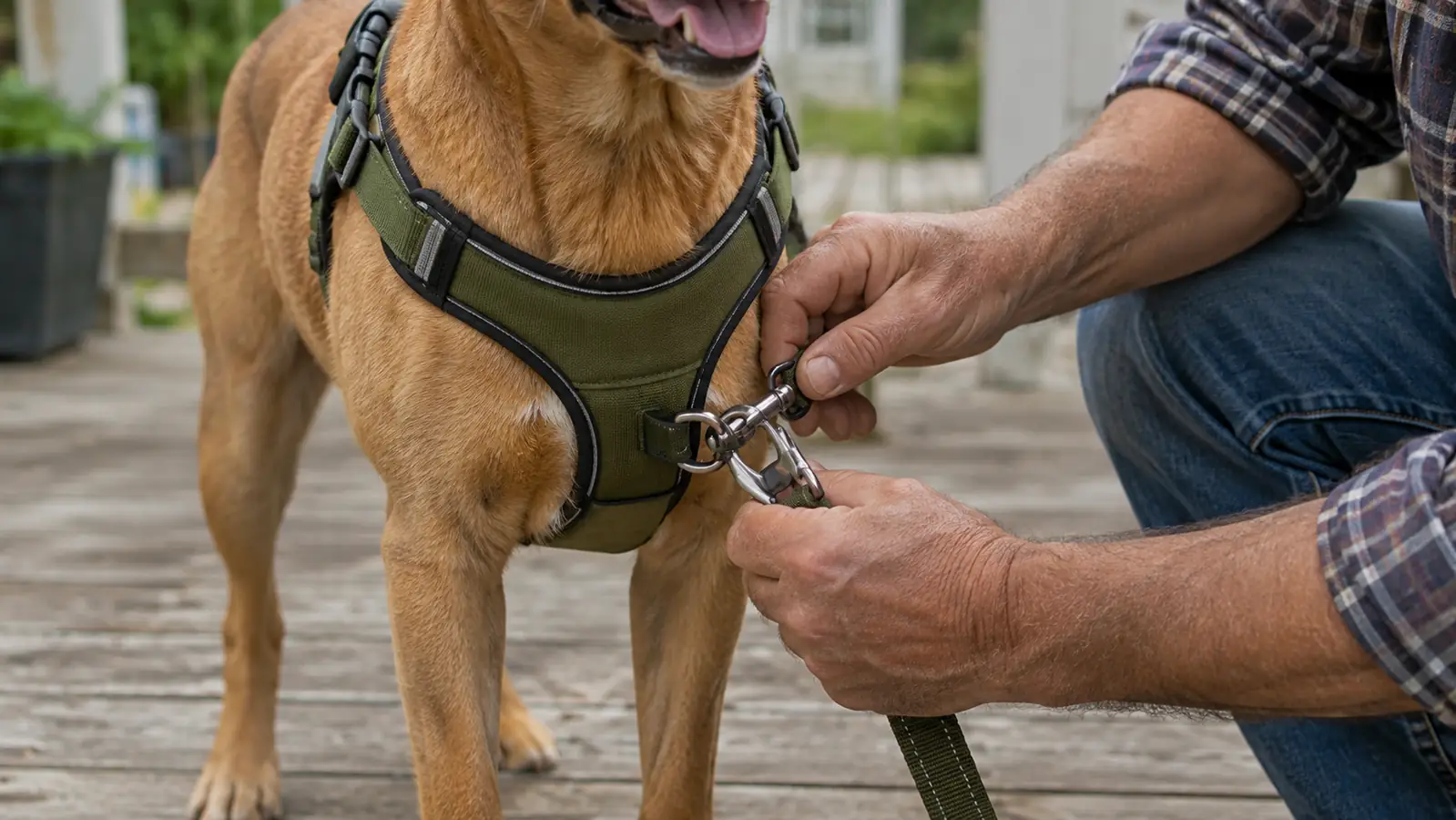
According to the listing, this is a pet vest made from polyester with breathable mesh, closing with a buckle, with two sturdy metal hook loops for leash attachment. The straps adjust in four places. My size Medium lists a chest range of 15 to 27.8 inches and a weight range of 10 to 25 kg. Tupelo is thirty two pounds, roughly 14.5 kg, and I measured his chest with a soft tape at the kitchen table before I ordered, because guessing on dog gear is how you end up mailing things back.
It weighs 8.82 ounces, which is close enough to the 8.82 ounces the listing gives that I stopped thinking about it after the first walk. The listing also notes bright reflective strips for early morning and late night walks, a warranty for quality issues, and that the harness comes with instructions. I read the instructions twice before I put it on him, which is the most librarian thing about me.
The two loops are the heart of it. One sits on the back, the way most harnesses do. The other sits lower, on the chest, and that lower one is the reason I bought this harness at all. A leash on the back loop gives a dog room to lean into the pull. A leash on the chest loop turns him. It is simple mechanics and it is the entire idea behind the words no pull in the product name.
What it is not: it is not padded like a hiking pack, it is not built for anything beyond walking a dog inside that 10 to 25 kg band, and it will not fit a chest outside 15 to 27.8 inches no matter how long you fiddle with the straps. I would rather know that going in than find it out at the mailbox.
The Front Clip, and What Eight Months of It Did
Here is what changed for us. When Tupelo spots a squirrel and lunges, the chest loop swings him slightly toward me instead of letting him hit the end of the line at full stretch. He still lunges. He still wants the squirrel, and I expect he always will. But I am not being towed down the middle of the street anymore, and that is a real difference in how my mornings go.
Tupelo's squirrel problem is specific. There is a live oak on the corner of our street with a resident squirrel who has figured out that a spaniel cannot climb. Tupelo has figured out that the squirrel will wait just above the reach of a leash. They have a standing appointment at seven in the morning. On a collar, that appointment once ended with me apologizing to a man collecting his newspaper. On the chest loop it ends with Tupelo doing a small sideways hop, me saying let's go, and us going. The whole exchange takes about four seconds now. It took longer in April, when he was newer and I was slower, and there was a morning I stood on that corner for two full minutes waiting for him to remember I existed.
I want to be careful here, because this is the part where reviews start overpromising. The harness does not train your dog. It does not make him stop wanting things. What it gives you is a way to hold the line that is not a contest of strength. I am sixty one and he is thirty two pounds and stubborn, and the harness lets me be the one who decides where we go without either of us getting yanked down the sidewalk.
The back loop has its uses too. In October we did the whole marsh boardwalk on a cool Saturday with the leash clipped to the back, and he walked beside me like a dog in a painting for most of it. Then a great blue heron lifted out of the reeds and we were both reminded that he is a spaniel. I clipped back to the chest loop for the second half of the loop.
Eight months, twice a day, and the stitching at the chest loop has not frayed once.
Getting the Fit Right With Four Straps
The first fit took me three tries. I had the chest strap too loose, which let the whole vest shift sideways when he turned, and then too tight, which he told me about by sitting down and refusing to walk off the porch. Four straps means you can fix a harness that sits crooked, and mine sat crooked. What finally worked was setting it with him standing on the kitchen floor, two fingers of room under the chest strap, then taking him one block and checking again. I did that on a Wednesday morning with a coffee going cold on the counter and a handful of treats in my cardigan pocket, and I have not touched a strap since.
A note on sizing, because this is the part I would tell a friend over the fence. The chart is a chest measurement, not a weight, and 15 to 27.8 inches is a wide spread, so measure the dog. Tupelo measured in the lower middle of the Medium range at thirty two pounds, and Medium still has room to let out. If your dog is near the top of the chest range, I would not assume Medium is fine just because the weight matches.
Getting it on takes about four seconds now. He stands for it because the harness means a walk, and he is very clear on that. The first week he sat down in protest on the porch, which had nothing to do with the harness and everything to do with being brand new to my house and my rules.
Eight Months of Wear, Rain and Marsh Mud
This is the part a first week review cannot tell you. Eight months in, the stitching at both leash loops is intact. The buckle still closes with a solid click. The mesh has not torn where it rubs under his chest, which is the spot I expected to go first. The reflective strips still catch headlights, and I notice, because our evening walk in November happens in the dark.
It has been rained on, dragged through marsh mud, and dunked in the washtub on the back porch more than once. There was a Saturday in September when the tide came in faster than the forecast said and we came back with the lower half of him the colour of pluff mud. I rinsed the rabbitgoo harness under the tap, hung it on the hook, and it was dry by the next morning. The fabric has softened and the edges look a little worn where it lives against the hook, which I consider normal for something that spends its life outdoors in coastal Georgia weather.
One thing I would change: a wet dog smell lingers in it after a marsh walk until it gets rinsed. That is my dog's fault and not the harness's, but a harness you could not rinse would be a much worse object, and I am glad this one takes the washtub without complaining.
What I Liked
- Two metal hook loops means I can move from the chest clip to the back clip without changing gear
- Four adjustment points, and the fit has stayed where I set it through eight months of daily walks
- The Medium chest range of 15 to 27.8 inches covered a thirty two pound spaniel with room left
- The reflective strips are bright enough that I notice cars noticing us on dark mornings
- Washed, rained on, and dragged through marsh mud, and the buckle still closes cleanly
Where It Falls Short
- It did not stop Tupelo pulling at squirrels, and no harness was going to
- Setting four straps the first time took me three tries and a pocket full of treats
- A wet dog smell stays in the fabric until you rinse it
- Sizing runs on chest measurement, so guessing instead of measuring will get you the wrong fit
- It is a walking harness, not something I would trust for hard pulling in open country
Who This Is For
This is for the person who just brought home a dog that pulls, or who is about to. Someone with a dog inside the 10 to 25 kg band the listing names and a chest between 15 and 27.8 inches, and someone willing to spend five minutes setting four straps properly before the first walk. If you want two leash options so you can change your grip depending on the situation, the two loops do that. If you walk before sunrise or after supper, the reflective strips are not decoration. It is also a reasonable first harness for a household starting from nothing, which is exactly what mine was in March. The rabbitgoo harness is not the only one on the market, but it is the one I have walked a mile a day in for eight months, and I would buy it again tomorrow.
Who Should Skip It
Skip it if you want a harness to fix a behavior, because it will not, and you will be disappointed by week two. Skip it if you will not measure your dog's chest, because a badly fitted harness is worse than a plain collar and you will blame the product instead of the fit. Skip it if your dog is a dedicated escape artist who backs out of vests, since that is a conversation for a trainer and different gear entirely. And skip it if you need something for hard pulling on a long line in open country, which is outside my experience and outside what a mesh vest is built for.
If your new dog pulls like mine did in March, start with the chest loop
Size Medium fits a chest of 15 to 27.8 inches and a weight range of 10 to 25 kg. Measure before you order, set all four straps on a flat floor, and give it a week before you decide how you feel about it.
Amazon Check Today's Price on Amazon →