
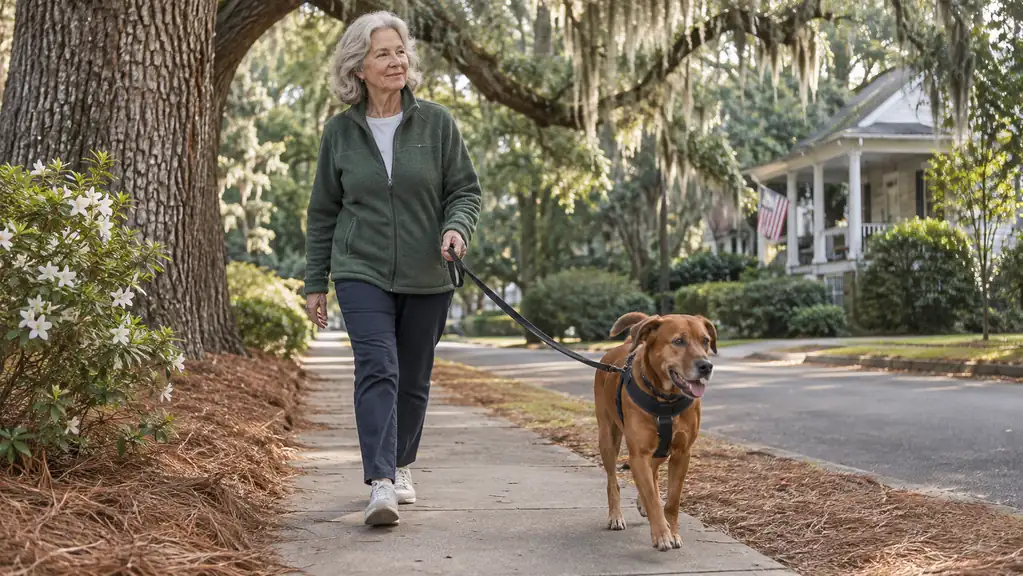
Tupelo came home on a Saturday in mid March 2026, and by the following Tuesday my right shoulder was telling me I had a problem. He is a Boykin Spaniel, about 32 pounds, not quite two, and he is convinced that every squirrel on our street is a personal invitation. The first two walks were on a plain collar. The second one ended with me braced against a live oak on the corner, both hands on the leash, while he made a sound like a small engine revving. I had owned no dog gear at all before that week. My old Lab, Duke, died in 2014 and I gave everything away that year, so there was nothing in the house to fall back on. That evening I sat at my kitchen table with a cloth tape measure and a notebook and started reading listings, which is how I ended up comparing the rabbitgoo harness against a head halter before I had bought either one.
The short answer, for our house, is the rabbitgoo harness. It did not stop Tupelo from noticing squirrels. It made the walks calmer, because the pull lands across his chest instead of his throat, and he stopped choking himself against the leash. A head halter has a real place and I will get to that, but it is a different tool with a harder learning curve. I am not a trainer and I am not a vet. I am a retired school librarian who reads every label and writes in the margins. If your dog has a neck problem, a collapsing trachea or a strong reaction to having anything on his face, ask your own vet or a qualified trainer before you choose either one. What follows is one woman's eight months with a medium harness and twenty minutes with a borrowed halter.
The Medium rabbitgoo harness lists a chest range of 15 to 27.8 inches and four adjustable straps. That is what let me fit Tupelo's chest without cinching his neck.
| rabbitgoo Harness | A Head Halter | |
|---|---|---|
| Steering a hard puller | Spreads the pull across the chest through a vest with two metal hook loops. | Turns the head, so a determined dog has less leverage. |
| Comfort on a daily walk | Polyester fabric with breathable mesh. The no-choke design keeps pressure off the throat. | A strap crosses the muzzle and sits behind the ears. Some dogs need weeks to accept it. |
| Fit and adjustment | Four adjustable straps and a chest range of 15 to 27.8 inches. | Fit depends on head and muzzle shape, and there are fewer points to adjust. |
| Visibility in low light | Reflective strips are built into the harness. | Varies by halter. Many have little or no reflective trim. |
| Learning curve for the dog | A vest is often easier to accept because nothing crosses the face. | Needs patient conditioning, and some dogs never settle with muzzle pressure. |
| Direct head guidance | Not designed to guide the head. | Gives the handler control of the head when fitted and introduced correctly. |
| Best use | Everyday neighborhood and marsh boardwalk walks. | A strong puller working with a trainer on head control. |
Where the rabbitgoo Harness Wins
The first thing I noticed was where the pressure went. Tupelo is 32 pounds, which puts him near the middle of the weight range the listing gives, and on a collar he could get his whole chest behind the leash. Before I ordered anything I measured him with the cloth tape: 24 inches around the widest part of his chest, 21 inches around his neck. The Medium lists a chest range of 15 to 27.8 inches, so he had room on both sides of that number, which mattered because he was still filling out at fourteen months. When the leash is clipped to one of the two metal hook loops, the polyester vest takes the load instead of his windpipe. The listing calls it a no-choke design. For us that was the whole point. He could still pull, but he was not making that awful gagging sound at the corner of Norwich Street.
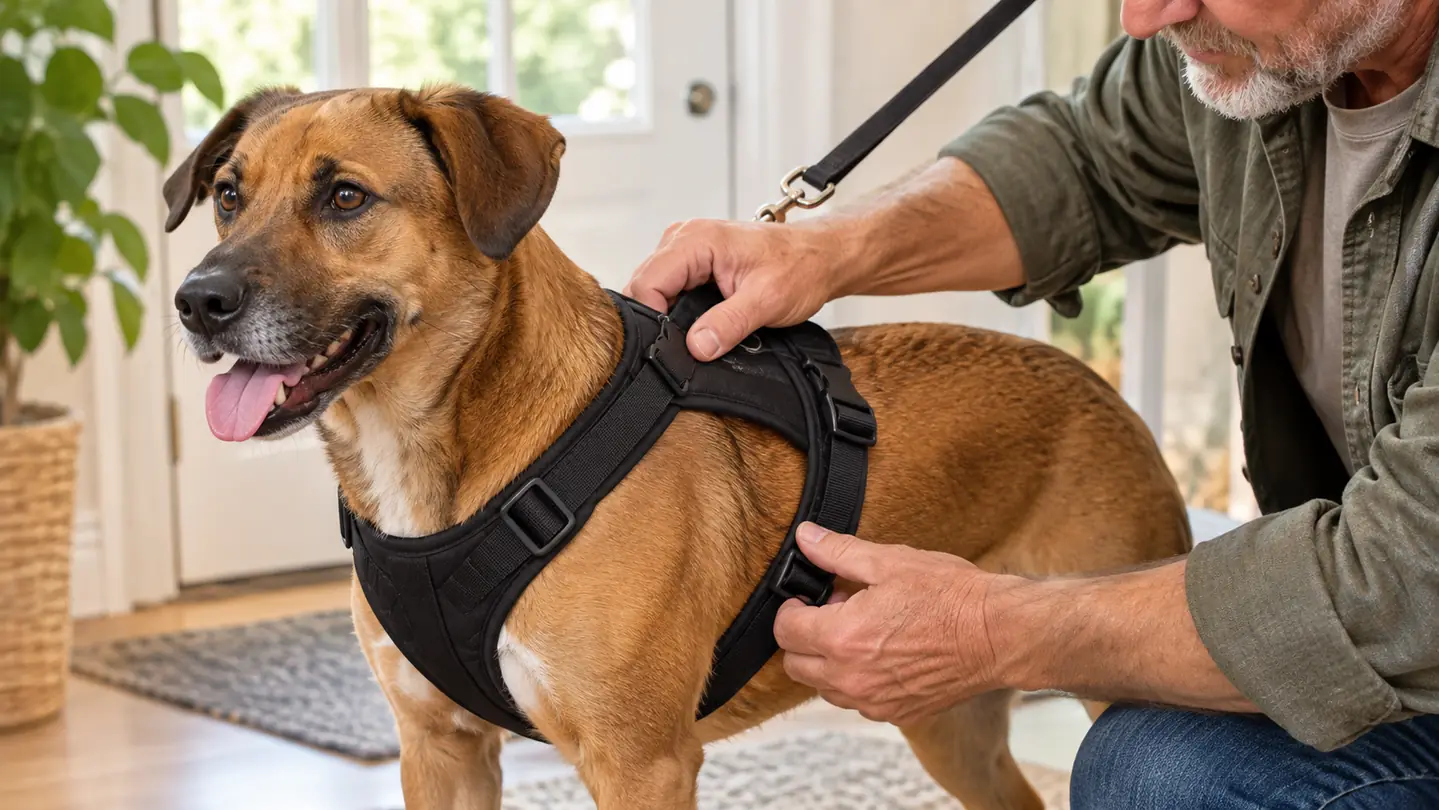
The fit is the other reason I kept it. There are four adjustable straps and I use all four, snugging the neck and the chest separately. A dog with a deep chest and a narrow waist is not a shape one strap can handle. The closure is a buckle, and it has not slipped once in eight months. Every Sunday I put the harness on him, fasten it, and slide two fingers under each strap to check. Twice I found the chest strap looser than I like, both times after he had rolled in the grass down at the marsh. Five minutes of fidgeting with the webbing fixed it both times, and the straps held where I set them. The listing gives the whole thing at 8.82 ounces, which is light enough that he forgets he has it on the moment the leash comes off the hook.
The reflective strips matter more than I expected. I walk Tupelo before breakfast, and by November the light is thin at a quarter to seven. The strips are stitched into the vest and headlights pick them up from a good distance down the street. I cannot prove that with a photograph, but I can tell you I cross Canal Street differently now than I did last spring. The fabric is polyester with breathable mesh, and it has come through eight months of twice-daily walks, two hand washings, and a great deal of marsh mud and burrs. The listing offers a full warranty for quality issues, which I have not had to use. It hangs on a hook by my back door and it is the first thing I reach for after my shoes.
What it does not do is give me head control. When Tupelo is locked on a squirrel, the harness lets me hold him, but it does not turn his attention back to me. I still carry a pocket of kibble, I still stop and wait, and I still turn around and walk the other way when he gets worked up, which happens about once a week on the boardwalk path. The harness is a walking tool, not a training plan. I think that is the honest way to put it. It made our daily walk possible while we worked on everything else, and for a 32-pound spaniel on a residential street, that was enough.
Where a Head Halter Wins
A head halter is not a muzzle, and I want to be clear about that because I misunderstood it at first and nearly skipped the whole idea. The one I borrowed from my neighbor Carol has a strap that crosses the bridge of the nose and another that sits behind the ears, with a ring under the chin where the leash clips. When the dog pulls, the halter turns his head toward the handler. For a dog that can genuinely drag a person, that is more control than a vest gives you. Carol uses hers on a seventy-pound mix who lunges at other dogs on the beach, and she has walked him with it for two years. If I were walking that dog, I would be having a very different conversation, and it would start with a trainer rather than with a shopping cart.
The catch is the learning curve. Tupelo did not like it. We tried it on a Tuesday evening in June, first in my back yard for ten minutes and then on a quiet stretch of sidewalk. He pawed at his face, he rubbed his nose in the grass, and he walked with his head low and his tail tucked for the whole twenty minutes. Carol told me to introduce it slowly, with treats, and never to leave it on a dog who is unattended. That is good advice and it also tells you something: the halter is not a grab-and-go piece of gear. The fit is fussier. The nose strap has to sit in the right place below the eyes, and there is far less room to adjust than there is on a vest with four straps.
I also think the head halter gets oversold as a cure for pulling. It is a management tool. It gives you control while you teach the dog what you actually want. If the dog is miserable in it, you have traded one problem for another, and the new problem is a dog who dreads the sight of the leash. That is why I did not buy one for Tupelo. He is a soft dog, he was already settling with the harness, and I did not want to spend three weeks teaching him to tolerate equipment when we could spend those three weeks walking. For a harder puller, or a dog who is already used to having his face handled, it can be the right call.
Where the head halter clearly wins is immediate steering. If a dog is already pulling you off balance, the halter gives you a way to guide the head and keep both of you safer on the way to the park while you work on the behavior. That is not nothing, and I would not wave it away. I just would not hand one to a shy rescue dog and expect a pleasant first walk. The dog has to be comfortable with the equipment before the equipment can help. That is true of a harness too, but a harness is easier to make comfortable, and that is the whole of my argument.
If you want the walking setup that worked in our house, start with the rabbitgoo harness.
The Medium fits a chest of 15 to 27.8 inches, has four adjustable straps, two metal hook loops, and reflective strips for early walks. It is the one hanging by my back door.
Amazon Check the rabbitgoo Harness on Amazon →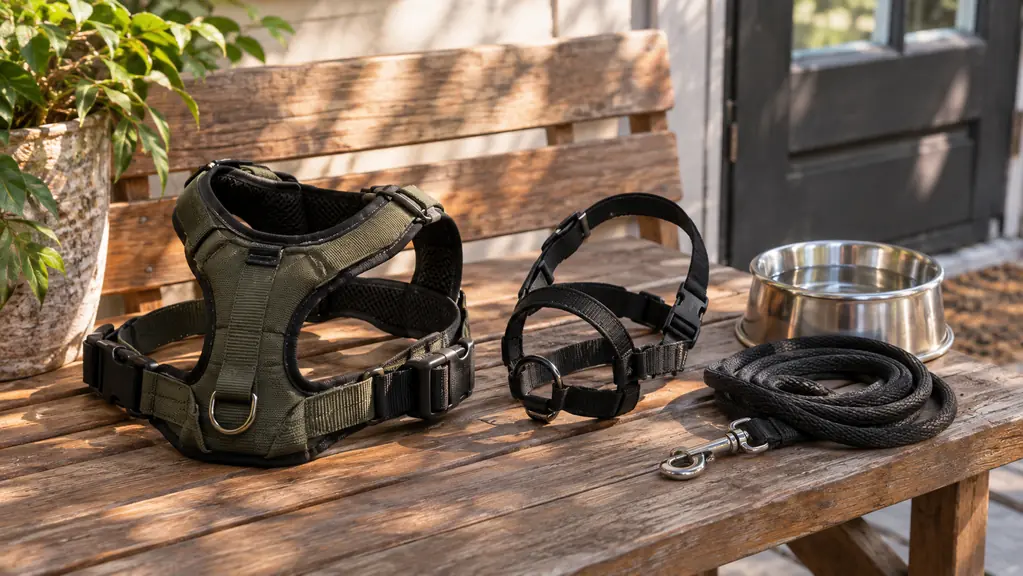
Who Should Buy Which
Choose the rabbitgoo harness if you are bringing home a young dog and you want one piece of gear that covers everyday walks. Tupelo was about fourteen months old when he came home and already strong enough to make a collar walk unpleasant. The harness gave me a handle without putting pressure on his throat, and it gave me room to adjust as his coat thickened and his weight settled. If your dog is in the 10 to 25 kg range, the listing puts him in the Medium sizes, and the listing names Border Collies, Chow Chows and Standard Schnauzers as examples. Measure the chest anyway, with a cloth tape, standing up, after a walk. Tupelo measured 24 inches and the Medium fit him with room to grow.
Choose a head halter if your dog is a serious puller and you have help from a trainer or from someone who has fitted one before. It is also reasonable for a dog who is already comfortable with his face being handled, and for a handler who needs control today rather than in six weeks. I would not start there with a shy rescue dog unless a professional told me to. A head halter can be a decent bridge while you teach loose leash walking, but it is not a substitute for the teaching. Nothing is, and I say that as someone who wanted the equipment to do the work.
You can use both, just not at the same time on the same leash. Some trainers walk on a harness and switch to a halter for training sessions in the park. I did not need that. The rabbitgoo harness, a pocket of kibble and a good deal of patience were enough for a 32-pound spaniel on a residential street and a marsh boardwalk. If your situation is bigger than mine, get a trainer's eyes on your dog before you buy either one. That is the advice I would give a friend at my kitchen table, and it is the advice I gave myself before I ordered anything.
The harness that made our morning walk a walk, not a tug-of-war
Tupelo still watches squirrels. He just does it from a harness that does not cut into his throat. The rabbitgoo harness is still on the hook by my back door after eight months.
Amazon See the rabbitgoo Harness on Amazon →