
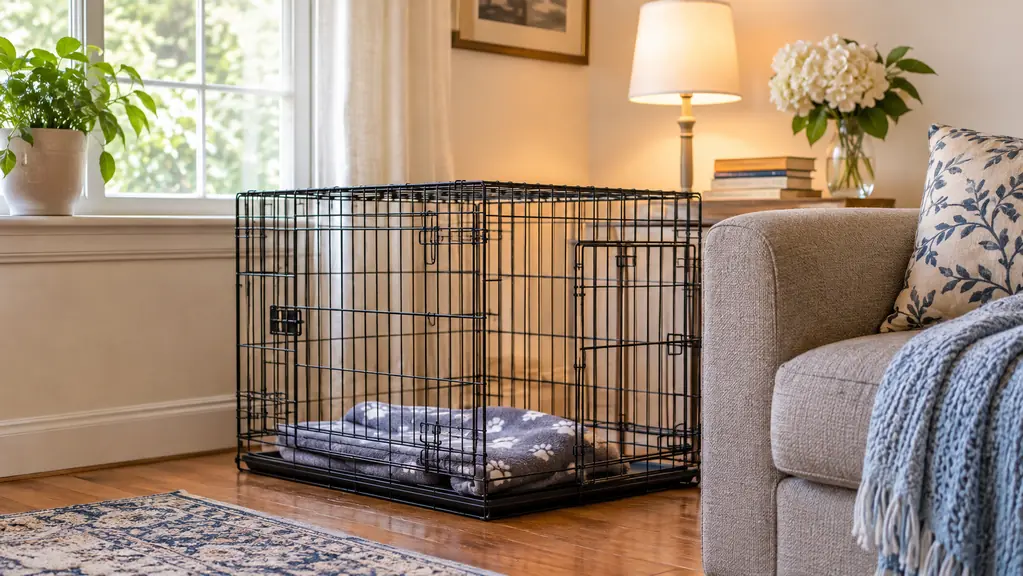
The first thing I did after I signed the adoption paperwork was order a crate. Not a bed, not a bowl. A crate. Tupelo is a Boykin Spaniel, fourteen months old when he came home on a Saturday in the middle of March, about thirty two pounds, with a docked tail and strong opinions about squirrels. He had been moved twice in a month, and I had read enough to believe that a dog in a new house does better with one small room he can call his own. I am not a trainer and I am not a vet. I am a retired school librarian in Brunswick, Georgia, with a fenced back yard, a stack of library books about dogs, and a habit of reading every label twice.
Short answer, eight months on: the wire crate stayed and the soft-sided crate went back to my neighbor's garage. The wire one is the MidWest Homes for Pets 30 inch double door iCrate, ordered the week before Tupelo arrived and standing in the corner of my living room, near the sofa, on the day he walked in. The soft-sided crate came to me in April, borrowed for a weekend trip, and it was good at exactly the thing it is meant to be good at. It was not good at the thing I needed most, which was a box a young dog cannot get out of and cannot chew through. Here is how the two of them compared in my house, with the honest parts left in.
| MidWest iCrate (wire) | Soft-sided crate | |
|---|---|---|
| Walls | Metal wire on all four sides, two lockable doors | Fabric panels with mesh windows and zippered doors |
| Chewing and digging | Metal bars, and mine has held up to a young dog's teeth | Fabric and mesh, which a determined chewer can work at |
| Folding it away | Folds flat, but it is still a 17 pound metal frame | Folds into a small bag you can put on a shelf |
| Car trips and weekends away | Fits in a hatchback folded, but it is a metal box to carry | Lighter and softer, easy to carry into a house that is not yours |
| Ventilation and view | Open on all four sides, so he can see the whole room | Mesh panels, which some dogs find more den like |
| Cleaning up | Leak proof tray slides out and wipes clean | Fabric liner, harder to wipe, more pieces to take apart |
| Noise at night | Metal, so it rattles a little when a tag hits a bar | Quiet |
| Footprint in a small room | 30.5 by 19.25 by 21.5 inches, and it stays put | Similar footprint, but it can be pushed into a corner |
| Warranty | The listing says a one year manufacture warranty | Nothing stated on the one I borrowed |
| Best for | A young dog at home, every night, for years | A dog who already settles, and a person who travels |
What I Bought, and Why
I chose wire for three reasons and none of them were about how it looks. First, I can see him and he can see me. A dog who has just changed houses spends his first week watching, and wire lets him watch. Second, air moves through it on a Georgia afternoon. Third, and this is the one that decided it, wire does not have a zipper. Tupelo was a chewer as a youngster. He chewed one corner of the bolster on his bed in his first weeks with it, and the cover held, but it taught me what his teeth could do. He would have found a zipper.
The crate came flat in a box I carried in from the porch myself. The listing says tool free assembly and it was telling the truth: the frame unfolded, the pins went in, and that was that, maybe five minutes with the instructions balanced on my knee. It has rubber feet so it does not skate across hardwood, a carry handle, and a leak proof tray that slides out from underneath. It measures 30.5 by 19.25 by 21.5 inches and the listing gives the weight at 17 pounds. There are two doors, both with locks, one on the long side and one at the end. I set it so the long door faces the sofa, which turned out to matter more than I expected.
The listing also says a divider panel is included so the crate can grow with a puppy. I never used it. Tupelo was already full size when he arrived, so the divider has lived in my hall closet since March, along with a spare latch I have never needed. If you are bringing home an eight week old puppy, that divider is the reason to buy this size now instead of a bigger one later. If you are bringing home a year old rescue, as I did, it is a piece of metal you will store.
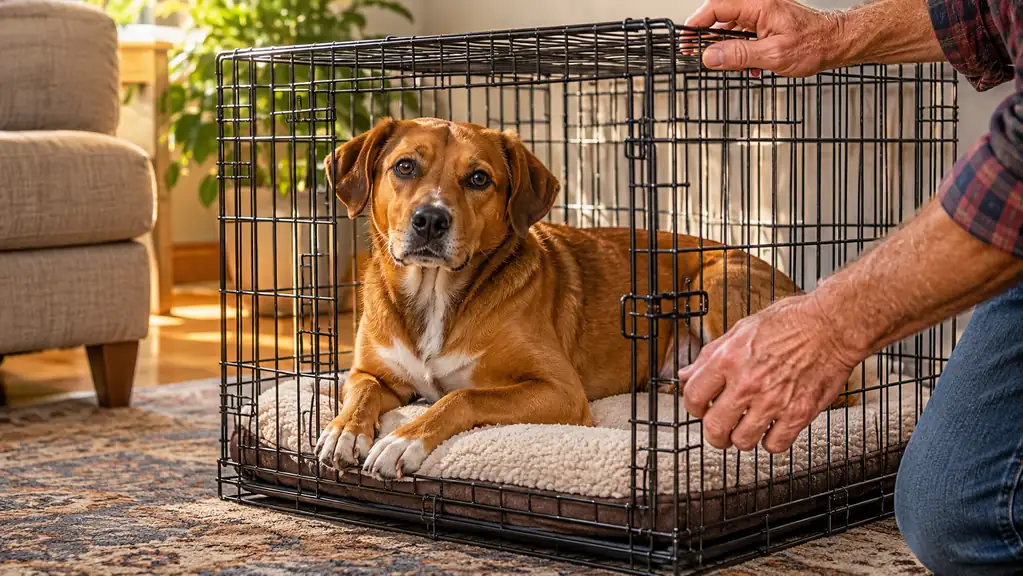
The Wire Crate in the Corner of My Living Room
For his first months he slept in it at night with the door shut and napped in it by day with the door open. Since late summer the door stays open most nights and he still chooses it. He is in there now, asleep on a folded blanket on the tray, while I write this at the kitchen table. The orthopedic bed I bought in April sits by the sliding door in the afternoon sun and has never once been inside the crate, which tells you something about how a dog decides these things without consulting anyone.
What I did not expect was how much the crate would do for the house rather than the dog. When the dishwasher repairman came, Tupelo went in with a smear of peanut butter on a rubber mat and the man worked in peace. When my daughter drove down from Savannah with her loud voice and her louder car, same thing. It is not a punishment in our house. It is where the good chews happen and the door closes and the world gets quiet for a while. He goes in on his own when the mail truck comes, which I take as his own opinion on the matter.
The downsides are the ones you would guess from looking at it. It is a metal box in the middle of a living room and it is not furniture. It rattles a little at night when he turns around and his tag hits a bar. My vacuum does not fit under it, so once a week I move it and sweep the floor beneath. And at 17 pounds it stays where I put it. I have not folded it since the day it arrived, so the fact that it folds flat is a feature I am taking on faith.
Where MidWest iCrate Wins
Containment, first and honestly. The point of a crate for a young dog is that it holds. Wire holds. The two doors lock, the frame does not flex when thirty two pounds of spaniel leans on it, and there is no fabric anywhere for a tooth to start on. The list of things a determined chewer can destroy begins with zippers and mesh, and this crate has neither. That is not a small thing. It is the whole reason I bought it, and eight months of a young dog leaning and turning and occasionally complaining has not loosened a single joint.
Cleaning is the second thing. The tray slides out, goes in the utility sink, and comes back in five minutes. The bars wipe down with a damp cloth. A soft-sided crate means a fabric liner, and a fabric liner in a house with a dog who rolls in the marsh mud means scrubbing something you cannot take apart. Third, the listing says a one year manufacture warranty, and MidWest Homes for Pets is a family owned business based in Indiana that has been at this a long time, which is the sort of detail I notice now that I am sixty one and tired of replacing things.
Where the Soft-Sided Crate Wins
And yet. If I had a dog who already settled, and a life with more car trips in it than mine, I would own the soft one instead. The soft-sided crate I borrowed folded into a bag about the size of a duffel and went into the back of my hatchback without me grunting. It weighed almost nothing. It opened in a parking lot in about four seconds. When I carried it into my daughter's apartment in Savannah, nobody looked at me like I was delivering furniture.
It is quieter and it is softer. A dog who startles at the sound of his own tag on a bar will do better in fabric. Mesh walls make a darker, more enclosed space than open wire, and plenty of dogs prefer that. Mine does not, but I have watched him choose the darkest corner of a room often enough to understand the appeal. It also does not mark a floor. The wire crate has rubber feet and I still put a mat under it, out of caution.
He slept behind a locked door for his first five months. Since late summer the door has stayed open most nights and he still walks into that crate on his own.
The crate that is still in my living room eight months later
The MidWest Homes for Pets 30 inch double door iCrate. Tool free assembly, two locking doors, a leak proof tray that slides out, rubber feet, and a listing that puts it at 21 to 40 pounds. Tupelo sits at about thirty two.
Amazon Check Today's Price on Amazon →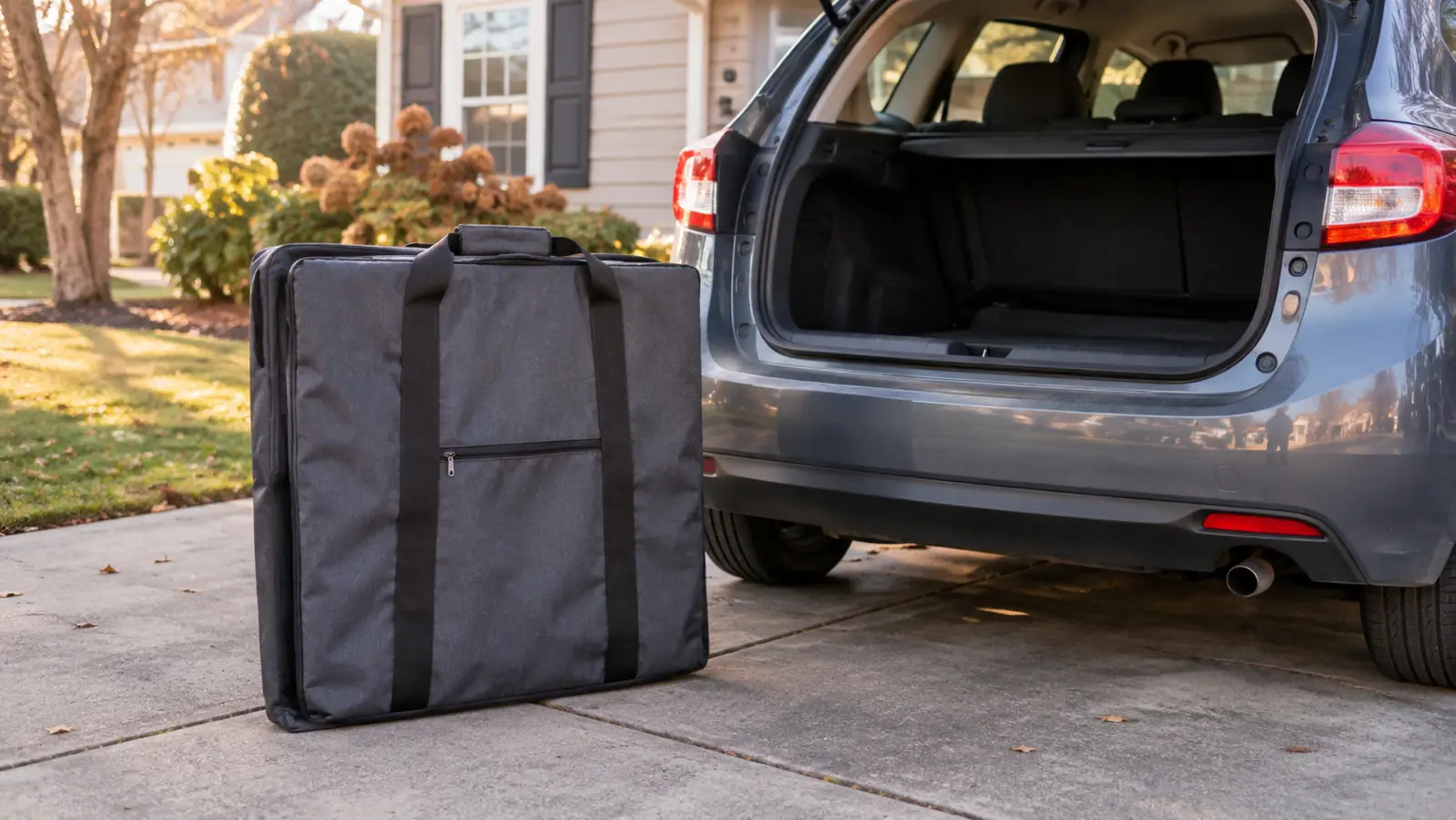
The Weekend I Actually Used the Soft-Sided Crate
In April I drove down to Savannah for a weekend and my neighbor lent me her soft-sided crate so I would not have to wrestle the wire one into the car. It was the right tool for the trip. Two nights, a strange apartment, a dog who had never slept anywhere but my living room. He went in, turned around twice, and slept. I think the smaller, darker space helped. I also think the fact that it smelled like my neighbor's dog helped more, and I am not above taking help.
What I noticed on the second morning was the zipper. He was not chewing it. He was nosing at it, the way he noses at the seam of his food bag, working out whether there was a way in. That was enough for me. A dog who chews does not need a crate with a zipper on it in a room where nobody is watching him. If your dog has never chewed anything in his life, ignore that paragraph. Mine had, and at that point in the year he was still young enough to try new things.
What I Liked
- Two locking doors, so it fits into almost any corner
- Tool free assembly that took me about five minutes
- Leak proof tray slides out and wipes clean
- Rubber feet that do not skate across hardwood
- Listing says a one year manufacture warranty
- The divider panel means you can buy one size for a puppy and keep it
Where It Falls Short
- At 17 pounds it stays where you put it
- Metal rattles at night when a tag hits a bar
- It is not furniture and it looks like a crate
- The divider panel went straight to the closet for a full grown dog
- Vacuum does not fit underneath, so it gets moved to sweep
Size, and What I Would Do Differently
Tupelo is about thirty two pounds. The listing on this crate from MidWest Homes for Pets says 21 to 40 pounds and names French Bulldogs, Welsh Terriers and Dachshunds as examples. He is longer than any of those, so I measured him on the kitchen floor, nose to the base of his tail, before I ordered, and then measured again to be sure. He stands up and turns around in it without ducking his head. If your dog sits near the top of a size range, measure rather than guess. When in doubt, go up a size rather than down.
The thing I would do differently is the bedding. I bought an orthopedic bed in his third week because I assumed the crate needed one. It has never been inside the crate. It sits by the sliding door and he naps on it in the afternoons, and the crate has a folded blanket on the tray. If I had it to do over, I would start with the blanket and wait to see where he actually chose to lie down. That is the whole of my regret, which is a pretty good run for a first dog in twelve years.
Who Should Buy Which
Buy the wire crate if your dog is young, if he chews, if he is new to your house, or if the crate is going to sit in one room and stay there. Buy it if you want to see him from the sofa, if you want a tray you can wipe, and if you want the thing that holds. Buy the soft-sided crate if your dog already settles, if most of his crating happens in cars and hotel rooms and other people's houses, or if you have a dog who is frightened by metal noise and does better in a small dark space.
If you can only have one, and there is a young rescue dog in your future, get the wire one first. It is the one that holds. Add the soft one later if your life turns out to include travel, and if it does, borrow a soft-sided crate for a weekend before you buy it, which is exactly what I did and exactly what I would tell a friend across my kitchen table. For us, eight months in, the wire crate is still in the corner, the door is open, and he is in it.
Eight months, one dog, one crate in the corner
The MidWest Homes for Pets 30 inch double door iCrate. It has held up to a young chewer since March, and the door has stayed open since late summer because he keeps choosing it.
Amazon Check Today's Price on Amazon →