
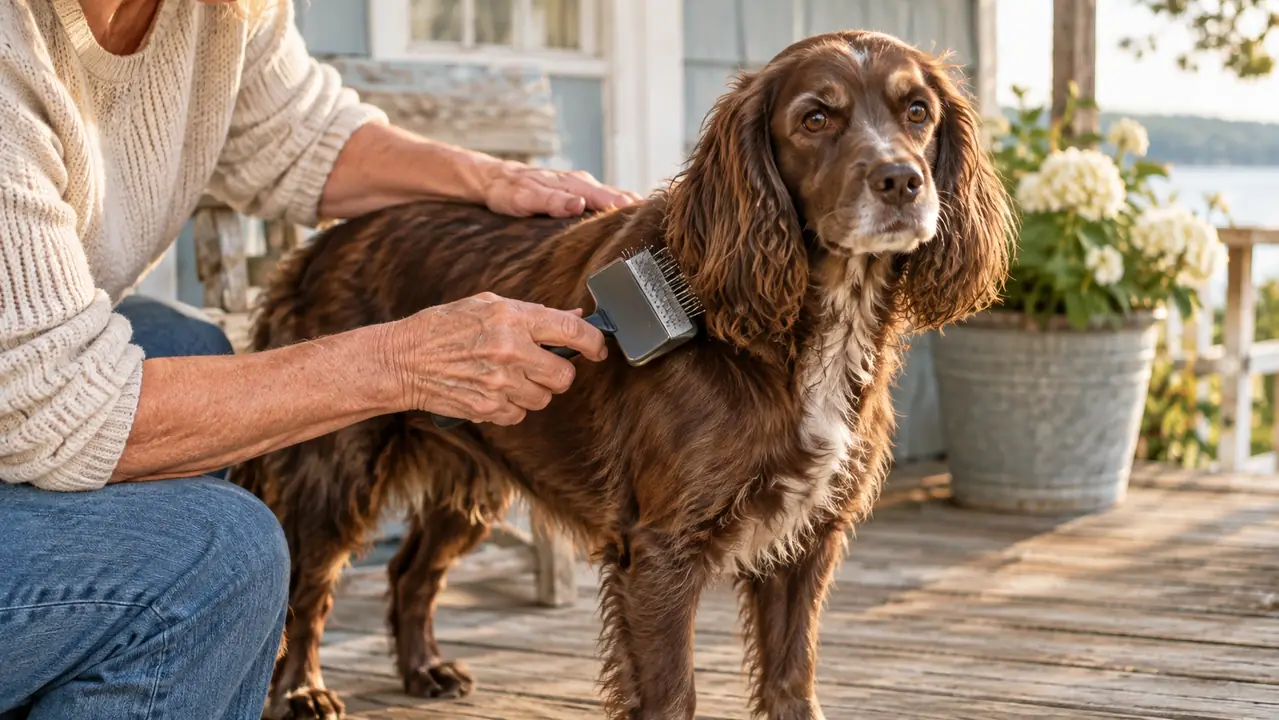
The first thing I noticed about Tupelo was not his eyes or his wiggle. It was the hair. He came home on a Saturday in mid March 2026, a young rescue Boykin Spaniel of about fourteen months, and within four days there was a fine brown dust of it along my baseboards, in the corners of the kitchen, and somehow on the inside of my storm door. I had gone twelve years without a dog. I owned nothing. No crate, no leash, no brush. And I had a wavy coated spaniel on my floors.
I bought the Depets self cleaning slicker brush in his second week home, late March, from the porch step on my phone while he nosed around the yard. It was not a researched decision. It was the one with the button, and the button was what sold me. Eight months later it lives in a basket by the back door and gets used three or four times a week. This is what I have learned about it, including the parts that are not flattering.
The Quick Verdict
A genuinely useful everyday brush for a wavy coat. The pins reach the skin, the one-click button clears the head in a second, and it has held up through eight months of porch brushing. It will not finish a matted coat and it is not a substitute for a groomer.
Amazon Check Today's Price →The brush that turned my baseboard problem into a porch routine
The Depets self cleaning slicker brush is the one I reach for three or four times a week on Tupelo's wavy coat. Push the button, the hair drops off the pins, done.
Amazon Check Today's Price on Amazon →How I've Used It
We brush on the back porch, not in the house. That was a decision I made in the first week after watching what came off him, and I have stuck to it. Tupelo stands on the boards with the marsh smell coming up from the yard and I work in short passes: shoulder, then flank, then the feathering behind his front legs, then his back end. Five minutes on a good day. Ten if he is patient, which he usually is not for the last two.
After a marsh boardwalk walk the session doubles. Burrs and fine grit get into that wave, especially around his chest and lower legs, and the brush lifts a surprising amount of it. I do not brush his face. He has a soft expression and I am not interested in testing it with wire pins near his eyes. I use the brush dry, on a dry dog, and I keep a folded towel on the table to catch what comes off.
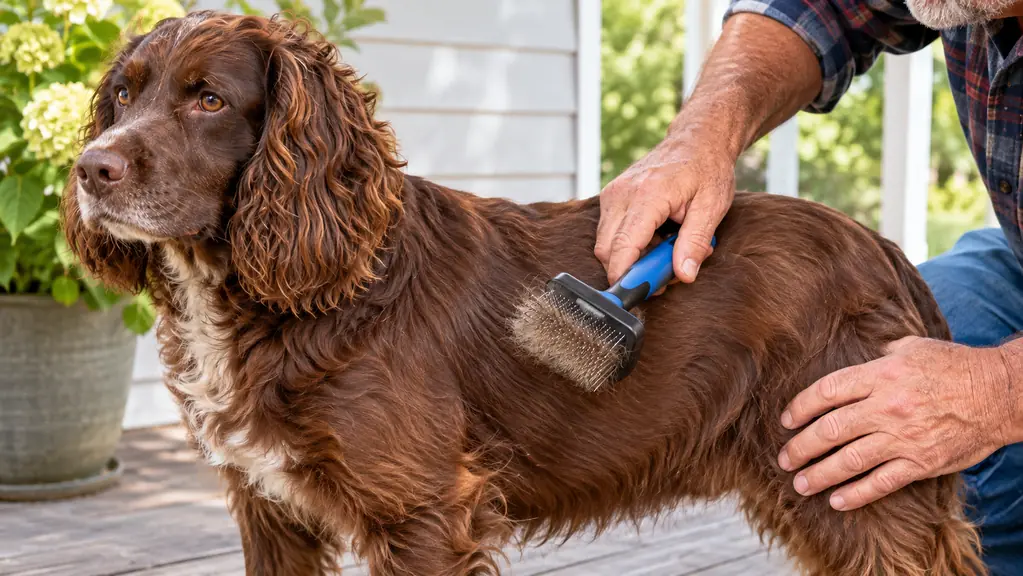
The listing says the stainless steel needles have a 60 degree bend to reach the skin, and the head is small enough that I can get under the wave rather than just skating over the top of it. That matches what I feel. When I first started I pressed too hard and he moved away from me. Now I let the pins do the work with almost no pressure and he stands still for it. If you take one thing from this, take that one.
I learned the order the hard way. My first few sessions I started at his back end because that is where the most hair was, and he simply sat down on me. So now it goes shoulder first, which he does not mind at all, then the flank, then the feathering behind his front legs, and the back end last, once he has decided this is a reasonable deal. I keep a small dish of kibble on the table and give him one piece when we finish. That is not training advice, it is just what made the routine stick in our house.
What the Pins Actually Pull Up
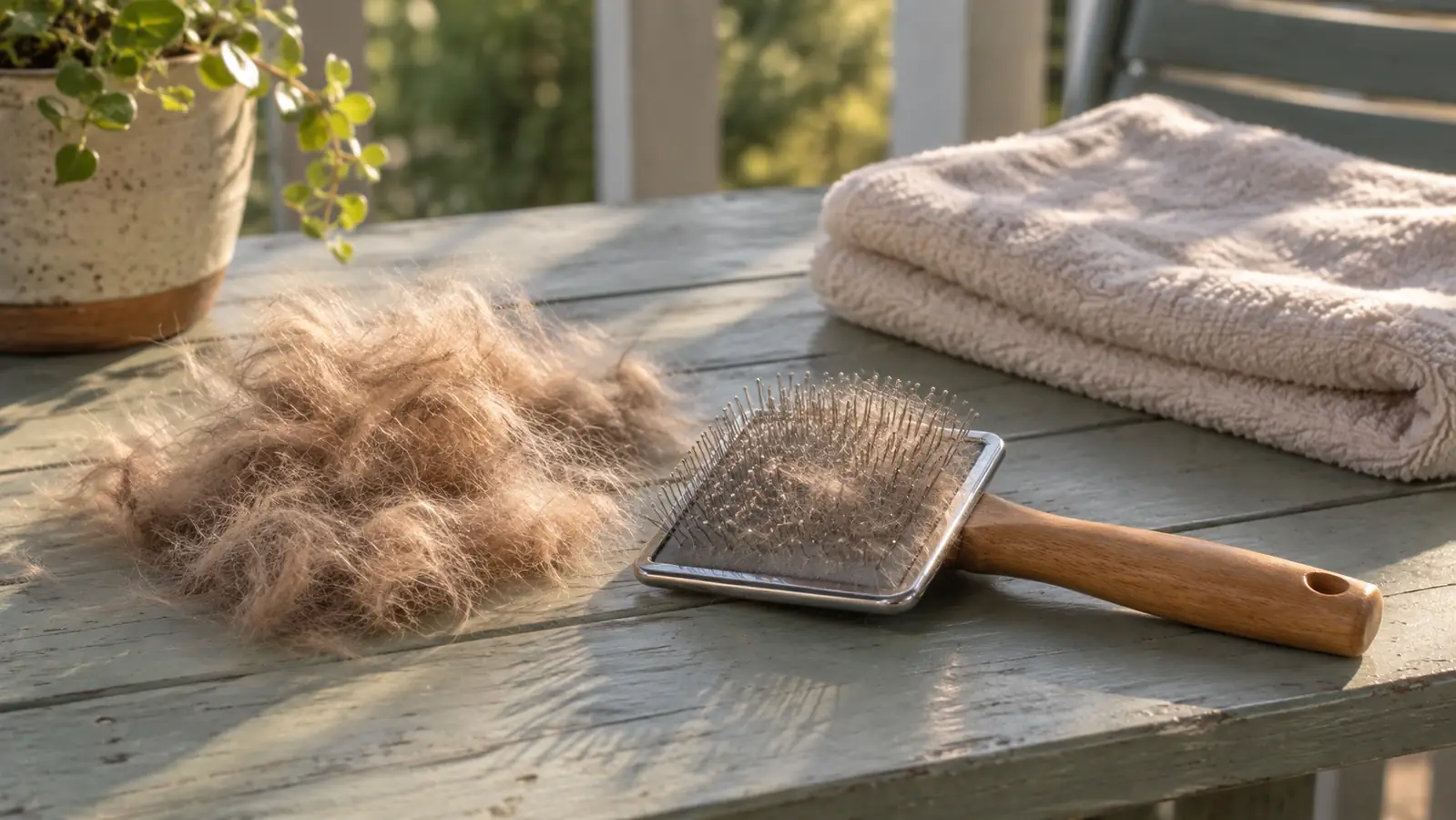
Here is the honest accounting. In a five minute session on Tupelo I get a soft pad of hair off the brush roughly the size of my palm. Loose undercoat, mostly, plus whatever grit he has picked up. That is not a dramatic figure, and it is why I want to be careful about how I describe this brush. It is not removing his coat. It is removing the hair that was already on its way off him, and catching it before it reaches my floor.
The listing describes it as removing loose hair, shedding mats, dander and dirt, and the brush is sold for dogs and cats both. I can only speak to the hair and the dirt. The dirt part surprised me more than the hair. A pass along his flank after a wet walk lifts a grey film off the top of the coat, and the porch looks like I have been sanding something.
What it does not do is get through a genuine mat. He developed two small ones behind his ears in his first weeks home, and the brush did nothing useful with them except pull. I stopped, worked them apart with my fingers over a couple of days, and asked my groomer about it at his first appointment. If your dog has real matting, brush gently or not at all and get help. That is not a brush problem. That is a coat problem.
One Sunday in October I got curious about how much was actually coming off him. I did it the crude way, since I do not own a kitchen scale I trust: I pressed the pad of hair flat on the towel and it covered most of a dinner plate. Three sessions that week, three of those. Multiply that across eight months and I understand exactly why my baseboards looked the way they did in March. He does not shed more than other dogs. A wavy coat holds what it sheds until something pulls it out.
It is not removing his coat. It is removing the hair that was already on its way off him, and catching it before it reaches my floor.
The One-Click Button, Eight Months In
This is the feature I bought it for and it is the feature I would buy it for again. You push the button at the back of the handle and the pins retract, and the hair that was caught in the head lifts off in one piece. It takes a second. I push it over the towel, peel the pad of hair off, and go back in. The listing calls it a release button and describes exactly that, and after eight months it still returns cleanly every time.
Before this I had a hand-me-down slicker with no button, back in the Duke years, and I remember picking hair out of it with my fingers and losing patience. That small mechanical difference is the whole reason a five minute session stays a five minute session. When the brush gets annoying, you stop brushing. That is the real cost of a bad brush.
One caution, and I learned it the wrong way. The pins retract inward, so if you push the button while the head is still pressed against the dog, you will pinch. I did it once in the first month and Tupelo left the porch and would not come back for ten minutes. My habit now is to lift the brush clear of him, hold it over the towel, and then push. It is obvious once you have done it wrong once, and worth saying out loud anyway.
Size, Weight, and What It Feels Like in the Hand
The listing gives the dimensions as about 5.91 by 1.97 by 1.97 inches and the weight as 3.53 ounces, or 100 grams. In the hand it is light enough that my wrist does not complain, which matters more at sixty one than it did at forty. The handle is small enough for my hand to close around fully. I wear a women's medium glove. If you have very large hands, this will feel like a compact tool rather than a full grip, and that is worth knowing before you order.
Because the head is small, brushing a thirty two pound spaniel takes more passes than it would with a wide professional slicker. I do not mind. The smaller head lets me follow the shape of his shoulder and hip instead of dragging a wide plate across them, and it is easier to keep the pins flat to the skin. It would be slow work on a big thick coated dog. I would not want to do a Labrador in spring coat with this. For a spaniel sized dog with a moderate wave, it fits.
There is a practical consequence of the small head I did not expect. It makes short passes natural, and short passes suit a young dog far better than one long session. With a wide brush I would be leaning over him for ten minutes and he would be done with the whole idea by minute four. Instead I do a shoulder in about forty seconds, let him shift his feet, and come back for the flank.
How It Has Held Up
Eight months, three or four sessions a week, stored in a basket by a door that gets opened constantly in Georgia humidity. The pins are all still seated and none have bent or pulled out. The retract mechanism has not stuck. The handle has a few scuffs from being dropped on the porch boards, which is my doing and not a defect.
I rinse the head under the tap every couple of weeks and dry it on a towel before it goes back in the basket. I do not know what the manufacturer recommends for cleaning beyond what the listing says, and I am not going to pretend I do. I have not put it in the dishwasher and I would not. This is a small metal and plastic tool and it does not need to be treated roughly to last.
I keep a note in the back of my calendar about dog things, mostly so I do not forget when the vet is due, and I flipped back through it while writing this. The brush shows up in late March, then again in April after the first marsh walk, then more or less every week after that. The only thing that changed in eight months was the volume of hair, which dropped off in June and came back up in September. The brush itself has not changed at all. The Depets brush has not given me a single reason to go looking for another one.
What I Liked
- The one-click release genuinely clears the head in about a second, so brushing stays a five minute job
- The 60 degree bent pins get under a wavy coat to the skin instead of skating over the top
- Light at 3.53 ounces, which matters on a long session
- Small head follows the shoulder and hip instead of dragging across them
- Eight months of regular use with no bent pins and no sticking mechanism
Where It Falls Short
- Small head means more passes on a bigger or thicker coated dog
- Will not work through real matting, and you should not try
- Compact handle may feel small in a very large hand
- Not the tool I would choose for a heavy double coat in full shed
Who This Is For
This is a good brush for someone with a medium sized dog who has a moderate coat and wants a short, repeatable grooming habit rather than a project. It suits a wavy or silky coat, a dog who tolerates being handled, and an owner who will brush a few times a week instead of once a season. It suits a beginner, honestly. I was a beginner at sixty one and it did not punish me for it.
It also suits the specific problem I had, which was hair on the floor and burrs in the coat after wet walks. If that is your problem, this is a sensible first brush, and if it turns out not to suit your dog you have not lost much by trying. If you are sorting out a whole new dog setup, I wrote separately about how a slicker brush fits into that first month and how it compares to a deshedding glove, and both are worth a look before you buy anything.
Who Should Skip It
Skip it if your dog is badly matted. A slicker brush is not a dematting tool and using one on tight mats hurts. That is a groomer or a vet conversation, not a purchase. Skip it if you have a large, heavy coated breed and you are looking for a single brush to handle a full seasonal shed. The head is too small for that job and you will be there all afternoon.
Skip it if your dog will not be handled yet. Tupelo was nervous for his first weeks and I did not force brushing on him. I let him sniff the brush, brushed two strokes, gave him a piece of kibble, and stopped. Build the tolerance first. And skip it if you are expecting a health outcome. It is a grooming tool. It removes loose hair and dirt. Anything about skin, coat condition or allergies is a question for your own vet, not for a review written by a retired librarian.
One more thing I would tell a friend. The brush did not solve my floor problem on its own. Brushing three times a week plus a damp cloth on the baseboards plus accepting that a dog with a coat will leave some hair in a house is what actually changed things. The Depets brush is the tool that made the brushing easy enough that I kept doing it. That is a smaller claim than some reviews make, and it is the true one.
Eight months on my porch and it is still the brush I reach for
If you have a wavy or silky coated dog and a floor that shows every hair, this is a low risk place to start. Push the button, the hair drops off, back in the basket.
Amazon See the Depets Slicker Brush on Amazon →