
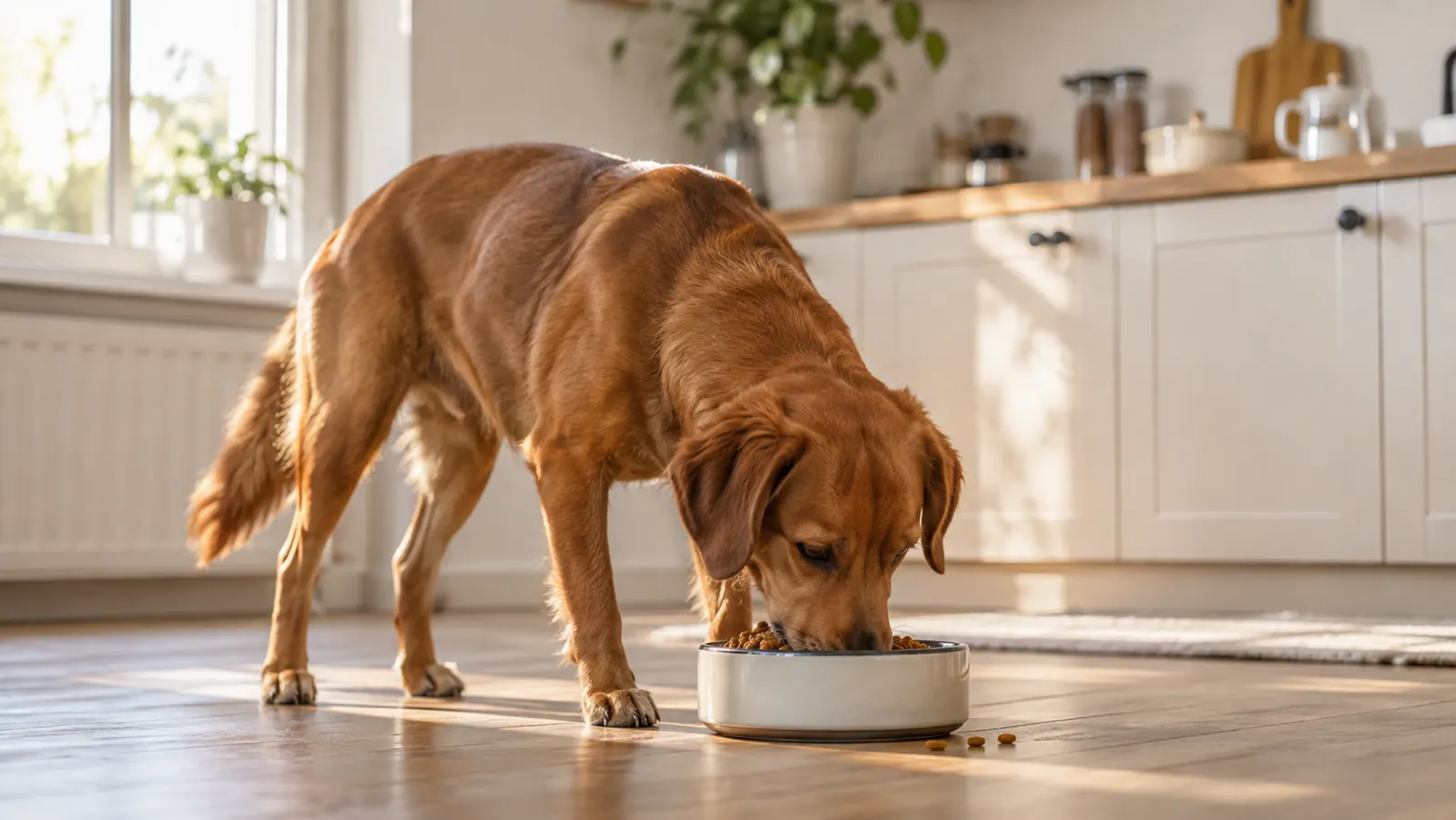
Tupelo finished his first dinner in this house before I had put the scoop back in the bin. I set the bowl down on the kitchen floor, turned to rinse my hands at the sink, turned back, and it was empty. Then he stood there licking his lips and hiccuped. That was a Saturday in mid March, the day he came home, and it was the first time in twelve years I had given any thought at all to how a dog eats.
I had a dog before. Duke, a Lab mix, gone since 2014, and I gave every last thing of his away that same year because I could not stand to look at it in the closet. So when I adopted Tupelo, a Boykin Spaniel from a regional rescue, I owned nothing. No crate, no leash, no bowl. Every item in this house for him was bought new, one at a time, usually the day after I realized I needed it. The Outward Hound Fun Feeder Slo Bowl came in his second week, after I watched him inhale a meal and then gulp air like a man who had lost a bet.
The Quick Verdict
It did the one job I bought it for. Dinner takes minutes now instead of seconds, and the gulping and the pacing afterward mostly stopped. It is not a puzzle toy, it will not portion food for you, and a determined bowl flipper will beat it. For a food motivated spaniel in a small kitchen, it earned its spot on the floor.
Amazon Check Today's Price →The bowl that turned a swallowed dinner into a five minute one
Same kibble, same dog, same kitchen. The only thing that changed was the shape of the bowl. That was enough for us.
Amazon Check Today's Price on Amazon →How I've Used It
Tupelo is about thirty two pounds, not quite two years old, and the most food motivated creature I have ever fed. He came to me at around fourteen months, already full grown, already neutered by the rescue, already set in his ways about dinner. The bowl sits on the kitchen floor between the refrigerator and the back door. He eats breakfast there around seven and dinner around five thirty, and it has been his only food bowl since the week it arrived.
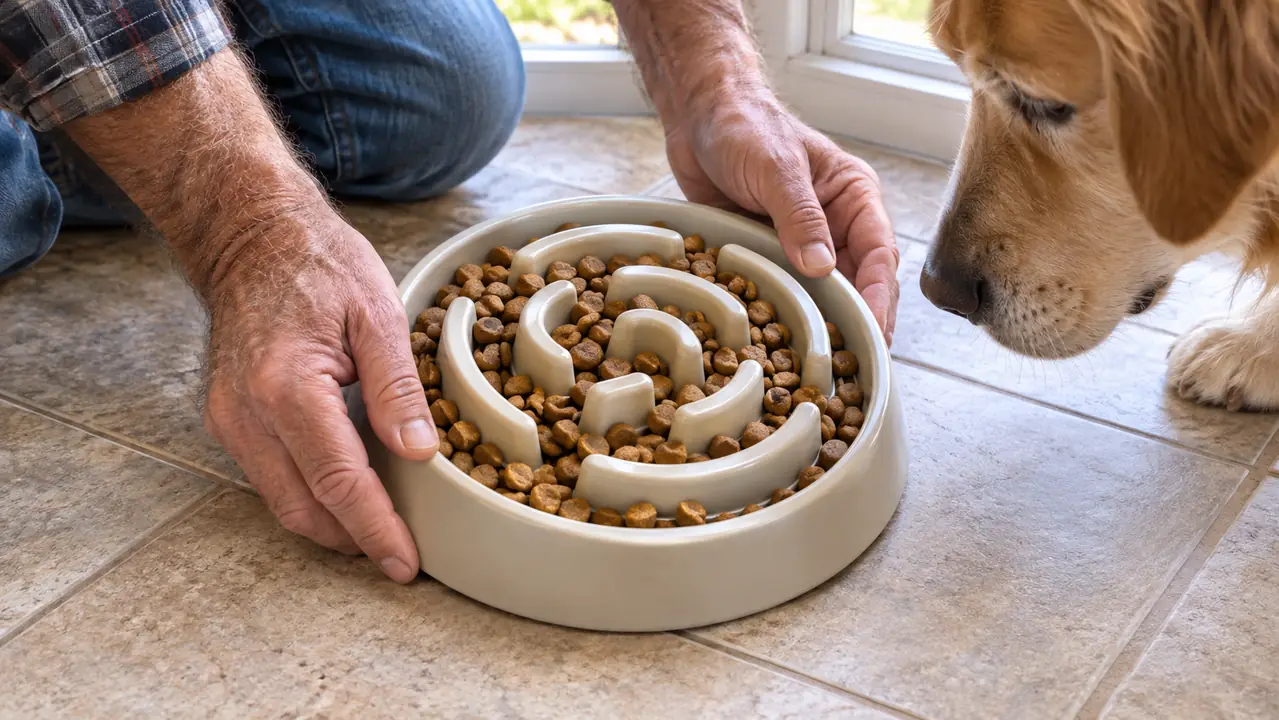
The one I bought is the medium, the Notch pattern. The listing gives it as eight and a half inches across, two inches tall, and eight ounces in weight, and says it holds two cups. I measured nothing myself. I am telling you what the listing says because that is the honest way to do this. What I can tell you from the floor of my own kitchen is that two cups of kibble is a generous dinner for a thirty two pound dog, and there is room to spare.
The first thing I noticed was not that he ate slower in some vague, measurable way. It was that he had to think. With a plain dish he never lifted his head, not once, from first bite to last. With this bowl he works the channels with his tongue, backs up, comes at it from the other side, and looks up at me once or twice as though asking whether I am serious. Dinner went from well under a minute to something closer to four or five. He still finishes. He just has to work for it now.
I feed him dry kibble, which is what the bowl is designed around. The listing also says it works with wet food, and I believe it, though I have not tried it because Tupelo gets his wet food mashed into a toy on the back porch on Sundays and I am not inclined to change two routines at once at my age.
What the Notch Pattern Actually Does
The inside of the bowl is a set of raised ridges arranged in a maze, and the kibble settles down into the channels between them. A dog cannot close his mouth around a scoop of food, so he has to pick at it a piece at a time. That is the entire mechanism. There is no lid, no timer, no moving part, no battery. It is a piece of molded plastic with a shape, and the shape is the product.
Outward Hound makes this bowl in three levels the listing calls Slow, Slower, and Slowest, and in several maze patterns. Mine is the entry level Slow, which the listing recommends for small to medium breeds. The listing also claims it can slow eating up to ten times. I cannot verify a figure like that and I would not want to try. What I can tell you is that it turned a meal he could finish in the time it takes to fill the kettle into a meal that lasts about as long as folding a load of laundry.
The Notch pattern has wide channels and it is easy. Tupelo figured it out on the first dinner with no coaching from me, which is what I wanted. I was not trying to entertain him or tire out his brain. I was trying to keep him from swallowing his dinner whole and then standing in the middle of the kitchen looking uncomfortable. If your dog is already quick with puzzles, the Slower or Slowest levels would likely be a better fit. If your dog is new to all of this, the one I bought is a reasonable place to start.
One thing worth saying plainly. This is not a puzzle toy and it is not meant to occupy a bored dog for an hour while you take a phone call. It is a bowl. The job is done in five minutes and then the job is over. Do not buy it expecting enrichment. Buy it expecting a slower meal.
The First Week at Our House
The first three dinners he was annoyed with me. He nosed at the ridges, licked one channel clean, and then stood and stared. In his first week I had fed him on a dinner plate from my own cupboard, so the bowl was new and strange, and he is a dog who likes a routine to stay put. By the fourth dinner he trotted over to it without being told, and by the end of the week he was waiting beside it while I scooped.
The other thing that changed was after dinner. He used to finish and then pace the length of the living room and burp and look at his own flank as if it had offended him. At the checkup the week he arrived, my vet said a slow feeder was a reasonable thing to try and to keep an eye on him. I am not a vet. I am not going to tell you what to do about your dog's digestion, and if your dog eats fast enough to worry you, that is a conversation for your own vet and not for a retired librarian with a website. I will only tell you what happened here, which is that the pacing mostly stopped and I think the bowl is the reason.
He also stopped doing the thing where he inhaled so hard he would cough. It happened twice in his first week and it frightened me both times. My vet looked him over, said he was healthy, suggested the slow bowl, and reminded me to feed him on a schedule instead of topping the bowl off through the day. That second part mattered as much as the bowl did.
Living With It: Cleaning, Space, and the Kitchen Floor
The bowl is plastic, light, and low to the floor, and it stays where I set it, which was not true of the plate. Eight months of twice daily use and the ridges are not chewed, worn, or scratched up. He has never picked it up and carried it off, which I half expected from a spaniel with a soft mouth and a strong opinion about food.
Cleaning is the part I did not think about before I bought it. Kibble dust and dog saliva dry down in the channels, and if you leave it overnight it sets like paste. I rinse it the moment he finishes and it goes through the dishwasher a couple of times a week. The listing says dishwasher safe, and nothing has warped or clouded in eight months of that treatment.
My one real complaint is size. Two cups is a lot of bowl for a thirty two pound dog. His breakfast is the smaller meal at our house, and when I put a small portion in, the food spreads thin across the whole maze and he finishes almost as fast as he used to. It still slows him some. It just slows him less. If your dog gets small meals twice a day, know that the bowl works best when it is reasonably full.
It travels well. I take it to my daughter's house in Savannah when I stay the weekend, and it goes in a tote bag with his leash and his brush without taking up any room in her kitchen. That was not something I planned for and it turned out to be the most useful small thing about it.
What It Doesn't Fix
A slow feeder changes how fast the food goes in. It changes nothing else. Tupelo still counter surfs. He still sits and stares at me while I eat, with an expression I can only describe as patient judgment. He still needs a walk after dinner or he is restless at nine at night, clicking around the living room like a man pacing a train platform.
It also does not work for every dog. A friend of mine has a terrier who simply tipped the bowl over and ate off the floor, which is a very sensible solution if you happen to be a terrier. If your dog is a flipper, this bowl will frustrate you both. And if your dog is a fast eater who also eats too much, a slow bowl will not portion anything for you. You still have to measure the food. The bowl only changes the pace.
Last thing. It is not a chew toy. If your dog likes to mouth his dish after he finishes, watch him with it for the first week or so, because plastic ridges are not indestructible and a chewed up bowl is not a slow feeder anymore.
What I Liked
- Took dinner from under a minute to four or five minutes for a genuinely fast eater
- The gulping, coughing, and after dinner pacing mostly stopped in our house
- Easy enough that a dog with no puzzle experience figures it out on the first meal
- Holds two cups, so a full meal for a medium dog fits with room to spare
- Dishwasher safe, and eight months of washing has not warped it
- Light and low, so it stays put on a tile floor and packs in a tote bag for weekends away
Where It Falls Short
- Only works well when the bowl is fairly full, so small meals get less benefit
- Kibble dust dries in the channels and needs a rinse right after the meal
- No use at all for a dog who flips or tips his bowl
- Does not portion food, so you still have to measure every meal yourself
Dinner went from well under a minute to something closer to five, the coughing stopped, and he stopped pacing the living room afterward. That is the whole review.
Who This Is For
This is for the person who watched their dog finish a meal in seconds and felt uneasy about it. It is for a dog who gulps air, who coughs at the bowl, who finishes first and then goes looking for someone else's. It suits a medium dog with a full two cup meal and a food driven temperament. It also suits a smaller house, because it takes up no more floor than a cereal bowl and there is nothing to set up or clean around. If you are bringing home a young rescue and you are still buying the basics one item at a time, this is a cheap and simple thing to add to the list early, before the habit of inhaling sets in. If you want to weigh it against other options, I have written about how a bowl like this compares with a snuffle mat, and about why a slow feeder suits a food motivated dog in the first place.
Who Should Skip It
Skip it if your dog flips bowls, picks them up, or works out quickly that tipping the thing over solves the problem. Skip it if you free feed and leave food down all day, because the entire point depends on a meal that starts and ends. Skip it if your dog gets a small portion at each meal, since a generously sized bowl with a small amount of food in it barely slows anybody. And skip it if what you actually want is a puzzle to occupy your dog for twenty minutes on a rainy afternoon. That is a different product and this one will disappoint you. Outward Hound sells this as a slow feeder, and that is exactly what it is, no more and no less.
If your dog eats like the bowl is not even there, start here
Ours has been on the kitchen floor for eight months, twice a day, and it is still the only food bowl he owns.
Amazon Check Today's Price on Amazon →