

Tupelo came home on a Saturday in the middle of March 2026, and by the end of his second week I had swept my kitchen floor four times for a dog who weighs about thirty two pounds. He is a Boykin Spaniel with a liver brown coat that carries a small wave to it, and that wave holds onto everything. Marsh grass. Burrs off the boardwalk path. Loose undercoat that drifted across my tile in little grey clouds and collected in the corners where the baseboards meet the floor. I owned no dog gear at all when he arrived. I gave all of Duke's things away in 2014 and never replaced a single item, so there was no brush in a drawer waiting for me. I bought the Depets Self Cleaning Slicker Brush in late March, in his second week, from a listing with a lot of reviews and a button on the back of the handle.
This is the honest version of that purchase, not the tidy version. I am not a groomer and I am not a vet. I am a retired school librarian in Brunswick, Georgia, with one dog, a fenced back yard, and a low tolerance for tools that promise more than they do. What follows is what the brush did in my house, what it did not do, and who I think should walk straight past it.
The Quick Verdict
A well built everyday brush that lifts a surprising amount of loose hair off a wavy coat. It is not a mat remover and it will not replace a groomer.
Amazon Check Today's Price →If his hair is already on your floor, start here
This is the brush I bought in Tupelo's second week and still use three or four times a week on the back porch. A plain tool doing a plain job, which is all I wanted from my first one.
Amazon Check Today's Price on Amazon →What Nobody Tells You About Your First Slicker Brush
The thing nobody told me is that a slicker brush is not a grooming appointment in a plastic handle. It is a tool for one job, which is lifting loose hair and light debris out of a coat before it lands on your floor. The listing for this one says exactly that: deshedding, and removing loose hair, dander and dirt. It does not say it detangles. It does not say it removes mats. I want you to hold onto that distinction before you buy anything, because I have watched two neighbors expect the wrong thing from a brush and blame the brush for it.
The second thing nobody tells you is that the first brush you buy for a rescue dog is a guess. Tupelo came to me at about fourteen months old with a coat I had never touched. I did not know whether he would tolerate brushing at all. Some dogs do not, and no product fixes that. He happened to lean into it from the first session, which is luck and not a feature, and I know it.
The third thing is the least romantic and the most useful. Slicker brushes vary enormously in how the pins feel on a dog's skin. Some are stiff enough to scratch. Some bend if you look at them wrong. This Depets brush sits in the middle for us. The listing says the stainless steel needles are set at a sixty degree bend so they reach toward the skin rather than skating across the top of the coat. That is the part that mattered on a wavy spaniel, because a wavy coat has a top layer that a flat brush just glides over.
How It Fits Into Our Week
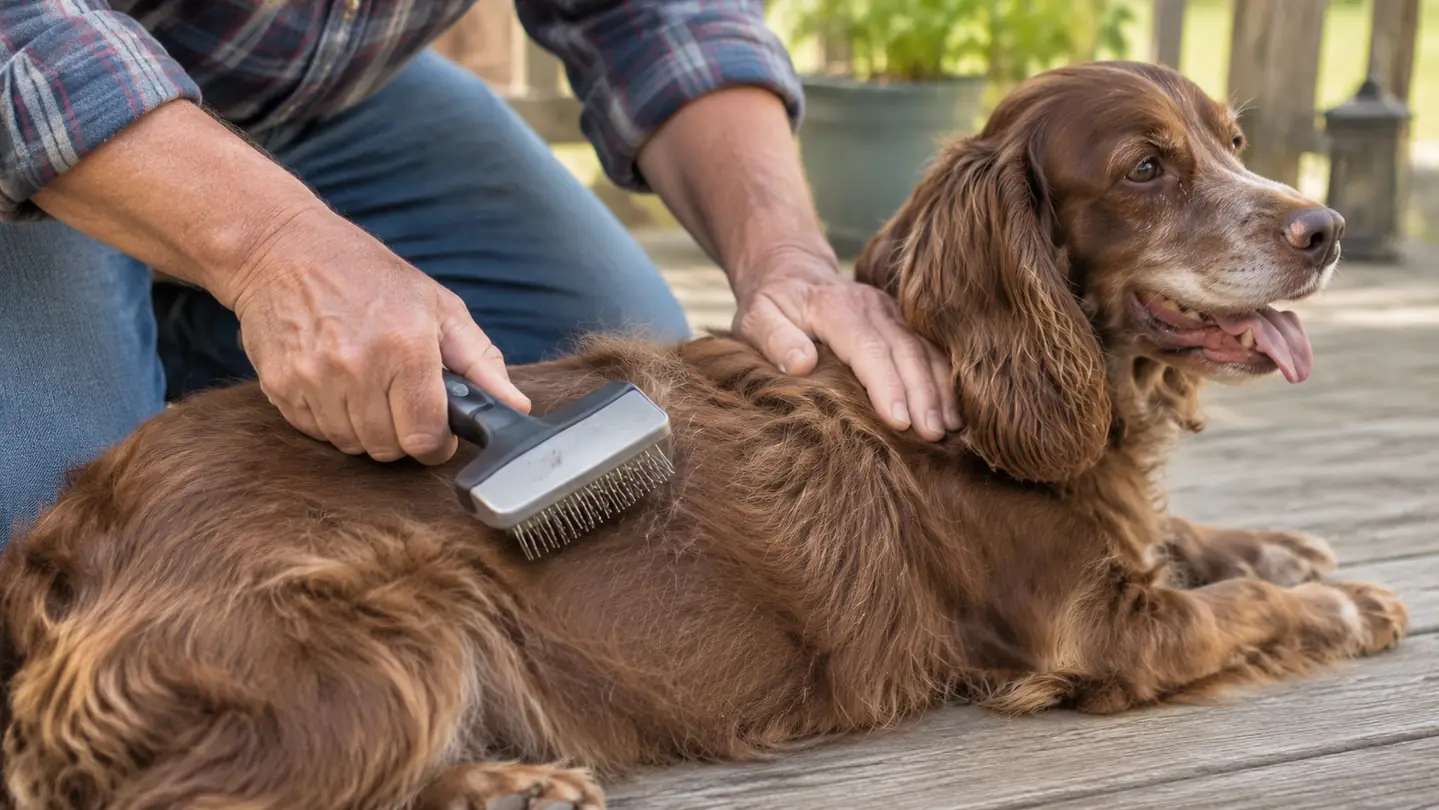
We brush on the back porch, three or four times a week, usually late afternoon when the light is good and I can actually see what I am doing instead of guessing. After a marsh walk it is every single time, because burrs come home with him and I would much rather pull them out on the boards than find them pressed into the living room rug. A session takes me about ten minutes. He lies down, I work in sections, back to front, with the grain and then against it, and then I push the button and knock the hair off the pins.
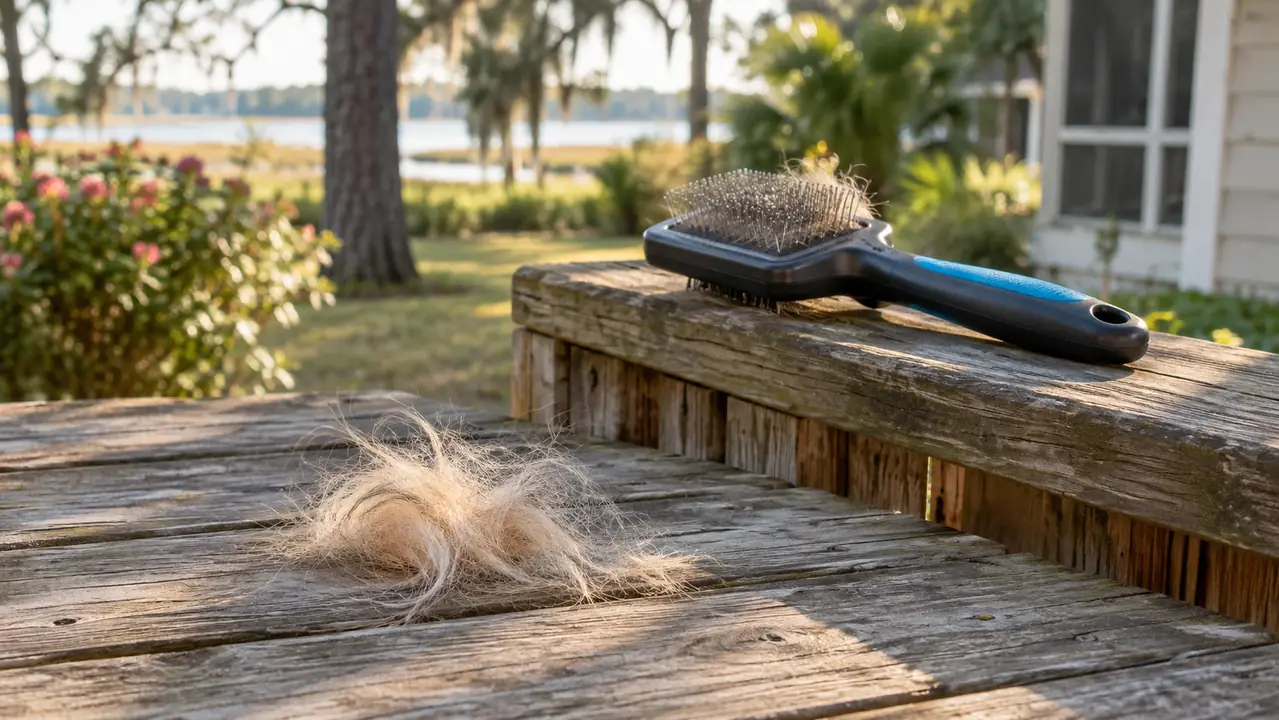
The first session is the one I remember. Three weeks of sweeping my floors, and ten minutes with this brush produced a pile of loose hair the size of a small grocery bag. Not hair I could see on him. Hair that was sitting in the coat waiting to fall. I sat there on the porch with my hand in it feeling mildly annoyed at all the sweeping I had done for nothing.
Size matters more than I expected. The listing gives the brush as about six inches long and a little over three ounces. That turns out to be the right weight for my hand. My wrists are sixty one years old and they complain about everything, and a heavier brush would have me switching hands halfway through a session. It also drops into the basket by my back door without hogging the whole basket, which sounds like a small thing until you have a basket with a leash, a towel and a bag of treats in it.
What the Listing Says, and What That Means on the Porch
I read every label, so here is what the listing actually claims and then what I saw. It says the brush removes loose hair, shedding mats, dander and dirt. The loose hair part I can confirm without any hesitation at all. The dirt part is real too, particularly after a muddy walk in the wet late summer we had. The mats part I would treat gently. A slicker brush is not what you want on a true mat, and if your dog already has one, a groomer is the person to ask, not a librarian with a brush and good intentions.
The listing also says the needles are bent to reach the skin and to promote blood circulation. I cannot see circulation and I am not going to pretend I can. What I can say is that his coat looks tidier and feels smoother after a session, and that he stands still for it, which tells me it does not hurt. That is the whole of my evidence and I am not stretching it any further than that.
It is unscented, which I noticed because I read labels and because strong smells bother me more than they used to. There is no perfume on this thing, and after eight months in a basket with a damp towel, it still does not smell like anything. The listing also names cats as a target species. I have no cat. I cannot speak to that at all, so I will leave it exactly where it is.
Three weeks of sweeping my floors, and ten minutes on the porch pulled off a pile of hair the size of a small grocery bag.
The Cleaning Button, Which Is the Whole Reason I Bought It
The reason I chose this brush over a plainer one is the release button on the back. The listing calls it a one click cleaning button: you push it and the hair lifts off the pins. I have owned enough small plastic mechanisms in my life to be suspicious of all of them, so here is the honest report after eight months of steady use. It works. It works every time, it has not stuck, and it has not jammed.
The caveat is that it does not launch the hair into the trash can. It pushes the hair up into a loose clump sitting on the surface of the pins, and then you pick that clump off with your fingers and drop it in the bin. That is a two second job, not a zero second job. If you were picturing something that disposes of the hair for you while you sip your coffee, adjust your expectations now and you will be happier with it.
What the button does buy you is not having to dig hair out of the pins with a comb or a fingernail, which is the part of brushing I have always hated enough to avoid brushing altogether. My rule for small plastic buttons is that they get used a few hundred times and then quietly quit. This one is still going. If it stops, I will come back and say so, but I am not expecting it to.
Where It Falls Short
The pins are metal and they are not soft. On the bony parts of a dog, over the shoulders, down the spine, along the hips, you have to lighten your hand considerably. Tupelo will move away if I press too hard, and he is right to. This is a brush that rewards a light touch and punishes a heavy one, and if you are the kind of person who scrubs, you will need to unlearn that.
It does nothing for a mat. Nothing at all. If your dog comes home with a mat behind an ear or under a leg, this brush will skate over the top of it and you will both end up frustrated. That is a job for a groomer or a proper mat comb, and a rescue dog in his first months is not the dog to practice on.
The hair goes somewhere. This is the part I did not think through. Brushing a wavy coated dog outdoors means the loose hair blows off the porch and into the yard, which is fine. Brushing indoors means the loose hair blows off the porch and into my living room, which is not. Either way, brush outside if you can, and on a day without much wind if you have the choice, because a stiff coastal breeze will redistribute the whole pile across your steps.
And the largest limitation is not about the brush at all. It is about the coat. Tupelo has feathering on his ears and legs, and a slicker brush does not get everything. I still keep a metal comb for the feathering and I still check behind his ears every week. The brush is one tool in a small kit, not the kit itself, and anyone who tells you a single brush handles a feathered coat completely is selling something.
What I Liked
- Lifts a lot of loose hair in a short session
- The release button has worked for eight months without jamming
- Light enough that a long session does not wear out my wrist
- Unscented, with no perfume to bother a sensitive nose
- Rinses clean and drops into the basket by the back door
Where It Falls Short
- Does nothing for mats, and should not be used on one
- The metal pins need a light hand over bony spots
- The button pushes hair into a clump you still have to pick off
- Loose hair blows around if you brush indoors
- Not a complete routine on its own for a feathered coat
What I Considered Instead
I looked at three things before I bought anything, because I always look at three things and then take a week to decide. The first was a grooming appointment. I did not do it, not because it is a bad idea, but because I wanted to know what I was doing with my own hands before I handed him to a stranger. The second was a deshedding glove, the kind with the rubber nubs on the palm. I have a friend in Savannah who swears by hers. What stopped me is that a glove puts the hair directly onto my hand, and then I have to get it off my hand, and I could picture that going badly in my kitchen with a dog who was still settling in.
The third was a plain slicker brush with no button, which is simpler and has fewer parts to break. I nearly bought that one. What tipped me toward the Depets brush was the release button, because the part of brushing I have always hated is the cleanup, and I know myself well enough to know I would brush him less often if cleanup was a chore. That reasoning held up. Eight months later I brush him three or four times a week without dreading it, and the button is a large part of why.
What I Would Do Differently
Two things. The first is that I would have bought it in his first week rather than his second, because the hair was already on my floor by the time the box arrived and I spent a week sweeping for no reason. The second is that I would have started on the porch from day one. My first session was on the kitchen floor and I spent twenty minutes afterward with a broom and a damp paper towel, learning a lesson I could have avoided with one look out the window.
The thing I would not change is starting short. Ten minutes, then stop, then a treat. He was a little anxious in those first weeks and a long grooming session would have been too much for a dog still learning what my house sounded like at night. Short and frequent worked for us. Your dog may be different, and if yours is sore, or flinches, or suddenly will not let you near a spot he used to tolerate, that is a question for your vet and not for me.
Who This Is For
This is for the person who just brought home a dog with a coat they have never dealt with, standing in an aisle or staring at a search results page feeling mildly overwhelmed. A brush like this is a sensible first purchase. It handles the daily loose hair job, the button means you will actually use it, and it is a small commitment next to a grooming appointment. It is also for the household where the hair on the floor has become a running complaint. That was my house in March.
I am not going to tell you it eliminated the sweeping, because it did not, and I would not believe anyone who told me a brush did. It cut the sweeping back enough that I stopped noticing it, and that was the goal. If your floors are the thing driving you up the wall, this is a reasonable place to start.
Who Should Skip It
Skip it if your dog has a coat that mats easily, or if you are already dealing with a mat right now. A slicker brush is the wrong tool for that job, and working over a mat with one is a good way to teach a dog to hate being touched. Ask a groomer what that coat actually needs before you spend anything.
Skip it too if your dog will not tolerate brushing yet. Tupelo leaned into it from the first session and I know exactly how lucky that is. If your dog flinches, the answer is shorter sessions, more treats and more patience, not a different brush. And if you notice sores, redness, or a dog who suddenly will not be handled, that is a vet question, full stop, from a woman who is neither a groomer nor a veterinarian.
Eight months in, it still lives by my back door
The Depets brush has done the job I bought it for, on a wavy coat, three or four times a week, without a single jammed button. If that is the job you need done, it is a sensible place to start.
Amazon Check Today's Price on Amazon →