

Tupelo came home on a Saturday in mid March 2026, and by his second week with me his coat had started turning up on my floors. Not in clumps. In a slow drifting way, like somebody had been flicking a paintbrush dry in every room of the house. He is a Boykin Spaniel, about 32 pounds, with a liver brown coat that has a little wave to it, feathering on the ears and the backs of the legs, and a docked tail. I had gone twelve years without a dog, and I had never groomed a wavy coat in my life. Duke, my old Lab mix, had a short coat you could wipe down with a damp towel and call it done.
So I did what I do with everything. I read the labels and I read the listings, and in late March 2026, his second week home, I bought the Depets self cleaning slicker brush. Eight months later it lives in a basket by my back door and I use it a few times a week, always after a marsh walk. The listing says the stainless steel pins have a 60 degree bend, and that a one click cleaning button pushes the collected hair off the pins. That is the whole thing. No cord, no batteries, no app to set up. What follows is the order I actually do it in, including the part I got wrong for the first two weeks.
The brush that finally got the marsh burrs out of Tupelo's coat
The Depets self cleaning slicker brush has been in the basket by my back door since late March 2026. Stainless steel pins with a 60 degree bend, and a button that lifts the collected hair off in one press.
Amazon Check Today's Price on Amazon →My first attempts were bad, and I want to describe them so you can skip them. I brushed him the way you dust a shelf, quick back and forth strokes over the top of his back. Two things went wrong at once. Almost nothing came off him, because a wavy coat holds loose hair down inside it and a fast surface stroke never reaches it. And I taught him that brushing was a thing that happened to him, fast and a little rough, with no warning and no end point. He started leaving the porch when he saw the brush come out of the basket.
Step 1: Pick the moment before you pick up the brush
The biggest improvement in our routine had nothing to do with technique. It was timing. I brush Tupelo after a walk, once he has spent his energy on the boardwalk and the smells along it, and he is content to stand still on the porch. I do not brush him when the mail carrier might come, when the neighbor's dog is out in the next yard, or right before dinner. A hungry, alert spaniel is not a cooperative spaniel, and I learned that the hard way in April.
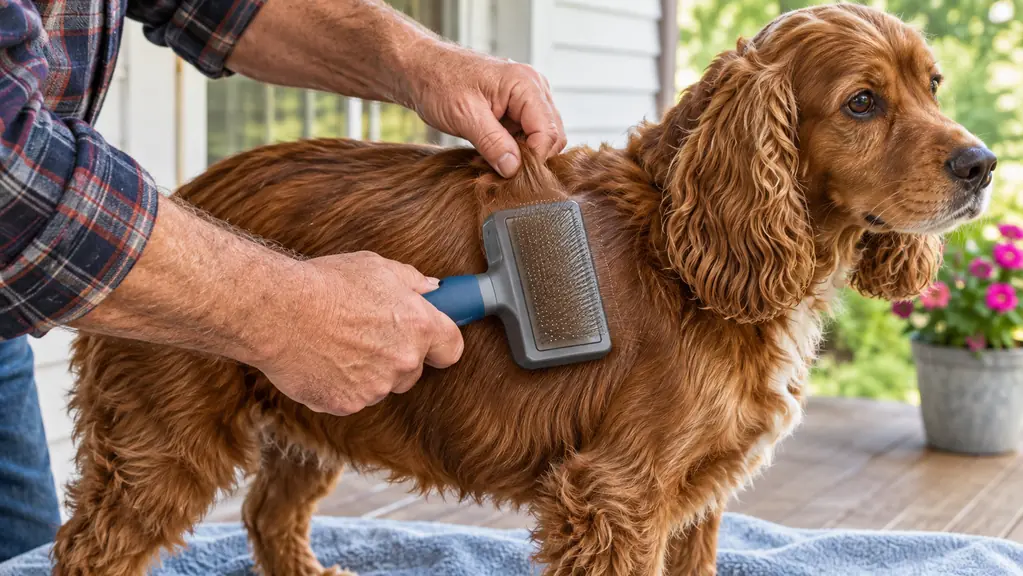
The setup is four things and it takes about a minute: the brush, an old bath towel on the porch floor, a small bowl of treats, and a door I can close. The towel matters more than you would think, because the hair comes off in drifts and you can fold the towel up and shake it out over the yard instead of sweeping your kitchen twice a day. I spread the towel, I set a treat on it, and I let him walk onto it himself rather than lifting him. That one choice, letting him step onto the spot instead of being placed on it, seems to be the difference between a dog who tolerates brushing and a dog who stands for it.
Keep the early sessions short. Mine were about five minutes for the first couple of weeks. If he stepped away, I let him go and we tried again the next day, because a fight over a brush is a fight you only have to have once to lose the whole habit. He is very food motivated, so a treat every thirty seconds or so kept him there. He now stands for ten or fifteen minutes on the porch without much bribery, though I still keep a few in my pocket.
Step 2: Read the coat, then work in sections
A wavy coat is not a smooth coat and it is not a curly one either. On Tupelo, the hair lies down along the back and the sides, gets longer and softer at the ears, the chest, the backs of the legs and the tail, and gets shorter and tighter on the muzzle and the feet. Sit with your dog once and just look at which way the hair grows. On most of the body it grows back toward the tail. On the ears and the leg feathering it simply hangs.
Then divide the dog into sections and do one section at a time, the same sections in the same order every session. Mine are the left side, the right side, the chest and the front, the back end and the tail, and the ears last. Same order, every time. He learned the order before he learned to like the brush, and now he stands for the side sections because he knows the ears come last and the ears mean we are nearly finished.
Inside each section, do not scrub. Take a strip of coat about as wide as your hand and brush it in the direction the hair grows, from the skin outward. Then part that hair with your free hand, lay it forward out of the way, and brush the next strip behind it. Groomers call this line brushing. It is the only reason I get anything off him. A stroke over the top of the coat just rearranges the hair into a tidier version of the same loose hair.
Step 3: Let the pins do the work, not your wrist
This is the correction I had to make on myself. I was pressing hard, on the theory that pressure gets more hair out. It does not. It just makes the dog leave. The pins are thin and there are a great many of them, and they do the work if you let them reach the coat. Light pressure, short strokes, and let the brush travel through the hair instead of dragging across the top of it.
The pins on the Depets brush are set at a bend rather than sticking straight out, and I found that the bent pins get down under the top layer of a wavy coat with far less push from me. You can test that on your own forearm before you ever use it on your dog. Run it down your arm with light pressure. If the pins scratch, you are pressing too hard, and that is exactly the pressure that makes a dog flinch away from his own shoulder.
One more thing about a coat with a wave to it: brush when the coat is completely dry. If you brush a damp coat, the hair clumps and the brush drags and pulls, and pulling is what convinces a dog that the whole business is something to be avoided. After a marsh walk I towel him off and we do something else. The brushing happens the next morning, when he is dry and has had his breakfast.
The first week I brushed him I filled the brush three times and still found hair on the rug. The brush was not the problem. My strokes were.
Step 4: Clear the brush every few minutes, not at the end
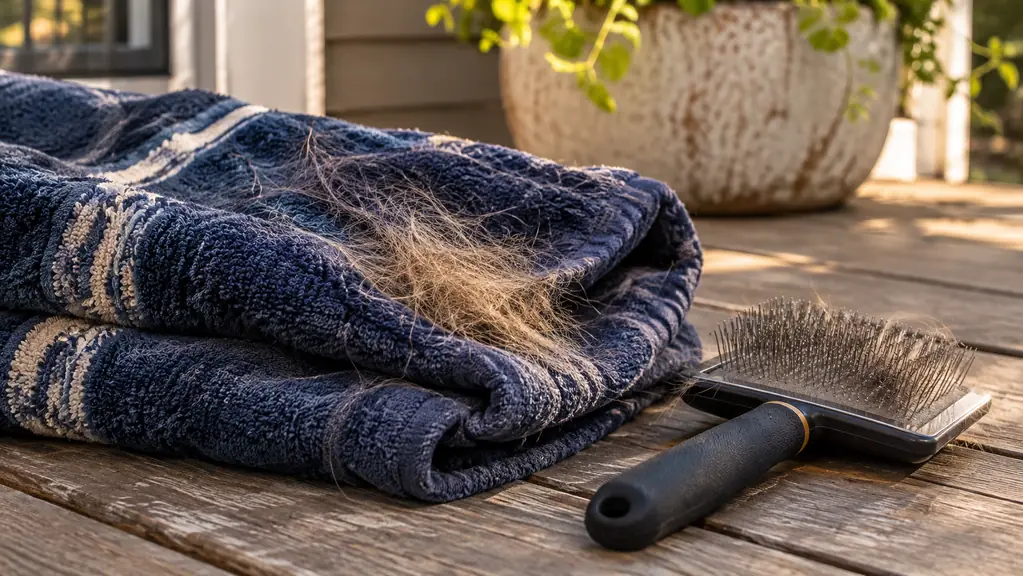
A slicker brush that is full of hair stops doing its job. The pins stop reaching the coat and start pressing the loose hair back down into it, which is the opposite of what you came out to the porch to do. I clear mine after each section, so four or five times in a session, and it takes about a second each time.
There is a button on the back of the head. You press it and the collected hair lifts up off the pins in a small flat pad, and you drop that pad in the trash. That is the entire cleaning process. It is also the reason this brush stays in a basket by the door instead of in a drawer, because a brush I have to pick clean with my fingers is a brush I would have quietly stopped using by the second week. The listing calls it a one click cleaning button, and that is precisely what it does. Mine has not jammed in eight months of steady use, and I have pressed that button a great many times.
Step 5: Do the trouble spots last, and know when to stop
The places that mat on a wavy coat are predictable. Behind the ears, under the ears where the ear leather rubs, behind the front legs where a harness sits, the chest feathering, the backs of the thighs, and the tail. Do those last, once the dog is already standing comfortably and the easy work is done. On Tupelo the spot behind the front legs is the one that needs attention, because that is where his harness rests on every walk.
Here is where I stop, and where I would tell you to stop. If you find a mat that is tight against the skin, do not dig at it with the brush. Working a hard mat pulls skin and hurts, and it is one of the reliable ways people teach a good dog to snap at a brush. Do not reach for scissors either, because it is easy to catch skin in a mat and there is soft skin under all that coat. A tight mat is a groomer's job. On Tupelo it has not come to that, and I think the reason is that I brush a few times a week instead of waiting for the coat to tell me it is time.
The other stop signal is the dog himself. If he pulls his ear away, licks his lips, yawns, or shifts his weight off the side you are working on, he is telling you he has had enough well before he says it any louder. I stop at the first one. Five short good sessions in a week beat one long bad one, every time, and it has taken me eight months to be able to say that from experience rather than from something I read in a pamphlet at the feed store.
What Else Helps
Brushing is one piece of it. The rest of what has worked at my house: a quick towel rubdown after every marsh walk, before the burrs and the sand work their way into the coat, and a bath when the coat starts to feel tacky instead of soft. The listing for this brush names deshedding and conditioning among its uses. The conditioning part is real in a small way, because a coat that has been brushed out properly holds less marsh and dries faster afterward.
Keep a routine rather than a marathon. Tupelo gets brushed three times a week in the cooler months and more often in spring when the coat lets go. I keep the brush by the back door where I will see it, which sounds like nothing at all but is the entire reason it gets used. I also keep a plain wide tooth comb in the same basket for the feathers on his ears, and I will say plainly that the slicker brush is the tool I reach for, because it is the one that gets down to the skin without me having to press.
And the part I am not qualified to answer: if your dog's skin is red, if he is chewing at one spot, if there is a bald patch or a rash under the coat, that is a question for your vet and not a question about brushes. I am not a vet, a trainer or a groomer. I am a retired school librarian with one spaniel, a fenced back yard, and a basket by the back door.
Eight months in, it is still the brush by my back door
If you are starting from nothing the way I was in March, this is the one I would buy again. A few minutes on the porch three times a week, cleared with the button after every section, and the floors stay a good deal cleaner than they were in his first week home.
Amazon Check Today's Price on Amazon →