
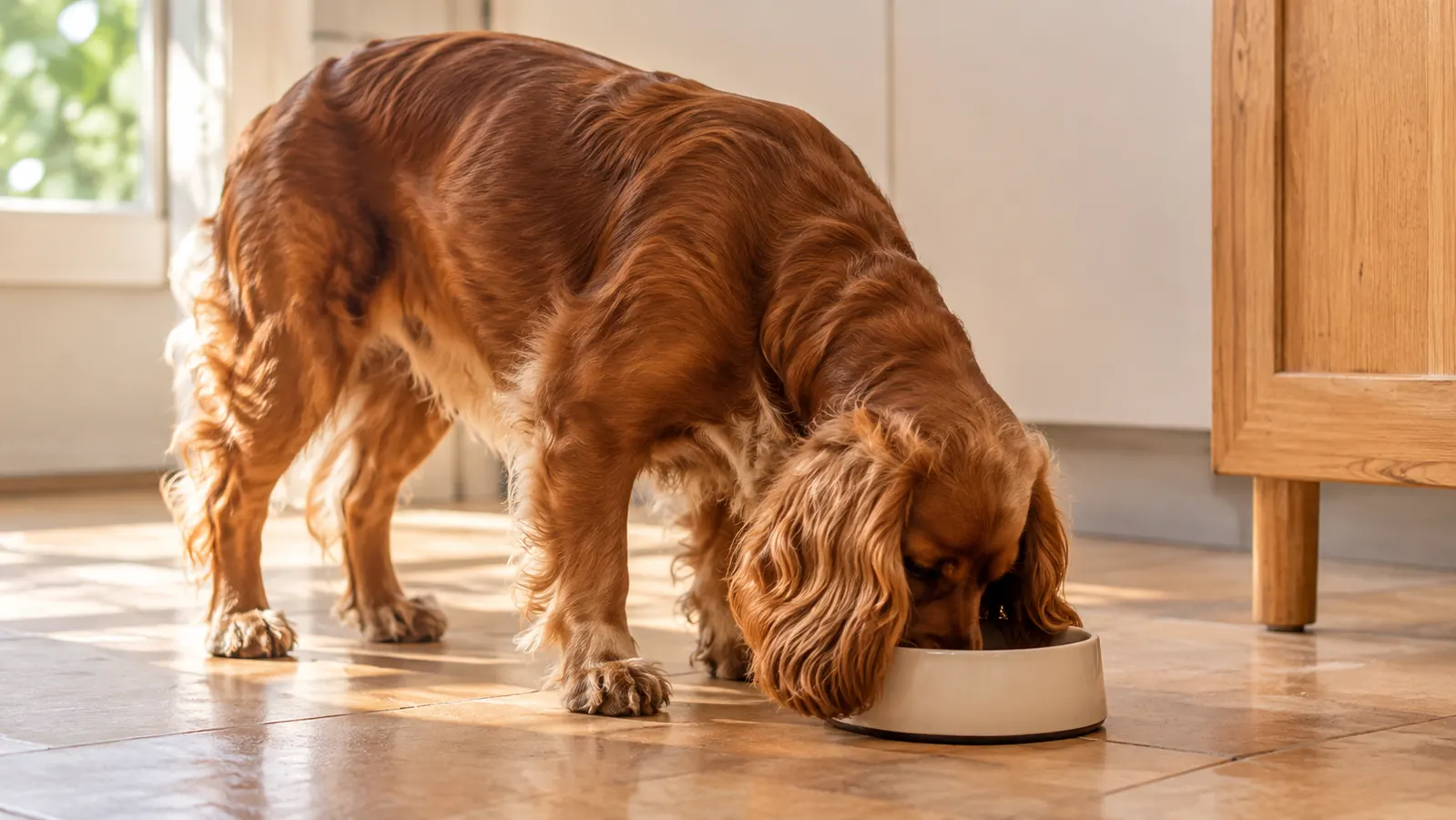
Tupelo came home on a Saturday in the middle of March, and by Sunday night I knew two things about him. He was as sweet as could be. And he ate like the food was about to be taken away from him. I set his bowl down at six o'clock. By 6:01 he was licking the linoleum. He swallowed so fast I could hear him pulling in air, then he stood and looked at me as though I owed him a second dinner.
I had no dog gear at all when he arrived. I gave away everything of Duke's back in 2014 and never replaced a thing, so my first week with Tupelo was one long shopping list on the back of an envelope. A bowl went on that list and I bought a plain one. Two dinners was all it took to see that a plain bowl was the wrong tool for this dog. The Outward Hound Fun Feeder Slo Bowl arrived in his second week, after I asked my vet at his arrival checkup whether a slow feeder was worth trying. She said it was reasonable, and that it would not hurt him.
Fifty seconds is not a meal. Here is the bowl that made dinner take longer.
The Outward Hound Fun Feeder Slo Bowl in the medium Notch pattern holds two cups of dry or wet food and goes in the dishwasher. It is the only food bowl in my kitchen.
Amazon Check Today's Price on Amazon →Step 1: Time one meal with a clock in front of you
Before I bought anything, I got a number. I sat on the kitchen floor that Sunday with my phone in my hand and watched him eat. From the moment the bowl touched the tile to the moment he walked away was fifty seconds. Fifty. I had been telling myself I had a quick eater. What I had was a vacuum cleaner with ears.
Write your number down. And while you are down there on the floor, write down the other things you see. Tupelo came up for air twice. His sides moved in and out like a bellows. He looked at the empty bowl, then at me, then back at the bowl. He also, some evenings, brought a little back up afterward, and that is a question for your vet, not for me. I am a retired school librarian. I am not a veterinarian and I will say so in every note I write on this site.
The number matters because it is what you will compare against in a couple of weeks. Without it you will be judging the bowl by how you feel about the bowl, and I have done enough of that in my life to know how it ends.
One more thing about that first measurement. Take it on a normal evening, not a rushed one, and not right after a long walk when he is still wound up. I took mine on a quiet Sunday, and every one since has been at six o'clock on a weekday, so I am comparing like with like.
Step 2: Ask your vet before you buy a bowl, not after
I got this right by accident. Tupelo had a checkup the week he arrived, and I brought a list of small worries on an index card. Gulping was second on it, under a question about his ears. My vet weighed him at thirty two pounds, listened to his chest, and said he was healthy. Then she said a slow feeder bowl was a reasonable thing to try.
I am putting this ahead of the shopping for a reason. Fast eating gets talked about online as though there is one answer, and there is not. Some dogs eat quickly and are perfectly fine. Some eat quickly and bring it back up. Some have something going on that no bowl will touch. Your vet is the person who can tell the difference for your dog. Mine told me what was reasonable for Tupelo. Yours will tell you what is reasonable for yours.
What she did not do was promise me a result, and I have tried to keep that word in mind ever since. She said it was worth a try. That is the most any bowl can honestly offer, and I would be suspicious of anything that offers more.
Step 3: Match the bowl to the meal first, then to the dog
The Outward Hound Fun Feeder Slo Bowl is a shallow plastic bowl, eight and a half inches across and two inches tall, and the medium holds two cups. That mattered here, because Tupelo is a medium sized dog at thirty two pounds and his dinner fits in it with room to spare. A deep bowl he had to jam his muzzle into would have been a different problem from the one I was solving.
The working part is the maze. The Notch pattern puts raised dividers through the middle of the bowl, so a dog cannot get his mouth around a mouthful and be done with dinner. He has to push the kibble along the channels with his tongue to get at it. The listing says the bowl can slow eating by as much as ten times. I cannot vouch for ten times in anyone else's kitchen. I can tell you exactly what it did in mine.
Something to know before you order, because I did not know it. The listing offers three levels, Slow, Slower and Slowest, and those are three separate bowls, not a setting you turn. I bought the Slow level in the medium size. It has been right for Tupelo, who is enthusiastic but not frantic. A dog who is more determined, or a small dog who gets cross when food is hard to reach, might do better at a different point on that scale.
It is also worth measuring your dog's dinner rather than eyeballing it. Two cups is the capacity, and knowing how much of that space his meal actually takes tells you whether the maze has anything to work with. Half a cup rattling around the bottom of a two cup bowl is a different experience from a full one, for the dog and for you.
Step 4: Change bowls at an ordinary meal, not a special one
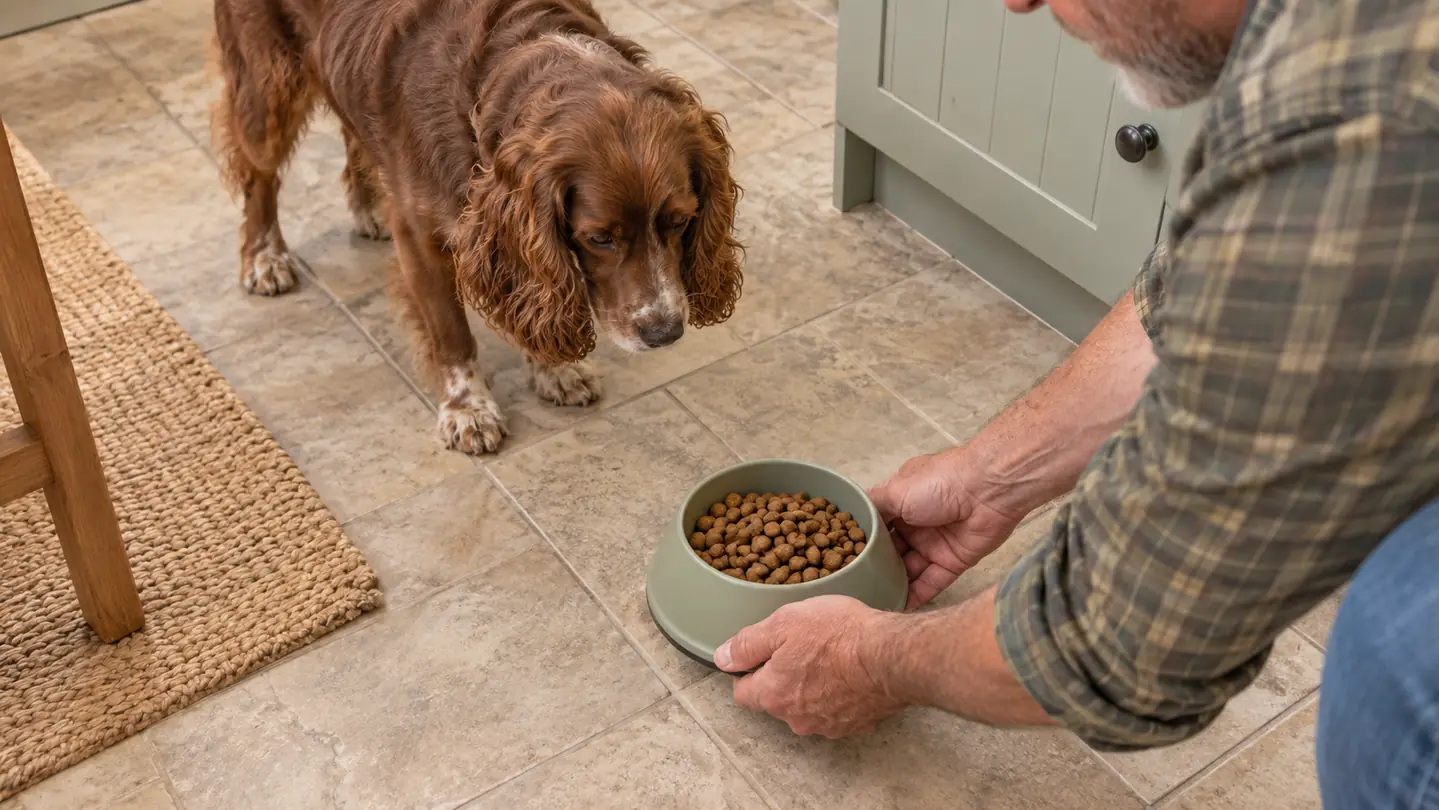
I made this bigger in my head than it needed to be. I read about gradual transitions and pictured a week of mixing bowls and coaxing. In the end I set his dinner down in the new bowl on a Tuesday and stood back.
The first meal he nosed at the dividers, licked around the outer edge, and then worked out that his food had gone into the channels. After that it was business as usual. He has never turned down a meal from it. If your dog does hang back, do not make a production of it. Put the bowl down, take a few steps away, and give him a few minutes to work it out. Standing over a nervous dog while he solves a puzzle is not a kindness.
Keep everything else the same. Same spot, same time, same food. The bowl should be the only new thing in the room, or you will not know which change made the difference when something does change.
Step 5: Wash it, check it, and get the clock out again
This one goes in the dishwasher. I run it through most evenings and it comes out looking the way it did the day I unwrapped it. Between washes I rinse it, partly for hygiene and partly so I can see the plastic clearly.
Which is the other half of that step. It is plastic, and a chewer will test plastic. Tupelo chewed a great deal as a youngster. I check the dividers every week or so for rough edges or bite marks. I have not found any on this bowl, but I look, and if I ever found a rough edge I would replace it rather than let him keep working at it. A bowl is not worth a cut tongue.
Then time a meal again, the same way you did on day one. Two weeks in, mine had gone from fifty seconds to somewhere near four or five minutes, and on a good night longer. He still eats with real enthusiasm. He just eats with a little more patience, and the gulping sound I used to hear at six o'clock is not a sound I hear anymore.
When I Knew It Was Working
I knew within the first week, and not from the clock. I knew because he stopped standing over the empty bowl staring at me. He would finish, lick his chops, wander into the living room, and get on with his evening. That sounds like nothing. In March it felt like the difference between a dog who was braced for something and a dog who was settled.
The clock confirmed it later. A month in he was still in that same four to five minute range, and it has not crept back up. He is not a slow eater now and I would not describe him as one. He is simply no longer in a race, and that was the thing I was after.
He used to be finished before I had straightened up from setting the bowl down. Now I start the coffee and he is still working at his dinner when the pot is full.
Where It Falls Short
It is light, eight ounces, and a determined dog can move it. Tupelo nudges it an inch or two across the tile when he gets going at the edges. It does not bother either of us and I have not felt the need to do anything about it, but if you have a dog who pushes a bowl across the room, you should know that going in.
The other thing is the cleaning. The channels hold a little kibble dust, and if you feed wet food you will be rinsing it more often than I do. It is dishwasher safe, which is the reason I am not complaining. But it is not a wipe and go bowl. It has corners.
And one honest note on the whole idea of it. A slow feeder changes the shape of a bowl. It does not teach manners and it does not undo a habit. Tupelo still eats with his whole heart. He just takes longer to do it.
What Else Helps
The bowl was the largest piece for us, but it was not the only piece. The simplest one is to feed him alone and feed him somewhere quiet. Tupelo eats in the kitchen, and I stopped standing in there chatting at him while he ate. A dog who thinks someone might take his dinner will eat faster, and I was the someone making him think it.
The second is water. Some fast eaters drink just as fast, and a large gulp of water straight after a large gulp of dinner is how some dogs end up uncomfortable. I asked my vet about that too. What she told me was to keep water available and not let him tank up immediately after a meal, especially after he has been running. That is as specific as I am willing to be on it. It is a question about your dog's body and I am not qualified to answer questions about bodies.
The third is a different kind of slow feeding altogether. A snuffle mat spreads loose kibble through fabric strips and makes a dog hunt for it, which is quieter work than a maze. I have looked at them and have not bought one, mostly because I have one dog, one kitchen, and a bowl that is doing the job. If your dog finds a maze frustrating rather than interesting, a mat is the other road, and there is nothing wrong with taking it.
The fourth is to split the meal. Half at six, half at eight, if your vet is happy with the total amount for the day. I did this for a few weeks early on and it helped more than I expected, though it did mean Tupelo began watching the clock around seven thirty like a small brown foreman.
And the last one is patience with yourself. I ate too fast as a girl and my mother used to tell me to put my fork down between bites. It never fixed me. I would not expect a bowl to fix a dog. What it did was give Tupelo something to work at, so dinner lasted long enough to be a meal instead of a swallow. That was all I was after, and it worked for us.
One bowl, two cups, and a dinner that takes longer than a minute
The Outward Hound Fun Feeder Slo Bowl in the medium Notch pattern is still the only food bowl in my kitchen. It holds his whole dinner, it goes in the dishwasher, and after eight months of daily use it looks like it will be here longer than I need it to be.
Amazon Check Today's Price on Amazon →