

Tupelo came home on a Saturday in the middle of March, and by Sunday evening he had already formed a strong opinion about my living room. He circled the sofa. He circled the rug. He stood in the kitchen doorway and looked at me as if I had forgotten to mention where he was supposed to sleep. I had gone twelve years without a dog. Everything of Duke's went to the shelter back in 2014, so there was no worn bed in a closet, no blanket that smelled like a dog, nothing.
What I did not understand that first weekend, and understand now, is that a new dog does not need to be taught how to sleep. He needs to be shown where. A dog walks into a strange house with no map of it, and a soft place in a busy corner is not obvious to him the way it is obvious to us. So the job is not training, exactly. It is pointing, then repeating the point until it sticks. The Bedsure orthopedic bed in Medium was where I did my pointing, and it is the bed he still uses every afternoon.
The bed he chose in his third week is the same one he is on today
The Bedsure orthopedic bed in Medium, 28 inches long, foam filled, with bolsters on all four sides and a cover that unzips. It has sat by my sliding door since April and has not moved.
Amazon See today's price on Amazon →Before Step One: Get the Size Right
The bed I bought for Tupelo is the Bedsure orthopedic bed in Medium. The listing gives it as 28 inches long, 23 inches wide and about 6.5 inches thick, with a foam fill and a bolster running around all four sides. It weighs about five pounds, which matters more than I expected. A light bed is one a dog can step into without the whole thing skating out from under him on a wood floor.
The listing also puts the maximum weight recommendation at 30 pounds. Tupelo is about 32. I did not read that line until the box was already on my porch, and I spent a week waiting for the foam to flatten under him. It has not. Eight months of daily use and the middle still comes back up when he steps off. I am not telling you to ignore a weight limit. I am telling you what happened in my house with a dog right at the edge of one. If your dog is well past 30 pounds, look at the next size up.
The other thing I got wrong at first was measuring. I ran a tape along Tupelo while he was lying down, which gave me a number that had nothing to do with anything. Stand the dog up. Measure from the base of his tail to the front of his chest, then add a few inches so he can stretch out. Tupelo measured near the top of the Medium range, and he sleeps curled with his chin on the bolster most of the time, so it suits him. A dog who sprawls flat on his side needs more room than a dog who curls.
Step 1: Put It Down Before He Picks a Spot Himself
I set the Bedsure bed down in the living room by the sliding door to the back yard, where the afternoon sun comes in, on the Tuesday before Tupelo arrived. It was there, in that spot, when he walked through the door on Saturday. That mattered more than anything else I did. He never had to wonder where the soft place was, because the soft place was already in the room with the people in it.
Where you put it decides how much use it gets. A bed in a back bedroom is a bed for a dog who already likes his own company. A bed in the room where you sit in the evening is a bed for a dog who wants to be near you, which is most new dogs in the first month. Mine sits about eight feet from my reading chair. He can see me and I can see him, and neither of us has to get up to check.
Then leave it there. This is the part I got wrong, because for the first week I kept nudging it a few inches one way or the other to keep it out of the walkway, and every time I did, Tupelo looked at it as though it were a new object he had never met. Dogs read position. Choose a spot that will not need to move, and then do not move it.
Step 2: Make It Smell Like Him, Not Like the Store
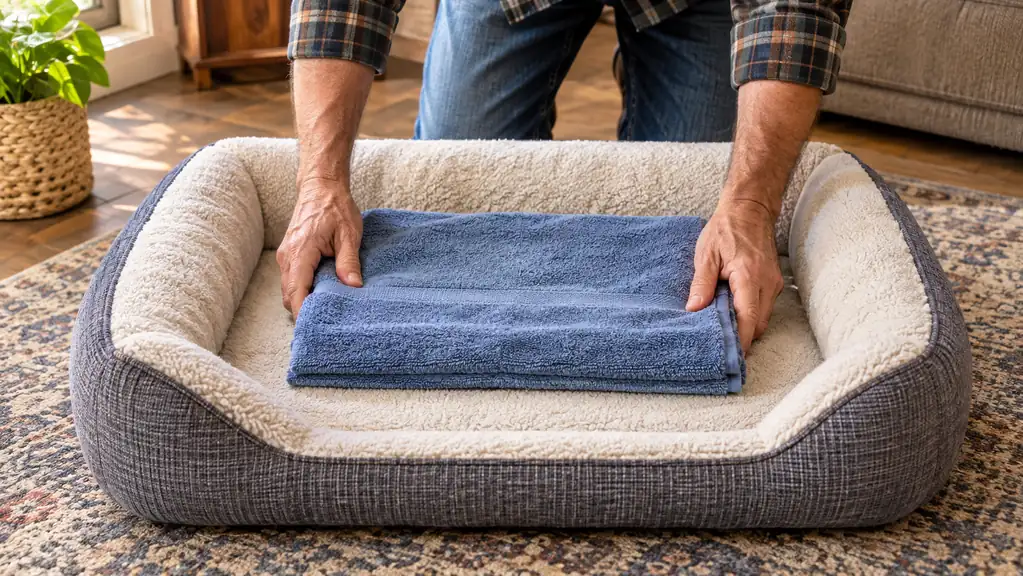
A bed out of a box smells like a warehouse. Tupelo sniffed his once, sneezed, and went back to the sofa. What fixed it was a towel I had rubbed over him after a walk, the one that came home smelling of marsh and dog. I folded that towel flat on the bed and he was on it inside ten minutes.
Anything that already carries his own smell will do. A towel, a blanket he has lain on, the cloth from his crate. What I would not do is put an old shirt of mine in there in the first week, because a young dog who is still mouthing everything will treat a loose piece of fabric as something to chew, and then you have taught him that the bed is for shredding. Tupelo was a chewer at that age and he did take one corner of the bolster in those early weeks. The cover held together, and I will come back to that.
Once he was using the bed, I took the towel away after a week or so. He did not need it anymore and it was collecting hair. The towel was never the point. The point was giving him one reason to lie down on a strange new thing.
Step 3: Pay Him for Standing On It
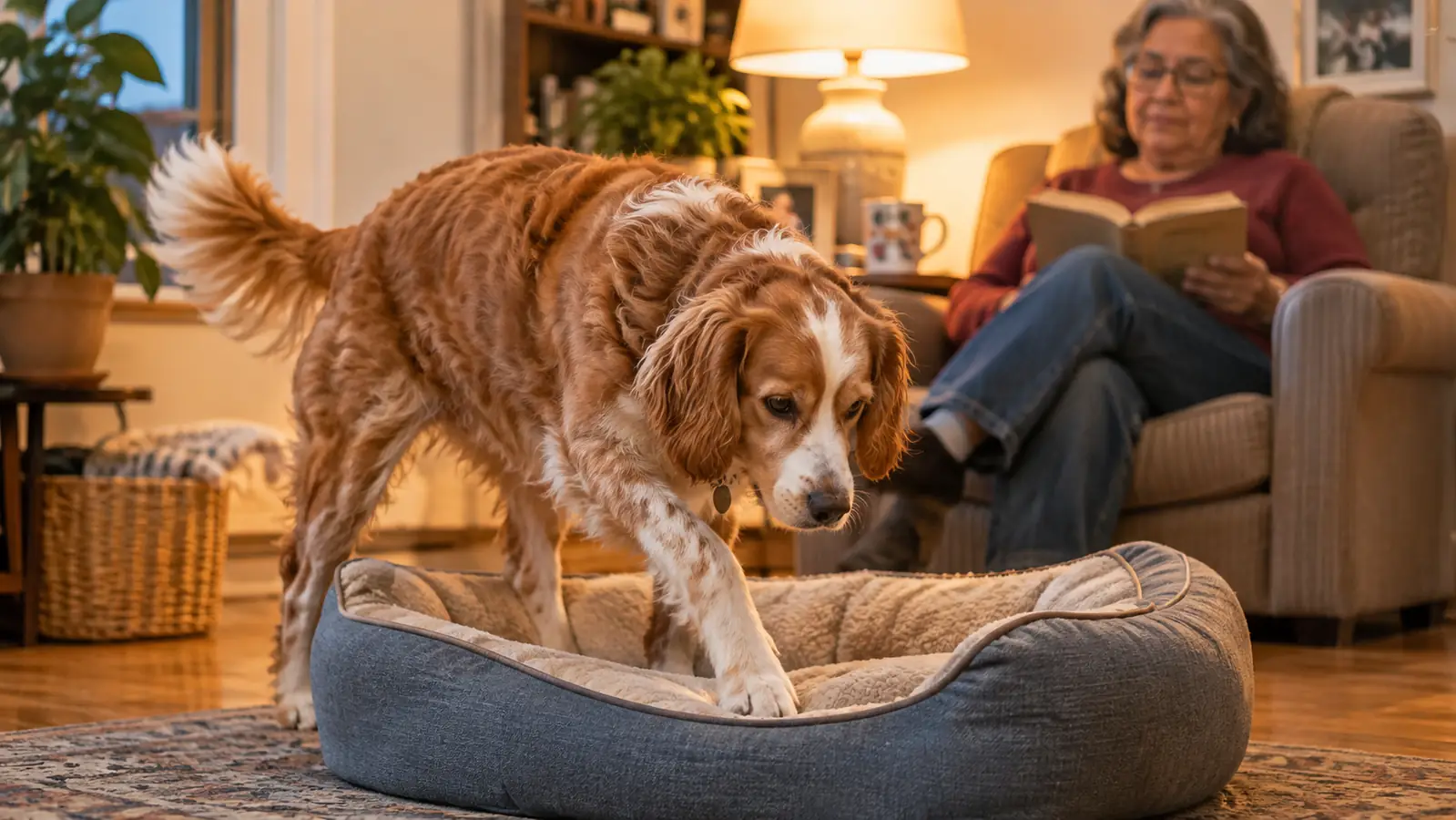
Tupelo will do a great deal for a piece of kibble, and I used that without shame. Every time he walked over to the bed, I dropped a piece of his dinner on it. Not for lying down, at first. For sniffing it. Then for putting one paw on it. Then for climbing in. The whole sequence took about four days and maybe twenty pieces of food.
The mistake people make here is waiting for the finished behavior before rewarding anything. A new dog has no idea what you want. Reward the step before the step before. Sniff, then paw, then all four feet, then lying down. It moves fast once he works out which object is the one that pays.
Two things to avoid while you are doing this. Do not put food on the bed and walk away, because a dog who guards food will start guarding the bed, and that is a harder problem than the one you began with. And do not lure him onto the bed and then close a door or leave the room. He learns that the bed is where good things turn into being trapped, and he will not go back to it.
Step 4: Stop Calling Him Off It
For my first two weeks with him I kept moving Tupelo off the bed, because I wanted to walk past, or because I thought he ought to be in the crate. Every one of those was a small tax on the habit I was trying to build. If the dog finally chooses the bed and the first thing that happens is being shifted, he learns that the bed is a placeholder until a person needs the floor.
So let him be. Step over him. Move your chair. If you do have to move him, do it slowly and set him back down on the bed rather than on the floor, so that being moved is not the same as being evicted. That sounds fussy and it is, and it took me about a week to stop doing it. That week was the week he started going to the bed on his own with no food involved.
The other half of this is that the bed cannot double as the place he goes when he is in trouble. If it is ever the spot where he gets scolded or shut away, it stops being the place he chooses. I have a crate for the times I need him contained. The bed is only ever a good place to be.
Step 5: Keep the Spot and the Routine Boring
A new dog's first month is a run of changes. New house, new sounds, new food, a vet visit, a harness he has never worn. The fewer things that move, the faster he settles, and a bed is one of the easiest things in the house to hold still. Mine stayed by the sliding door through all of it. Same corner, same blanket underneath, same stretch of afternoon when the sun came across it.
What did move was the cover. The Bedsure cover unzips and comes off, and I have washed it several times since April, usually after a marsh walk when he has come home damp and gritty and gone straight to the bed. That is the practical reason I would not buy a bed with a cover that does not come off. A dog bed you cannot wash is a dog bed that ends up in the garage.
The bolster corner he chewed in those first weeks is still there eight months on, a little flattened at the seam. I thought about replacing the bed and then thought again, because he is attached to that corner and the foam has held. If your dog is a serious chewer, though, I would not leave him alone with any soft bed until you know what he does with it. Tupelo outgrew it. Some dogs do not.
What Else Helps
The bed was one part of it. The other parts were the things that made the rest of his day predictable, and I think they work for the same reason. The crate in the corner of the living room, door open during the day, gave him somewhere that was his alone. The harness with the front clip made our morning walks calm enough that he came home tired instead of wound up. The slow bowl in the kitchen turned dinner from a thirty second event into something that took him a while.
I am not a trainer and I am not a vet, and none of this is advice about behavior problems. If your dog paces for hours, cannot settle anywhere, or seems frightened in the house, that is a conversation for your vet, and possibly for a trainer who can watch him in your actual kitchen. What I am describing is an ordinary young dog in a new house and the ordinary things that helped him stop circling my sofa.
One more thing helped, and it surprised me. I stopped watching him. For the first week I hovered every time he went near the bed, and he would stand up and follow me instead. When I finally sat down with a book and ignored him, he got on the bed and went to sleep. If you have a dog who will not settle, try being boring for an evening. That worked better in my house than anything I bought.
The job is not teaching a dog to sleep. It is pointing at a soft place in a busy room and then leaving it, and him, alone long enough for the habit to take.
Eight months on, the chewed corner has held and the foam still comes back up
The Bedsure orthopedic bed in Medium, 28 inches long, foam filled, with a cover that unzips and washes. It sits by my sliding door and he is on it most afternoons.
Amazon Check today's price on Amazon →