
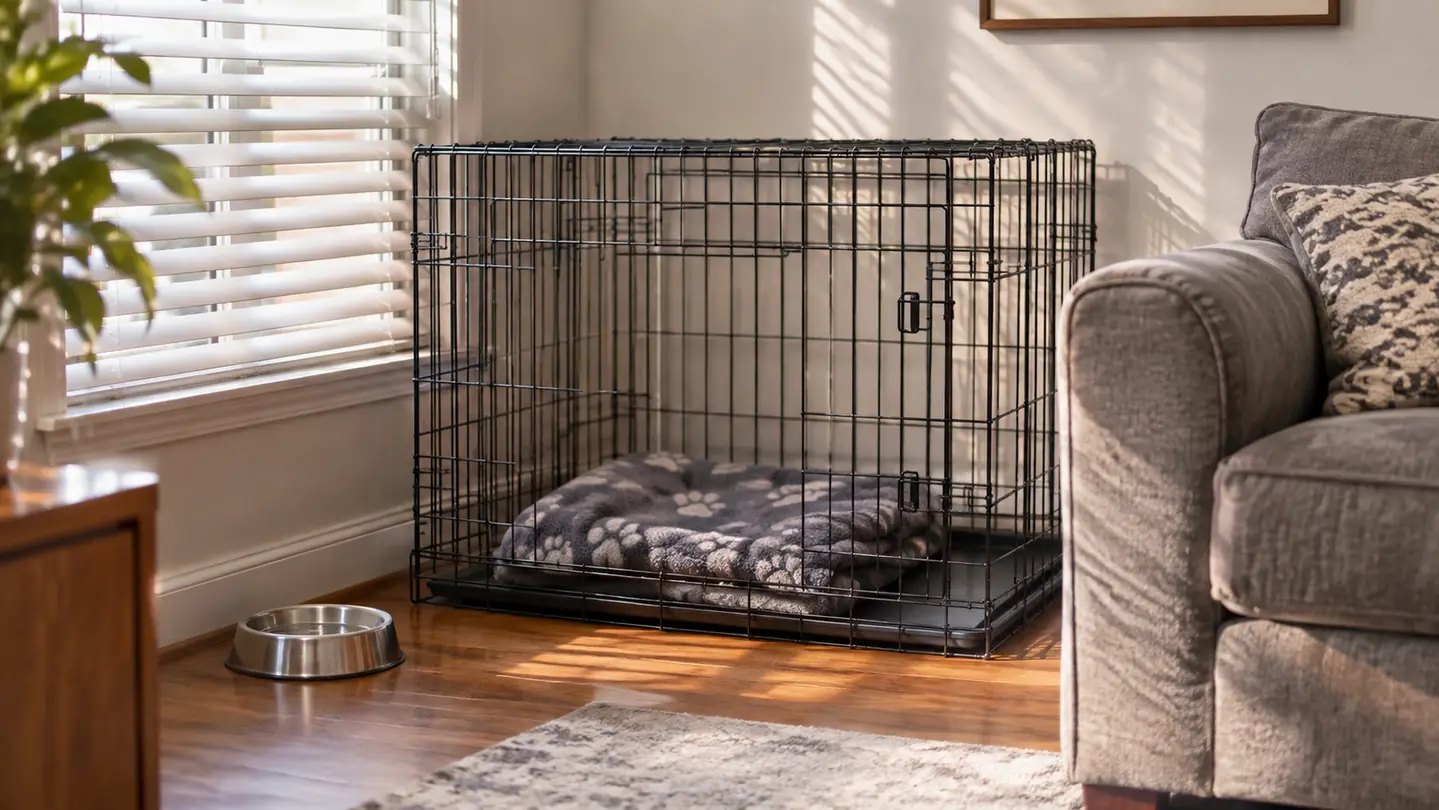
When Tupelo came home on a Saturday in mid March 2026, he was about 14 months old, 32 pounds, and all ears and nerves. He is a Boykin Spaniel from a regional rescue, and he had spent the previous week in a foster house with three other dogs. My house was quiet. I had lived without a dog since Duke died in 2014, and I had given all of Duke's things away that same year. So the crate in the corner of my living room was not a hand-me-down. It was the first thing I bought for Tupelo: the MidWest Homes for Pets 30 inch double door iCrate.
I am not a trainer, and I am not a vet. I am a retired school librarian in Brunswick, Georgia, with a fenced back yard and a stubborn belief in writing things down. What follows is what I did in my house, in the order I did it. It worked for us. Your dog may need a different pace, and that is fine. If your dog is showing real distress, or if you are dealing with a health problem, ask your own vet. I did.
The crate I set up before he walked through the door
I wanted one safe place ready on day one, not a pile of boxes and a nervous dog. The 30 inch double door iCrate was that place for Tupelo.
Amazon See the 30 inch iCrate on Amazon →Step 1: Set the crate up before the dog comes home
I ordered the MidWest Homes for Pets crate the week before Tupelo arrived. The listing says it measures 30.5 by 19.25 by 21.5 inches, and it is meant for medium breeds in the 21 to 40 pound range. Tupelo was 32 pounds, so that put him in the middle of the range. The crate weighs 17 pounds according to the listing, and it came flat. I put it together on the living room rug with the tool free assembly the listing describes. No tools, just the panels and the latches. I am 61 and not handy. If I can do it, most people can.
I set it in the corner by the sofa, not in a back bedroom. I wanted Tupelo to be able to see me and hear the house. The crate has two doors. I opened the one that faces the room and left the other closed. The crate came with a leak proof tray, and I slid that in before I put anything else inside. Then I folded an old blanket and laid it on the tray. The rubber feet kept the frame from sliding on my wood floor. I did not use the carry handle. I did not use the divider panel. Tupelo was already full size, so the divider went into the hall closet and it is still there.
That first setup took me about twenty minutes, including the time I spent reading the directions twice. I am glad I did it before he came home. When he walked in, the crate was already a piece of furniture, not a strange thing I was building while he watched. I put one of his toys inside and left both doors open. Then I went about my afternoon. He sniffed the crate, walked around it, and came back to it three times before he put one paw inside.
Step 2: Make the crate the best place in the house
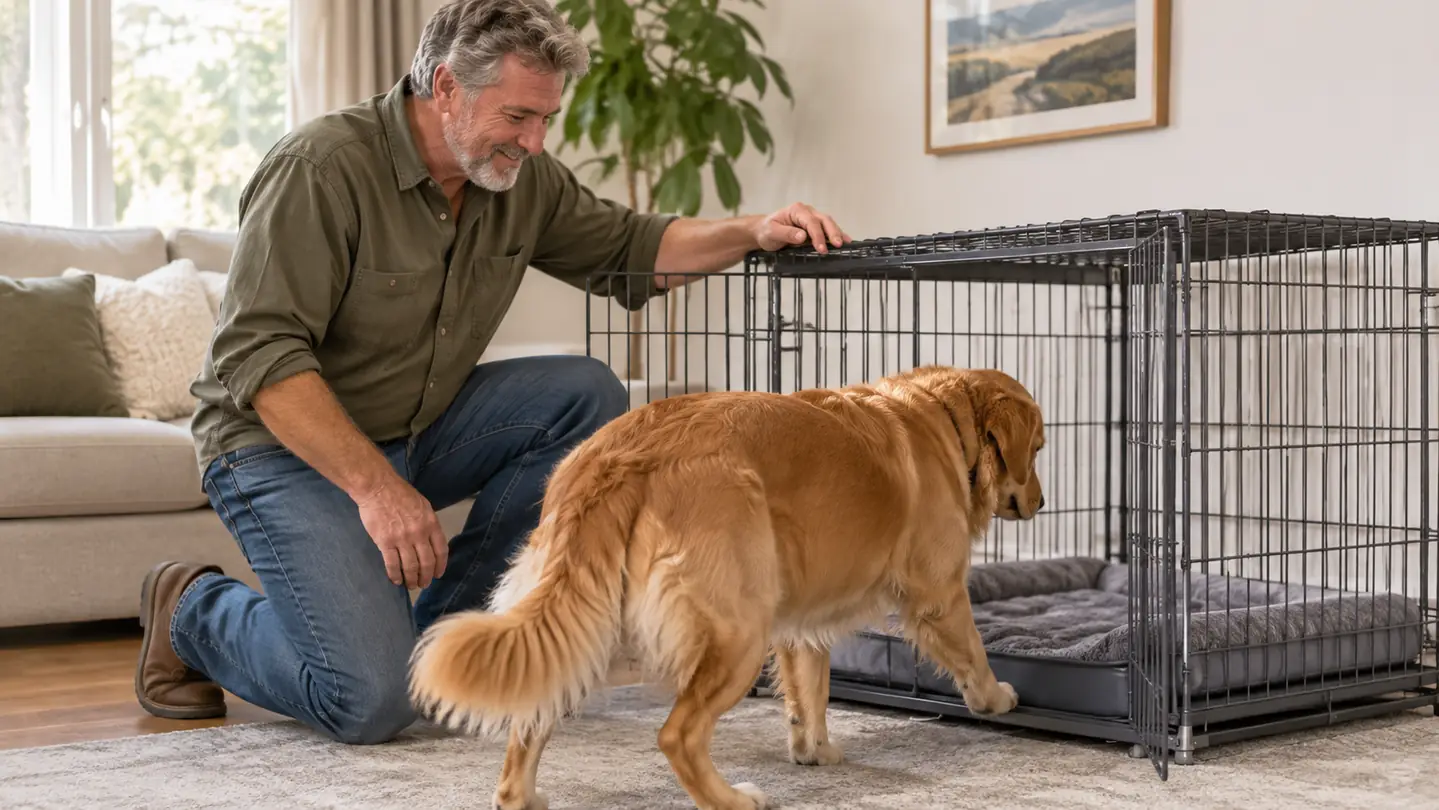
The first rule in my house was simple: food and good things happen near the crate. I did not push Tupelo in. I did not pick him up and place him inside. I put his meals on the floor beside the crate for two days. Then I put the bowl just inside the open door. Then I put it halfway in. He is very food motivated, so this part moved quickly for us. By the third day he was walking in on his own to check the bowl. I let him come back out. I did not close the door.
I also used a handful of kibble from his dinner as a reward. I would toss one piece into the crate, let him go get it, and then let him walk out. That was the whole game. No pressure, no long session. I did five or six pieces at a time, a few times a day. The crate has lockable latches, but I left the doors open and out of the way during this stage. The point was for the crate to feel like the place where the good stuff lands.
One thing I would tell a friend: do not make the crate a punishment. I never sent Tupelo to the crate because he was bad. He was a rescue dog in a new house. If I had made the crate a jail, he would have learned to hate it. Instead, I made it the place where his dinner appeared and where I dropped a treat when I walked past. That is not a trainer's advice. It is just what made sense to me, and it is what worked in our house.
Step 3: Feed meals inside the crate
After about a week of bowl games, I put Tupelo's bowl all the way inside the crate and closed the door while he ate. I stayed in the room. I did not latch it at first. I just held it shut with my hand. He was too busy eating to care. When he finished, I opened the door and let him walk out. We did that for every meal for four days. Breakfast and dinner. The crate became the dinner room.
Tupelo eats from a slow bowl, because he used to finish his dinner in well under a minute and gulp air. That bowl is wider than a regular bowl, so I checked that it fit between the crate door and the back panel before I started. It did. If your bowl is too wide, use a smaller one for the crate game and feed the slow bowl outside the crate. The crate is 30.5 inches long and 19.25 inches wide by the listing, so there is room for a medium dog and a bowl, but not a lot of extra.
By the end of the second week, I could close the door, latch it, and leave the room for the length of his meal. He did not scratch. He did not whine. He ate, turned around, and waited for me to open the door. That was the first time I thought, all right, this might work. I still did not leave him in there for long. A meal is a few minutes. That was enough for that week.
By the end of the second week, I could latch the door and leave the room for the length of his meal. He ate, turned around, and waited.
Step 4: Close the door for short stretches
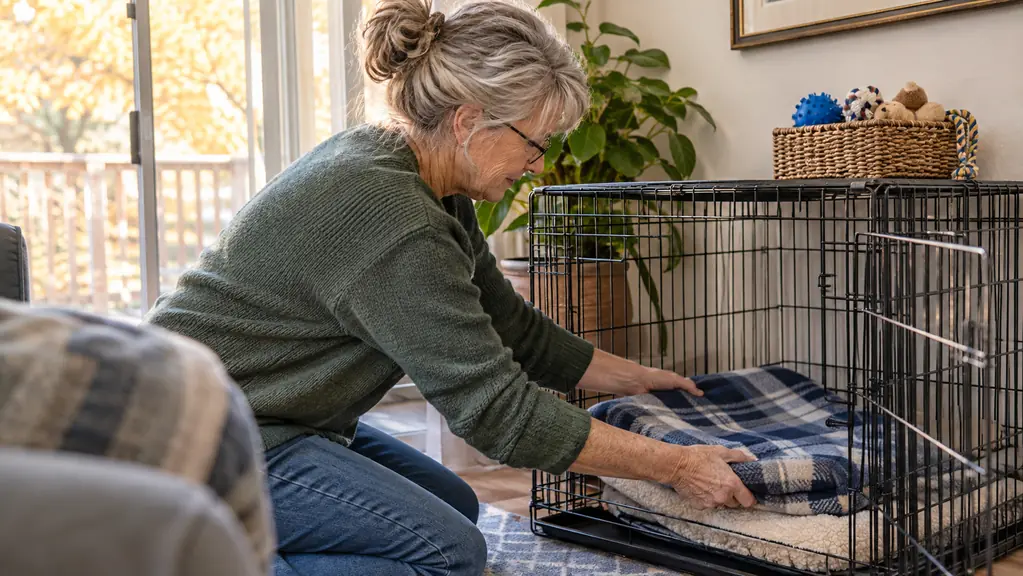
The next step was to close the door when Tupelo was not eating. I started with two minutes. I would put a piece of kibble in the crate, let him walk in, close the door, and sit on the floor beside the crate. I did not talk to him in a high voice. I did not make a big deal of it. I read a book. When two minutes were up, I opened the door and let him out. We did that three times a day.
The listing says the crate has two doors and lockable latches. I used the same door for these short sessions, the one that faces the sofa where I sit. The other door stayed closed. I wanted one door to be the door we used, so the routine was the same every time. If your crate is set up in a corner, you may prefer the other door. Pick one and stay with it for a while. That was easier for Tupelo than switching back and forth.
I added a minute every few days. By the end of the third week, he could stay in the crate with the door closed for fifteen minutes while I folded laundry in the same room. I did not rush to thirty minutes. I did not leave the house yet. The goal was not a long stretch. The goal was for him to learn that the door closing did not mean I was gone forever. He fussed once, for about a minute, and then lay down. That was the worst of it for us.
Step 5: Build up to nighttime
Nighttime was the part I worried about. Tupelo was used to sleeping near other dogs at the foster house, and my bedroom is at the end of a quiet hall. I put the crate in the living room, not my bedroom, because that is where it fit and where he spent his days. For the first three nights, I slept on the sofa beside the crate. I am not saying everyone should do that. I am saying I did, because I was 61 and I wanted to hear him.
The first night, I put him in after his last walk. I gave him a small treat, closed the door, and turned off the lamp. He fussed for four minutes. Then he sighed and slept until 5:40. I know it was four minutes because I looked at the clock. The second night was two minutes. The third night was none. After that, I went back to my own bed. He slept in the crate with the door shut at night for his first months with me.
Since late summer 2026, I have left the door open most nights. He still chooses the crate. He naps in it during the day with the door open, and he sleeps in it at night with the door open or shut, depending on the weather and his mood. The crate is still in the same corner by the sofa. The blanket on the tray has been washed more times than I can count. The divider panel is still in the hall closet. I never needed it.
What Else Helps
A crate is not the whole plan. The MidWest Homes for Pets crate gave Tupelo a safe place, but the rest of the house had to be ready too. I put a water bowl on the floor near the crate, but not inside it, because I did not want him to knock it over on the tray. I kept the back door closed when I was not watching him. I picked up the trash can. I moved the electrical cords behind the sofa. None of that is fancy. It is just what I would tell a friend who is bringing home a dog.
The crate itself has a few details I came to appreciate. The rubber feet kept it from sliding when Tupelo turned around. The leak proof tray came out for washing, which mattered more than I expected. The two doors gave me options in a small living room. The tool free assembly meant I could take it apart and move it by myself, though I have not needed to. The listing says it has a one year manufacturer warranty. I have not had to use it. I am careful with latches, and I check them every week.
I also kept a leash and harness by the back door, and a towel for wet marsh walks. Tupelo is a spaniel, and he loves the water and the marsh smell. After a muddy walk, he goes into the crate while I dry his feet, because that is where he settles. I did not plan that. It just became our routine. If your dog is not a spaniel, your routine will look different. The crate is the same idea: a place to pause before the next thing.
If you are bringing home a dog this month, start with the corner
I would set up the MidWest Homes for Pets crate before the dog walks in, put a blanket on the tray, and let the rest of the house stay quiet. That is what I did for Tupelo, and it is what I would tell a friend.
Amazon See the 30 inch iCrate on Amazon →