
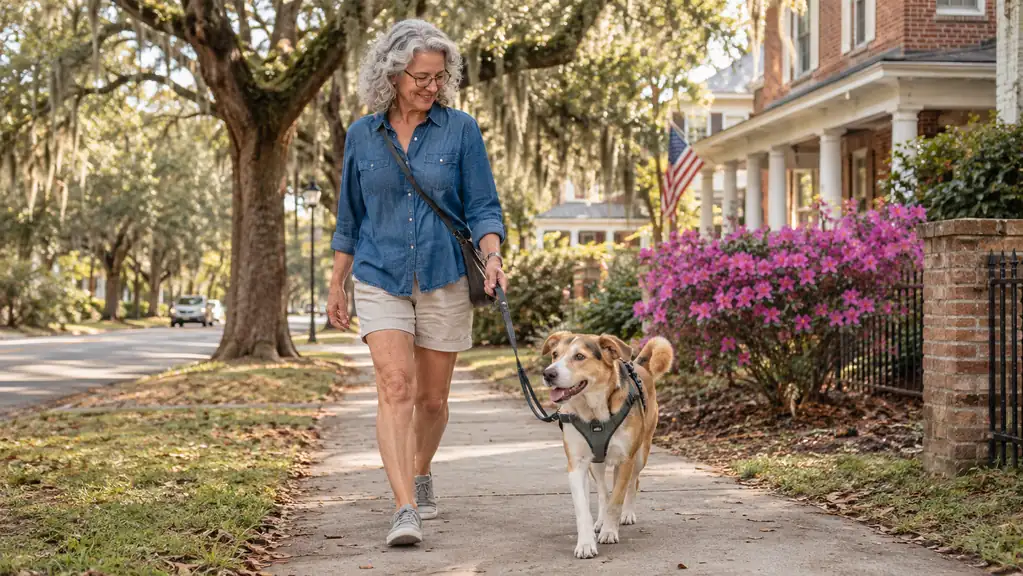
The first time I walked Tupelo around my block in Brunswick, he spotted a squirrel and took off like the leash was a suggestion. I had him on a plain collar then, and I spent the rest of the walk apologizing to a neighbor. A few days later I ordered the rabbitgoo no pull harness in Medium. That was in his first week home, in March, and it is still hanging on the hook by my back door. He is a Boykin Spaniel, about 32 pounds, and he is not quite two. He is also food motivated, which matters later.
I am not a trainer, a vet or a groomer. I am a retired school librarian who had not owned a dog since 2014, so I read the listing, read the instructions in the box and learned by trial on our sidewalk. What follows is the sequence that worked for us. It did not turn Tupelo into a dog who ignores squirrels. He still pulls when one crosses the path. The difference is that I can interrupt it sooner, and neither of us ends the walk frustrated.
The front loop is the part I reach for every morning
Tupelo still watches squirrels. This harness gives me two leash loops and four straps to work with, and I use the front loop on our neighborhood walks. It is the Medium rabbitgoo I bought in his first week.
Amazon See the rabbitgoo Harness on Amazon →The five steps that worked for us
Step 1: Measure his chest before you order
The listing gives one chest range for Medium: 15 to 27.8 inches. It also gives a weight range of 10 to 25 kilograms. Tupelo was about 32 pounds when he came home, so he was inside that weight range, but weight alone would not have told me if the vest would sit right. I used a soft tape measure around the widest part of his chest, just behind his front legs. I did it twice, once with him standing and once with him sitting, because he wiggled.
I wrote the number on a sticky note and compared it to the listing before I ordered. If your dog sits at the very top or bottom of a size range, or if the tape lands between sizes, ask the seller or your vet before you guess. I am not a fitter, and a harness that rubs is worse than no harness at all. For us, the Medium was the right starting point. Tupelo has a deep chest for a dog his size, and the four adjustable straps let me take up the extra room.
The box included the harness and instructions for use. I read them on the porch before I put it on him. That sounds obvious, but I have opened enough packages to know I will skip a step if I am eager. The instructions showed me which straps move and how the buckle works. I keep them in the basket by the back door, though I do not need them now.
Step 2: Put it on with the straps loose, then tighten
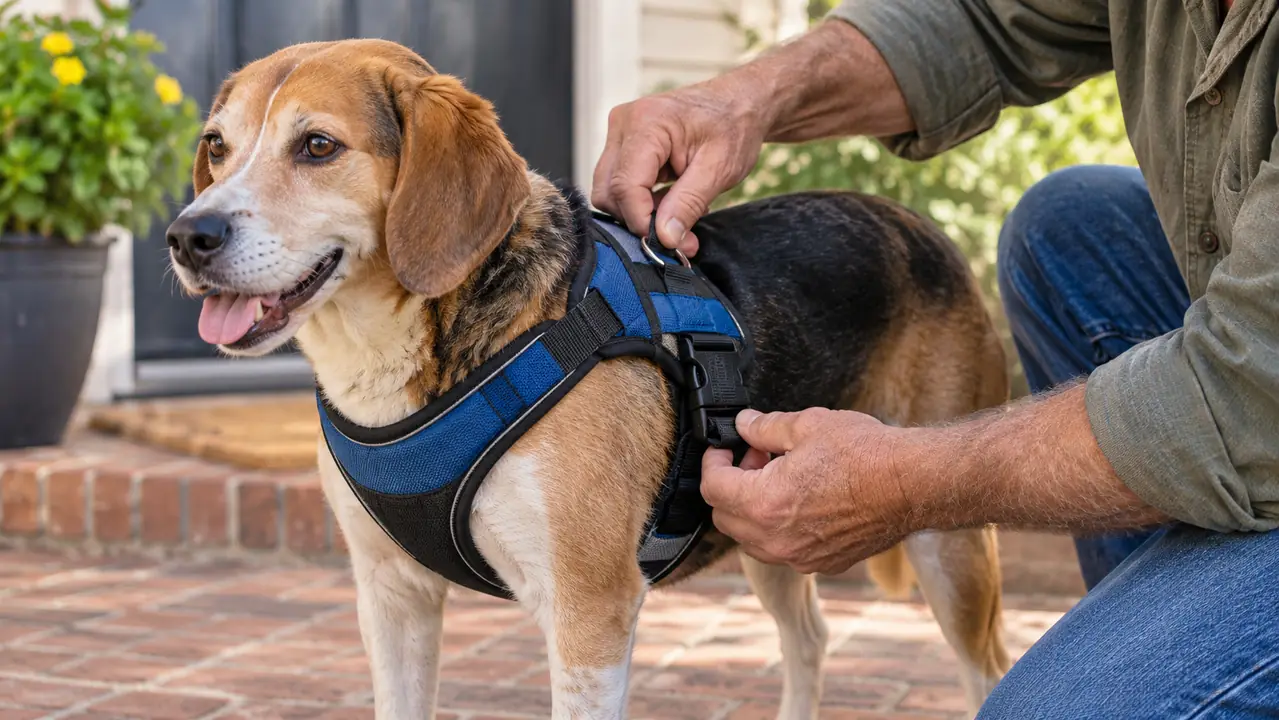
The first time I put the rabbitgoo harness on Tupelo, I left every strap at its loosest setting. I opened the buckle and followed the instructions that came in the box. He stood still because he was unsure, not because he was trained. I gave him a piece of kibble and let him wear it around the living room for five minutes with the leash off. That gave me a chance to see if anything twisted.
The listing says the harness has four fully adjustable straps. I used all four. I tightened them a little at a time, then walked him up and down the hallway. A vest that feels snug in your hand can still slide when the dog moves. The buckle should close cleanly, and the fabric should lie flat. If the harness bunches behind the front legs, loosen that strap and try again. It took me three tries the first night.
I did not leave it on him for the rest of the evening. I put it on, checked the fit, took it off and gave him another bit of kibble. The next morning I did the same thing before our walk. By the third day he came to the door when I picked it up. That was not because he loves the harness. He loves the walk, and the harness now means the walk.
Step 3: Check the two-finger rule after every adjustment
The fit I look for is simple. With the harness on and the buckle fastened, I should be able to slide two fingers under each strap without forcing them. Any tighter and I worry about rubbing. Any looser and the harness shifts when Tupelo lowers his head to sniff. The four straps make this a matter of small changes, not one big one. I adjust one strap, check it, then move to the next.
The front of the harness should sit behind his front legs, not over his shoulders in a way that limits his reach. The listing calls it a pet vest, so it covers more of the body than a simple strap. That coverage is why I can see it move when he pulls. I watch the fabric at the front of his chest. If it rolls or gathers to one side, the strap on that side is too loose or too tight. The listing says the material is polyester with breathable mesh, and it has held up to marsh mud and burrs.
I check the fit again after ten minutes of walking. Dogs change shape when they trot, sniff and turn. What felt right on the porch can feel different at the end of the block. If Tupelo starts scratching at the harness or walking with a stiff shoulder, I stop and reset it. A harness is not supposed to be a distraction. If it is, the fit is wrong or the harness is not the right shape for your dog.
Step 4: Use the front loop and stop when the leash goes tight
The rabbitgoo harness has two sturdy metal hook loops for leash attachment. I use the front one on our neighborhood walks. That is the loop nearest his chest. I clip a plain six foot leash there, not a retractable leash. The first week, I stopped every time the leash went tight. I did not yank, and I did not keep walking. I stood still and waited. When Tupelo turned back toward me, I said yes and gave him a piece of kibble.
This is the part that takes patience. A dog who has been pulling for a year will not understand a new rule in one walk. Tupelo still pulled when he saw a squirrel. The difference was that the front loop turned him slightly toward me instead of letting him lean into the pull. I could feel the change in my arm. I am not saying the harness trained him. I am saying it gave me a way to interrupt the pull without a wrestling match.
I also used the back loop on quiet streets where I wanted him beside me without the leash crossing his chest. The listing says two clips, and both are metal. I check the clip before I attach the leash, every time. A clip that is not fully closed is not a clip. That is not a product problem. That is me being in a hurry.
The harness did not make Tupelo stop pulling. It made the pulling easier for me to interrupt, which is the part I needed.
Step 5: Build a short routine and keep the walks boring at first
For the first two weeks, I walked Tupelo on the same three blocks. I did not take him to the marsh boardwalk until he could walk past a neighbor's barking dog without spinning. That was not a punishment. It was me lowering the number of things I had to manage at once. A new harness, a new dog and a new route is too much for one walk.
I started every walk with a minute of standing still in the driveway. I clipped the leash to the front loop, asked him to wait, then walked. If he pulled, I stopped. If he looked back, I rewarded. I kept the first walks short, about ten minutes, and ended them before he got overexcited. The point was repetition, not distance. By the end of the second week, he was still a dog who liked squirrels. He was also a dog who checked in with me more often.
Now I use the same routine in the morning and evening. The harness hangs by the back door, and the leash hangs with it. I check the buckle, the two loops and the reflective strips before we leave. The listing says the strips are bright, and I have noticed them in the early light when a car turns into our street. That is not a guarantee that a driver will see us. It is one more thing in our favor.
What Else Helps
The harness is only one piece. The rest was treats, timing and a leash that did not encourage pulling. I used a plain six foot leash and a handful of kibble from Tupelo's dinner. I did not use a retractable leash on walks, because I needed to be able to stop the leash from paying out. I also practiced in the driveway before we went to the sidewalk. Less space, fewer squirrels, easier to think.
If your dog coughs, gags or keeps pulling until he is hoarse, stop and ask your vet. A harness can change how pressure feels, but it does not fix a medical issue or a dog who is afraid. I am not a vet. Tupelo had a checkup the week he came home, and I asked about his fast eating then. I would ask the same kind of question about pulling if it changed suddenly. A trainer who uses positive methods is also worth the time if you feel stuck. I did not hire one, but I would have if Tupelo had started to panic on walks.
I keep the walks short when the weather is bad. A wet dog on a slippery sidewalk is not the time to practice a new skill. On those days I put the harness on, walk him to the end of the driveway, reward him for checking in and go back inside. The harness stays in the routine even when the walk does not. That has made it easier to pick up again the next day.

What I Would Do Differently
I would put the harness on Tupelo for a few minutes at home before I ever clipped a leash to it. I did that after the first walk, not before, and the first walk was more chaotic than it needed to be. I would also measure his chest one more time after he had been walking for ten minutes. He was not a statue on the porch, and the fit changed when he relaxed.
I would stop sooner. On our first walk in the harness, I kept going because I wanted him to get used to it. That was backwards. Three good minutes and a calm return home would have taught him more than fifteen minutes of me hanging on. I would also keep a handful of kibble in my pocket instead of going back to the kitchen for it. The reward has to be faster than the squirrel.
None of this is a cure. Tupelo is a young dog with a strong nose and a strong opinion about squirrels. The harness helps me manage the walk we have. It does not change who he is. If you are looking for a tool that does the training for you, this is not it. If you are looking for a way to keep your arm in its socket while you teach your dog, it is a reasonable place to start.
Start with the fit, then give the front loop a week
If your dog pulls like Tupelo, the first walk in a new harness will not be perfect. Mine was not. I measured, adjusted, stopped a lot and kept the route short. The Medium rabbitgoo is the one that worked for us, and it is still by my back door.
Amazon See the rabbitgoo Harness on Amazon →