
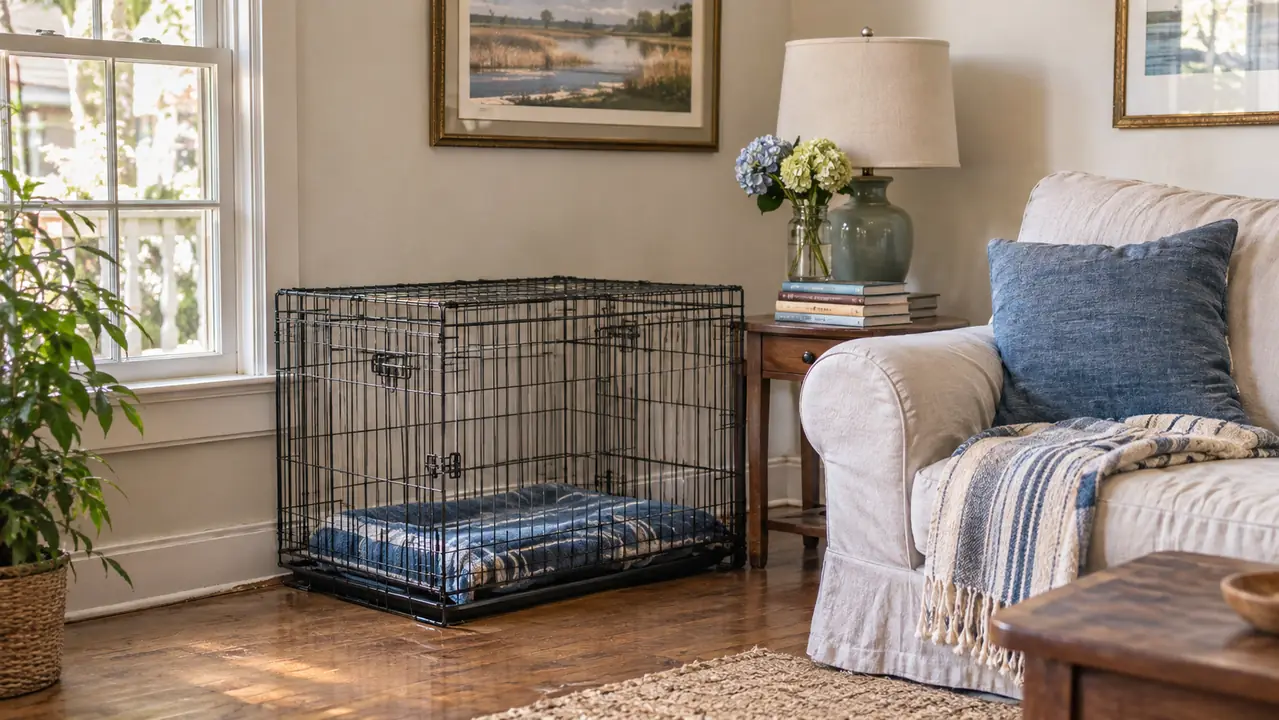
I ordered the MidWest Homes for Pets 30-inch double door iCrate the week before Tupelo came home, so it was standing in the corner of my living room beside the sofa on the Saturday in mid March when a confused young spaniel walked through my back door. I had no dog gear at all. I gave all of Duke's things away in 2014 and spent twelve years not thinking about crates, so I read that listing the way I used to read a card catalogue, one line at a time, out loud, to nobody. I chose this one because the size chart pointed at it for a dog his weight and because I wanted the corner settled before he arrived. Eight months later it has not moved.
What follows is not a victory lap. It is the review I wish someone had handed me in February, when I stood in my kitchen holding a tape measure and wondering whether a wire crate is one of those things you buy because everyone buys it or because it earns its place. The short version: it earned its place, with three caveats and one part of the box I would happily have left out. If you are bringing home a medium sized dog and you want plain facts about how a wire crate behaves in a real house with a real chewer in it, this is that. I am not a trainer and I am not a vet. I am a retired librarian with one dog and a good memory for what I got wrong.
The Quick Verdict
A sturdy folding crate that did its job for eight months with one dog and no drama. Buy it for the frame and the two doors, then supply the comfort yourself.
Amazon Check Today's Price →What the size chart says, and what actually shows up in the box
The listing gives outside measurements of 30.5 by 19.25 by 21.5 inches and puts this crate in the 21 to 40 pound range. Two doors, a removable leak-proof tray, a divider panel, rubber feet, a carry handle and a one year manufacturer warranty.
Amazon Check Today's Price on Amazon →What Nobody Tells You Before You Buy a Wire Crate
Here is the thing nobody says out loud: a wire crate is a frame, not a room. The box arrives with a metal frame, a removable tray, a divider panel, rubber feet and a carry handle. It does not arrive with anything soft, anything warm, or anything that makes the inside look like somewhere a dog would choose to lie down. That is not a flaw exactly. It is the truth of what you are buying, and the photographs on the listing do not say it plainly because the dog in the picture is always lying on a cushion that came from somewhere else. I folded a fleece blanket into the tray on day one. That was my contribution, and it is the reason the crate became his.
The second thing is size, and this is where I would slow down if I were you. The listing gives the outside of the crate as 30.5 by 19.25 by 21.5 inches and puts it in the 21 to 40 pound range, and the breed list on the page runs to French Bulldogs, Welsh Terriers and Dachshunds. Tupelo is a spaniel, about 32 pounds, and he fits. But he fits the way a person fits a small car. He can stand, he can turn around, and he curls up to sleep. He does not sprawl out flat with his legs everywhere, because there is not the room for that. If your dog is long and likes to sleep stretched out, measure him standing and measure him lying down before you order, not after.
The third thing is the divider panel, and I want to be fair to it because I have been unkind about it in my own head. This crate ships with one, and the idea is that you shrink the inside for a small puppy and let it grow as the dog does. That is a sensible idea and it is the reason to pick this crate over a cheaper frame with no divider. It is also completely useless to me, because Tupelo was roughly fourteen months old when he arrived and already at his full size. The divider came out of the frame on the first afternoon and has lived in my hall closet ever since, behind the good tablecloths. If you are bringing home a puppy, that panel earns its keep. If you are bringing home an adolescent or an adult dog, you are getting a piece of wire you will store.

How We Have Actually Used It Since March
The crate went into the corner of the living room beside the sofa, where I could see it from the kitchen and where he could see me. That placement mattered more than any feature printed on the box. For his first months he slept in it at night with the door shut, on his blanket, on the tray, and he settled into that routine in under a week. I want to be careful here and say plainly that I am not a trainer and I am not telling anyone how to crate a dog. I am telling you what happened in my house. He fussed for two nights, then stopped, and by the end of March he was walking in on his own when I turned the lamps off.
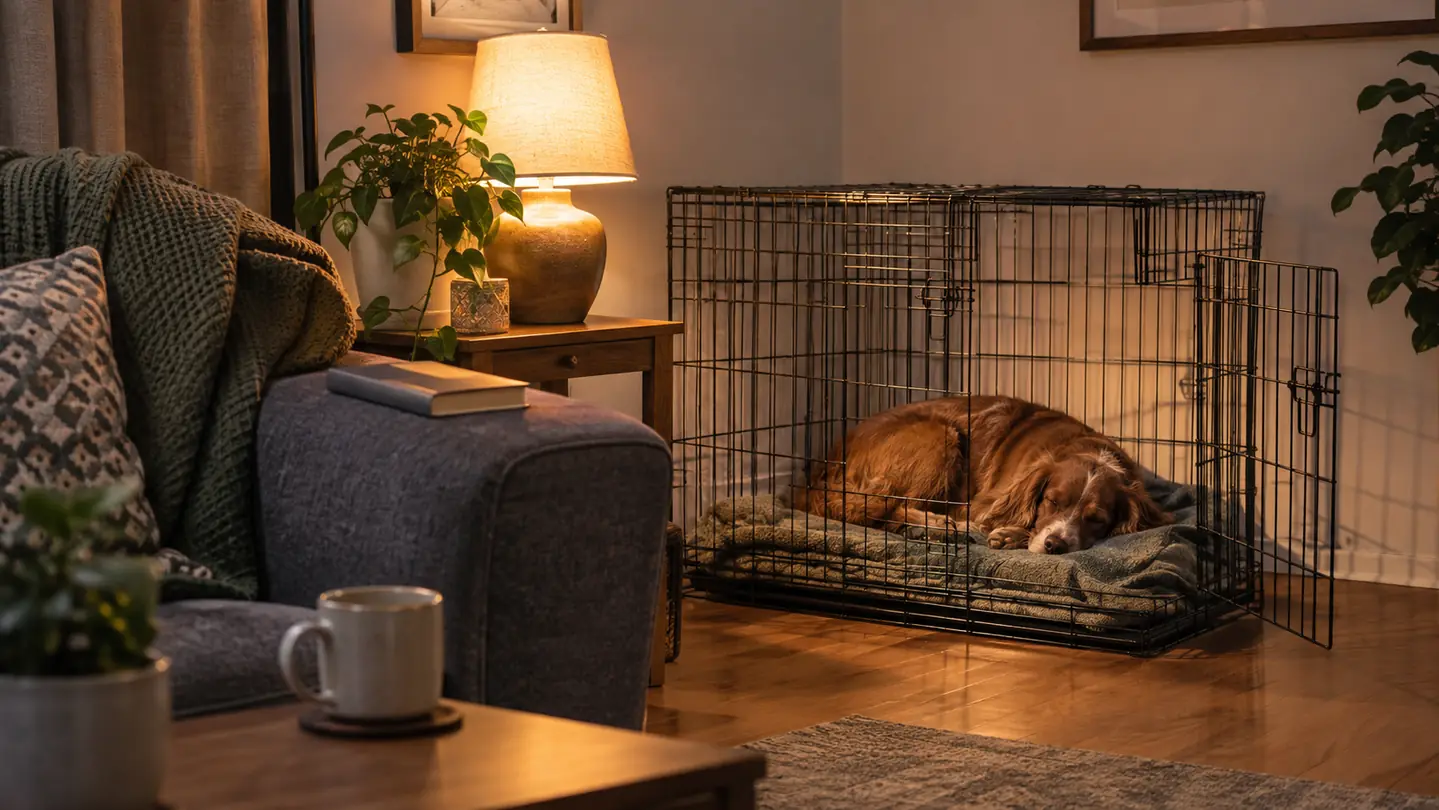
Since late summer the door has stayed open most nights. He still chooses it. Around nine he goes in, turns around twice the way spaniels do, and settles. During the day it is his nap spot with the door open. When the afternoon sun comes through the sliding door and lands a foot short of the crate, he moves himself to the warm patch of rug, then back into the crate when the floor cools. The padded bed I bought in April lives by that sliding door and has never once been inside the crate. It does not fit through the door frame comfortably, and honestly he did not want it there. A folded blanket on the tray is what he wanted.
What has surprised me is how little the crate itself intrudes. It is 17 pounds and it has rubber feet, so it does not walk across the floor when he turns around inside it, and it has not marked the wood. The tray is removable and leak-proof and it lifts out in one piece, which I have done more often than I expected, mostly after marsh walks when he comes home damp and gritty and lies down before I can get his harness off. Two doors means I can open the side that faces the room rather than the one pressed against the wall, which in a corner is the whole point of paying attention to door count.
A folded blanket on the tray is what he wanted. Not the padded bed I bought in April. A blanket.
The Parts That Genuinely Work
The two doors are the reason I would buy this one again. In a corner, one door faces the room and one faces the wall, and I use the room-facing one every single day. When my daughter visits from Savannah with her weekend bag and the floor space gets tight, I swing the crate out a little and open the other door instead. That sounds like a small thing. It is a small thing you notice every day for eight months. The latches slide and hold, and the listing describes them as lockable. I have never needed to lock them. I have needed to reach in at two in the morning to check on a dog who was making a strange noise, and a door that opens without a fight is worth something.
The folding is real, not a line on the box. The crate folds flat, the carry handle is part of the top frame, and it is light enough that I have carried it out to the back porch by myself and set it up there while I scrubbed the living room floor. The listing says tool-free assembly, and it is tool-free. The first time took me the better part of an hour because I was being fussy about the door frames sitting square, and a door frame that is not square drags at the top corner. Once it was square, the doors swung clean, and they have stayed clean through eight months and one move to the porch and back.
The tray deserves its own sentence. It is thin, it is not a piece of furniture, and mine has held up through eight months of a damp spaniel flopping down onto it. It wipes. It lifts out. It has not leaked. The listing states a one year manufacturer warranty and I have not needed to test it, which is the only sensible thing a person can say about a warranty she has not used.
What I Would Change
Nothing soft comes in the box, and I think that is a mistake for a first-time buyer. I understand the reasoning. Anything soft adds bulk and something to clean, and a blanket is personal. But the crate as shipped is a bare metal room, and a dog walking into a bare metal room in a strange house on his first Saturday is not being set up to succeed. I would rather see a plain pad included and the buyer upgrade later if she wants to. As it was, I stood in my kitchen the night before he arrived folding a fleece blanket into the tray and hoping it was enough. It was enough. It should not have been my job to guess that.
The divider panel is the second thing. I have already complained about it, so I will be brief and fair. It is the right part for a puppy and the wrong part for an adult dog, and the listing does not make that distinction clearly enough. You read that the crate grows with your dog and you picture years of use out of one purchase, and what actually happens with an older dog is that you take the panel out on day one and store it. MidWest Homes for Pets is not doing anything dishonest there. The part does exactly what it says it does. It just does nothing for me.
The third thing is the noise, and this one is worth planning for. A wire crate with a metal tray amplifies a dog shifting his weight at two in the morning. My first week I woke four times a night to the sound of a spaniel turning around. The blanket helped. A folded towel under the tray helped more. If you are a light sleeper and the crate is going in your bedroom rather than your living room, think about that before the first night, because there is nothing in the design that muffles it for you.
What I Liked
- Two doors mean the crate works in a corner without stranding the wall side
- Folds flat with a carry handle, light enough for one person to move alone
- Rubber feet hold the floor and have not marked the hardwood
- Removable leak-proof tray lifts out in one piece and wipes clean
- The divider panel is genuinely useful if you are crating a puppy
- Tool-free assembly, and the listing states a one year manufacturer warranty
Where It Falls Short
- Arrives as a bare metal frame with nothing soft inside it
- The divider is dead weight for an adult dog and ends up in a closet
- The metal tray amplifies every shift in the night
- Door frames must sit square or the doors drag at the top corner
- The listing puts the bar gap at 37.5 millimeters and aims the crate at medium breeds, so it is not the one it points at for a small dog
The Setup Details I Got Wrong
Three things, in case they save you an evening. I set the crate up too far from the sofa at first, in a corner by the bookcase where it looked tidier, and he fussed for two nights. Moving it four feet, so he could see the sofa, ended the fussing. Second, I draped a folded sheet over the two panels that face the wall during his first weeks, not over the door side, and it made the inside feel less like a cage. I took the sheet off in the summer and never put it back. Third, I bought a padded bed in April thinking it would be the crate liner, and it never went inside. It is his daytime bed by the sliding door and the crate kept the blanket. Two beds, one dog, and the plain one won.
One more note about the doors, because it caught me out. When you fold the crate down and set it back up, take ten seconds to push the frames until both doors swing freely before you tighten anything. Mine dragged at the top for an afternoon after I moved it to the porch and I was convinced something had bent. Nothing had bent. The frame was sitting a quarter inch out of square and a firm push with the heel of my hand fixed it. The listing says tool-free assembly and it is, but tool-free is not the same as foolproof, and I am the fool in that sentence.
Who This Is For
This is the right crate for someone bringing home a medium sized dog, roughly in that 21 to 40 pound band, who wants one crate that will sit in the corner of a living room and stay there. It suits a house where the crate is going to be seen by visitors, because a wire crate does not pretend to be furniture and does not look bad doing it. The two-door design is worth seeking out if your corner only allows one usable side, which mine did. And if you are bringing home a puppy, the divider makes this a crate you can use from eight weeks through adulthood, which is the one case where that stored panel earns its keep. That was not my situation, but I can see it plainly enough.
I also think it suits a person who wants to understand what she is buying. MidWest Homes for Pets publishes real measurements on that listing, in inches and in pounds, and the breed list is specific rather than cheerful. I measured my living room corner with a tape before I ordered and I measured Tupelo against the door frame when the crate arrived. It fit both. If you are the kind of person who reads the dimensions on the box before you open it, you will get along with this crate just fine.
Who Should Skip It
Skip it if your dog has already destroyed a wire crate and you suspect he would do it again. The bars on this one are sturdy and mine has held through eight months of a young chewer, but wire can bend, and no wire crate can promise otherwise. Skip it if you have a very small dog or a toy breed, because the listing puts the bar gap at 37.5 millimeters and points the crate at medium breeds. Skip it if you want something that looks like furniture, since it looks like a crate. And skip it if your dog sits at the top of that weight range or above it, because the 30-inch size will be tight, and the honest answer there is a bigger crate rather than a tighter fit.
Eight months in, the only thing I would genuinely change about my own purchase is nothing. I bought the size the chart pointed to, I put it where he could see me, and I put a blanket in it. The parts I would change are things MidWest Homes for Pets could change on the box rather than on the crate: say plainly that the inside arrives bare, say plainly who the divider is for. That is a short list. For a wire crate in a living room corner with a real dog in it, a short list is a good outcome.
Eight months in a living room corner, and I would buy it again
Not for the bare frame it arrives as, but for the two doors, the folding frame and the tray that lifts out in one piece. Read the measurements first and it will do what you need it to do.
Amazon Check Today's Price on Amazon →