
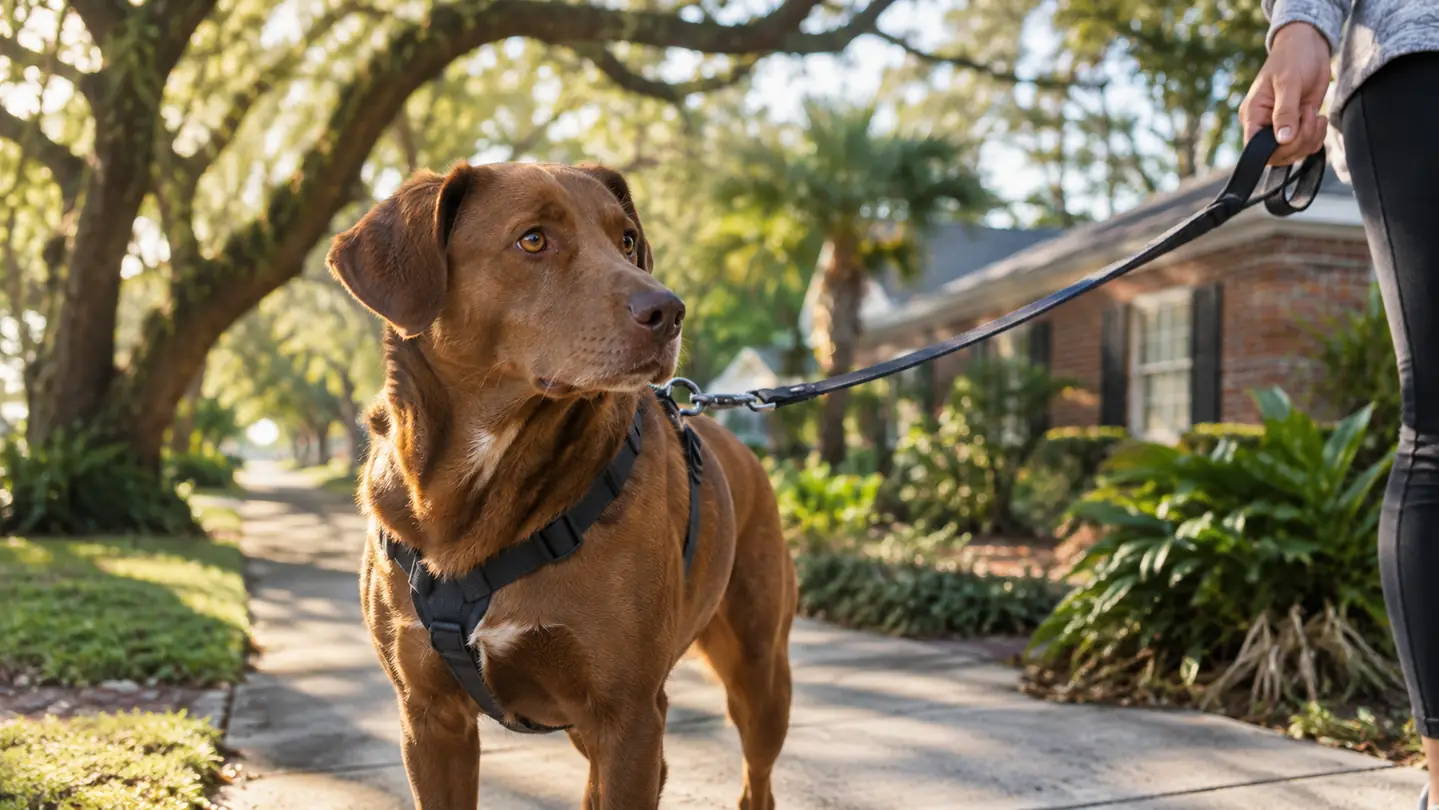
Two walks. That is how long Tupelo lasted on a plain collar before I went looking for something else. He came home on a Saturday in mid March, about thirty two pounds of Boykin Spaniel with a docked tail and a nose that could find a squirrel three yards into a hedge, and by Sunday evening my right shoulder had opinions about the arrangement. He is not quite two now. He still pulls when a squirrel breaks cover, but the walk stopped being a wrestling match somewhere in that first month. The rabbitgoo no pull harness in size Medium is what I ordered in his first week home, and it is what still hangs on the hook by my back door.
I want to be plain about what a harness is and is not. It is webbing, mesh, four straps and a buckle. It did not train my dog, and I would be lying if I said it did. Tupelo's manners came from repetition, a pocket of kibble in my coat, and eight months of walking the same two blocks until the routine stopped being exciting. What the harness did was stop him choking himself against his own collar while we worked on the rest. So this is the honest version: what the listing says, what showed up in the bag, how it fit a thirty two pound spaniel, and the parts of it that irritate me enough that you should hear them before you order.
The Quick Verdict
A sturdy two clip harness that fits a deep chested dog properly and gave me real leverage on a puller. The straps run long once you tighten them down and the mesh collects burrs, but eight months of twice daily walks have not loosened a single seam.
Amazon Check Today's Price →Start with the clip on his chest, not the one on his back
The front loop is the half of this harness that does the work on a dog who pulls. It is the one I use every morning, and the first thing I would tell a friend to try.
Amazon Check Today's Price on Amazon →How I've Used It
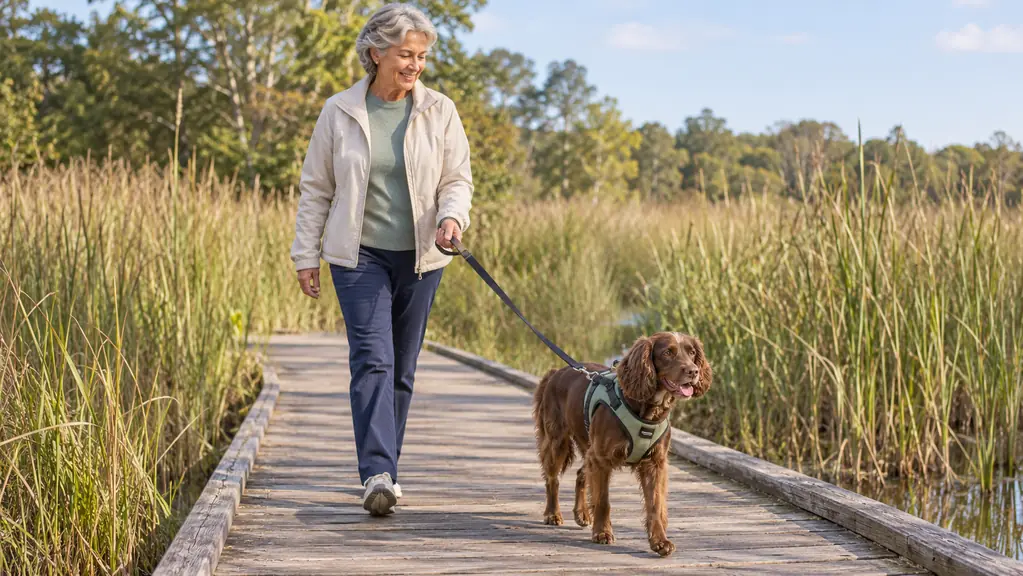
The rabbitgoo harness went on him for the first time four days after he came home, and it has gone on him at least twice a day since. A morning walk around my block, an evening walk on the same route in reverse, and on weekends the long one out along the marsh boardwalk, where the smell of the pluff mud is apparently worth more to him than any treat I own. Call it four hundred walks. Nothing has cracked, split or frayed. The buckle still clicks the way it did in March.
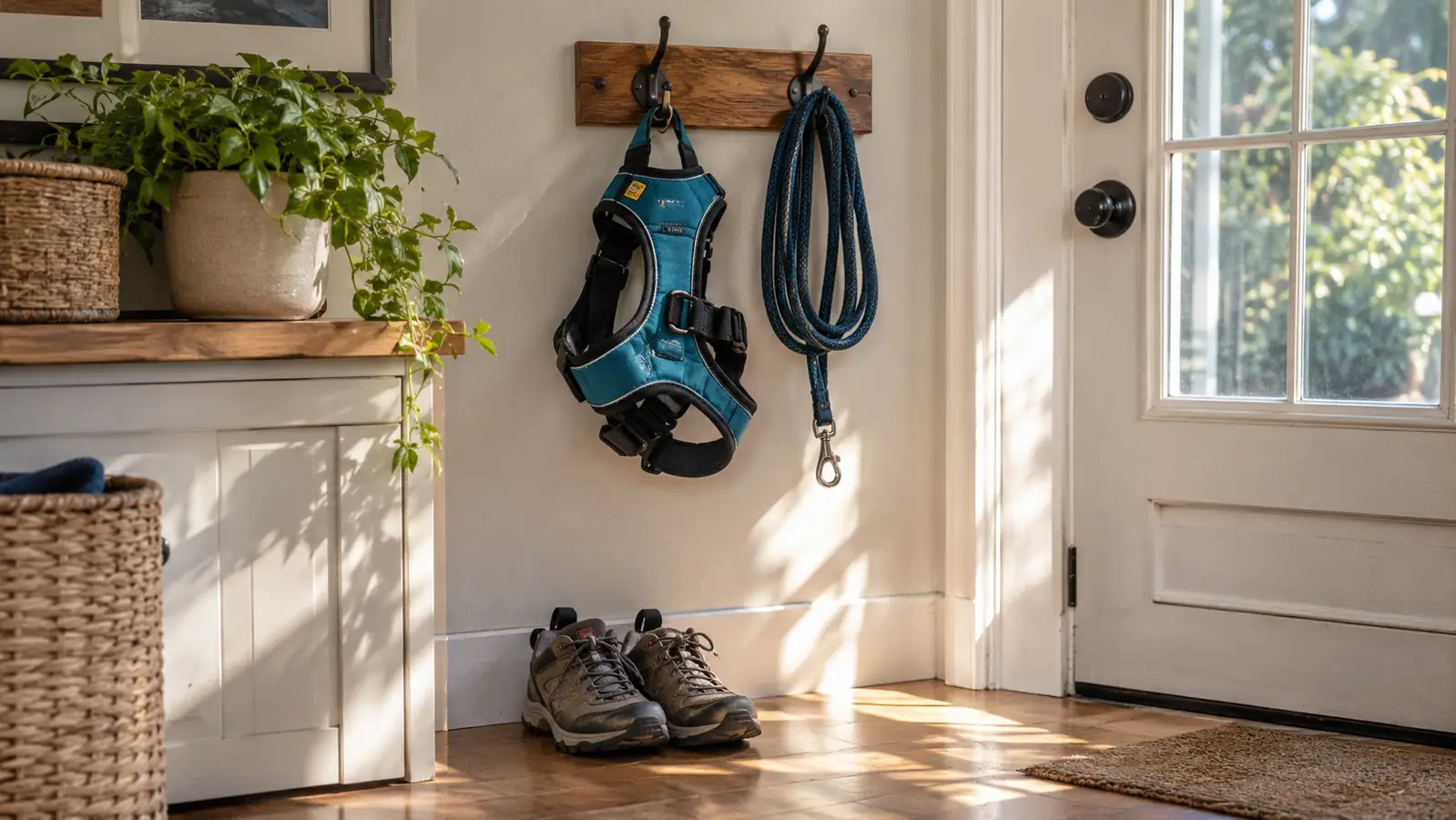
Getting it on is one buckle and about four seconds. He stands still for it because standing still for it has always meant we are going out, and by now the harness itself is the signal. It comes off just as fast at the door and goes straight back on the hook. I clip the leash on before we step outside, which sounds obvious until you are standing in the rain with a spaniel who has spotted a cat.
The listing says two metal hook loops, four adjustable straps, breathable mesh and reflective strips, and that is exactly what came out of the bag, along with a folded instruction sheet. The webbing is polyester. The seams are straight and evenly stitched the whole way around, which I checked carefully, because I have sewn enough in my life to know when something was rushed together. This was not.
The Chest Measurement Is the Number That Matters
The chart for a Medium says a chest of 15 to 27.8 inches and a weight range of 10 to 25 kg. I measured Tupelo on the kitchen floor with a cloth tape, around the deepest part of his chest just behind his front legs, and got twenty four inches. He weighed thirty two pounds then, a little under fifteen kilos, so he sat near the top of the chest range and mid range on weight. That gap between the two numbers is the thing to understand before you order.
Weight is only a rough guide, because two dogs at the same weight can be built nothing alike. The breed recommendation on the listing, Border Collie, Chow Chow, Standard Schnauzer, tells you the shape they had in mind: a dog with some chest on him rather than a greyhound. A spaniel with a deep rib cage lands right in the middle of that. A slim, leggy dog of the same weight would have been swimming in it, with the chest panel riding low instead of sitting flat against the body.
Four straps means the neck and the chest each adjust on both sides, and I set all four the first afternoon and have not touched them since. He was full grown when he arrived, so there was no growing into it. If your dog is still filling out, those same four straps are what give you room, and it is worth rechecking the chest measurement every few weeks rather than trusting that the fit from the spring still holds in the fall.
One small thing I noticed and then stopped noticing: the panel sits where it should, across the chest and behind the shoulders, and it stays there. On the two occasions I had it too loose at the neck, I could see after a walk that the whole thing had rotated a little to one side. Tightened properly, it stays put, and he shows no interest in it once we are moving.
Two Clips, and Which One I Use
There is a metal loop on the back of the harness and a second one on the chest. For the first week I used the back loop, because every leash and collar I had ever owned trained me to clip behind the shoulders. He pulled. Not badly, but steadily, the way a dog does when the thing he wants is forty feet ahead and the thing behind him is sixty one years old.
In the second week I moved the leash to the chest loop and the walk changed inside a block. When he hit the end of it, his front end swung toward me instead of driving forward, and I had two or three seconds where he had to notice me. I am not a trainer and I am not going to explain the mechanics of why that works. I can tell you it worked for us, on this dog, on our street.
What it did not do was teach him anything. He still pulls when a squirrel breaks from the hedge, and the harness has not changed that and would not claim to. What it gave me was a few seconds of leverage to get his attention back, and a few seconds turns out to be the whole game with a dog who is not quite two. The pulling is much less than it was in March. The credit for that goes to the walking, not the webbing.
I use the front loop with a plain six foot leash and nothing else. On the boardwalk, where the path is narrow and there are bicycles, I shorten my grip and keep him close on the chest clip, and he handles it well enough. I have not used the back loop since April. It is still there if I ever want it, and I like knowing it is.
What I Liked
- A metal loop on the back and a second on the chest, and the front one gives real control of a puller
- Four adjustable straps, which let me fit a deep chested spaniel properly instead of approximately
- Metal loops rather than plastic, and neither has bent in eight months
- Reflective strips down both sides for early morning walks
- Even stitching and no fraying after roughly four hundred walks
- One buckle, on and off in seconds
Where It Falls Short
- The strap tails are long once the harness is tightened and they hang and flap
- The mesh panels pick up burrs and grass seed on marsh walks
- Sizing is really about the chest, and the weight range on the listing can mislead you
- It does not stop a determined dog from pulling at a squirrel, and it does not claim to
Where It Loses Points: Straps and Mesh
When I tightened the four straps down to fit him, the leftover webbing had nowhere to go. The tails hang. On a dry walk it is untidy. On a wet walk it slaps against his side, and I have folded the ends back on themselves more than once so they stop swinging. It is not a defect that would make me return the harness. It is the one thing I would change if I could.
The mesh is cool on him in Georgia heat, which matters more here than it would in most places, but it is also a net for anything with a hook on it. Burrs, grass seed, the little green things that come off the marsh grass. Ten minutes with my fingers after a boardwalk walk and it is clear again. If your dog runs in brush every day, expect to do that every day.
The reflective strips run down both sides and they are bright in headlights. I noticed one evening in April when my neighbor pulled into her drive and her lights swept across him at the end of the leash. That is not something I would have thought to look for when I ordered, and it is the feature I am most glad is on there.
I rinse the rabbitgoo harness in the sink when it gets salty from the marsh and hang it over the porch rail to dry. It has come back soft every time, with no fading that I can see and no stiffening at the seams. I have not put it in the washing machine. I did not want to find out the hard way.
When he hit the end of the leash on the chest loop, his front end swung toward me instead of away. That was the whole difference.
What I Got Wrong at First
Three things, and the first one was my fault entirely. I clipped to the back loop and decided within a week that the harness was just expensive webbing with a logo on it. It was not the harness that was the problem. It was where I had attached the leash.
The second thing I got wrong was the fit. I had the neck straps too loose for the first week because I was worried about it being tight on him, and a harness that shifts side to side is not comfortable for anybody. I spent ten minutes on the kitchen floor with a handful of kibble, set all four straps properly, and the difference in how he walked was immediate. Loose is not kindness. Loose is a thing that rubs.
The third was expecting the harness to do the work. It is a harness. It gives you a better place to hold a dog who pulls. The walking still has to happen, the same two blocks, the same pocket of kibble, the same boring repetition. Anyone who tells you a piece of gear fixed their dog's manners is selling you the gear.
What It Has and Has Not Fixed
What it fixed was the gagging. On a collar, every squirrel set him coughing. That stopped the day the harness went on, and it has not come back. What it also fixed was my own grip on the leash, which had gotten tight and nervous. A nervous hand on a leash does the dog no favors. I walk him now instead of bracing against him, and that change alone made our mornings quieter.
What it has not fixed is the squirrel. Nothing has fixed the squirrel. I have made my peace with that. He is a young spaniel with a nose that works better than mine, and the rabbitgoo harness is a tool for managing that on a sidewalk, not a cure for it. If a harness were a cure, half the trainers in Glynn County would be out of work.
One note, and I mean this seriously. If your dog has a skin problem, a shoulder issue, or anything your vet is already treating, ask your vet before you put a harness on him that pulls across the chest. I am a retired librarian with a dog and a tape measure, not a veterinarian. I asked at Tupelo's checkup about the fast eating and about the pulling, and I would ask about anything else before I changed gear.
Who This Is For
If you have a medium sized dog with a real chest on him, somewhere in that fifteen to twenty eight inch range, and he pulls enough that walks have stopped being pleasant, this is a sensible place to start. It is also a good fit for anyone who wants the option of two clips rather than being told there is only one right way to attach a leash. And it suits a household like mine, where the harness lives on a hook by the door and goes on twice a day in all weather, wet or dry, March or November.
I would also say it suits a first time harness buyer, or a person like me who had no dog gear at all and was starting from nothing. There is not much to learn here. Four straps, one buckle, two loops, and a folded sheet in the bag that tells you what each part is for. I read it twice, which tells you more about me than about the harness. And if you already know that you want a front clip and a back clip on the same piece of gear rather than picking one and hoping, this is that piece of gear.
Who Should Skip It
Skip it if your dog sits at the small end of the Medium range or below it, because the chest panel will hang instead of sitting flat and no amount of strap adjusting fixes that. Skip it if your dog falls between sizes, since the honest answer there is to measure the chest, order whichever size matches that number, and be ready to send one back. Skip it if long strap tails hanging off the sides will bother you every single day, because they will be there every single day. And skip it if you are looking for something that stops pulling by itself. This harness gives you a better hold on a dog who pulls. It does not take the training out of the job, and anyone who says otherwise has not walked a young spaniel past a hedge full of squirrels.
Eight months in, it is still the harness on the hook by my door
Same harness, same two clips, same four straps I set in March. If you are starting a puller on a harness, this is the one I would hand you, with the leash on the chest loop.
Amazon Check Today's Price on Amazon →